
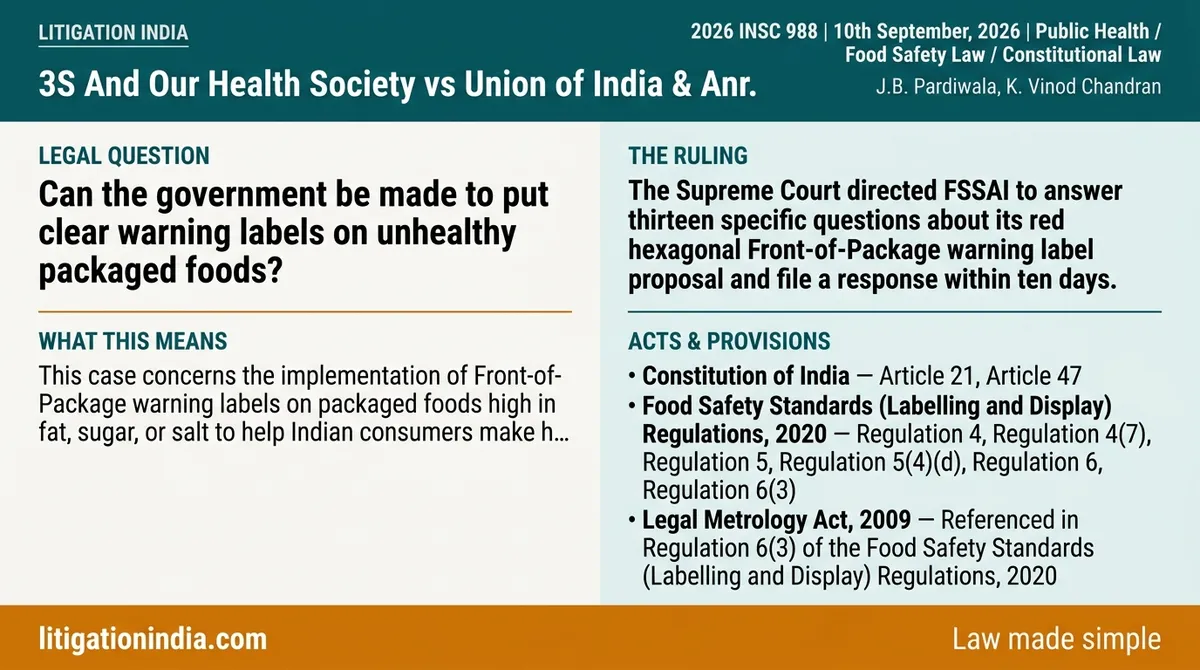
Can the government be made to put clear warning labels on unhealthy packaged foods?
Supreme Court Directs FSSAI to Clarify Front-of-Package Food Warning Label Proposal
Case: 3S And Our Health Society vs Union of India & Anr.Citation: 2026 INSC 988Decided on: 10th September, 2026
What this case means
This case concerns the implementation of Front-of-Package warning labels on packaged foods high in fat, sugar, or salt to help Indian consumers make healthier choices. The Supreme Court acknowledged FSSAI's proposal for a red hexagonal warning label but raised multiple concerns about its phasing, thresholds, font size, colour, and accessibility. The Court directed FSSAI to answer thirteen specific questions and file a response within ten days.
“The Supreme Court directed FSSAI to answer thirteen specific questions about its red hexagonal Front-of-Package warning label proposal and file a response within ten days.”
Story Slides
In short
This order is part of ongoing proceedings in Writ Petition (Civil) No. 437 of 2024. The Court had previously directed the Union of India and FSSAI to take prompt action on implementing Front-of-Package Labelling on packaged foods, emphasising the connection between High Fat, Sugar or Salt foods and health conditions like obesity, diabetes, and hypertension, and anchoring this in the right to health under Articles 21 and 47 of the Constitution. In response, FSSAI filed an affidavit proposing a red hexagonal warning label to be placed on the front of packs of food products that are high in two or more specified nutrients — added saturated fat, added sugar, and salt — with the warning to be implemented in two phases. Phase I would cover products high in two or more nutrients and specified sweetened beverages, while Phase II would extend to products high in any one nutrient. The Court acknowledged this as significant progress but identified several ambiguities requiring clarification. These included: the scientific basis for the 'two or more' threshold given that each nutrient causes independent health harm; the absence of a fixed timeline between the two phases; whether an alternate phased approach moving from stricter to more lenient thresholds (as adopted in Israel) should be considered; inconsistencies in the definition of HFSS across the 2024 Guidelines and 2022 Draft Regulations; whether thresholds should be based on total sugar and saturated fat rather than added sugar and added fat; the adequacy of the proposed font size; the dimensions and placement of the hexagonal logo; the need for pictorial representations alongside text; whether separate hexagons for each nutrient would be preferable; whether the red colour risks confusion with non-veg indicators; the risk of increased use of artificial additives as a consequence of reducing fat, sugar and salt; and the mandatory nature of the final FoPL regime. The Court also directed the Union to address how nutritional literacy will be incorporated into school curricula. FSSAI was directed to file a detailed affidavit within ten days addressing thirteen specific questions. The matter was posted for 28.09.2026.
Need clarity on a similar legal issue?
Request free pro bono guidance from a Supreme Court Advocate.
Background
The petitioner, 3S And Our Health Society, filed a writ petition seeking implementation of Front-of-Package Labelling on packaged foods in India. The Court had previously emphasised the link between HFSS and Ultra-Processed Foods and health conditions like obesity, diabetes, and hypertension, and directed the Union and FSSAI to act. In response to the Court's order dated 13.08.2026, FSSAI filed an affidavit dated 28.08.2026 proposing a red hexagonal warning label for food products high in two or more of the specified nutrients of concern.
The Decision
The Supreme Court acknowledged significant progress by FSSAI but found several aspects of the proposal ambiguous. It directed FSSAI to file an affidavit within ten days addressing thirteen specific questions covering the phased timeline, threshold basis, sweetened beverages, food categorisation, fat and sugar measurement standards, label colour, dimensions, placement, pictorial representation, separate hexagons, regulation of additives, mandatory compliance period, and school-level nutritional literacy. The matter was posted for hearing on 28.09.2026.
Why it matters for you
This case directly affects every person who buys packaged food in India, as the Court is pushing for clear, prominent warning labels so consumers — especially parents of young children — can quickly identify unhealthy products. It reinforces that the government has a constitutional duty to actively protect public health and cannot delay action on scientifically established food-related health risks. The case may ultimately lead to mandatory, standardised warning labels on millions of packaged food products sold across India.
Relevant Legal Provisions
Key Acts and sections cited or relied upon in this judgment
“Article 21 guarantees the right to life which includes the right to health, and Article 47 casts a duty on the State to improve public health; the Court relied on both to emphasise the State's obligation to implement effective food warning labels.”
“These regulations prescribe general labelling requirements, clarity and legibility standards, principal display panel specifications including minimum font sizes, and placement requirements for symbols; the Court examined these to assess whether FSSAI's proposed red hexagon label and its font size would meet the required standards.”
“Cited in the context of font size requirements for declarations such as net weight, retail sale price, and expiry date on the principal display panel of packaged food products.”
“The 2022 Draft Regulations proposed the Indian Nutrition Rating system and defined HFSS foods using a disjunctive standard; the Court noted a definitional inconsistency between these regulations and the 2024 Dietary Guidelines and questioned whether the final FoPL regime should be mandatory from the outset.”
AI-assisted summary, reviewed and verified by our editorial team.
In the Court's words
“The right to life under Article 21 encompasses the right to health. When the Constitution guarantees this right, it casts a corresponding duty on the State to not only refrain from actions that impair the health but also to take affirmative steps to protect it.”
“We do not approve the stance of the Union when it says that it is not possible to match with international standards, more particularly, developed countries. Should India remain as an underdeveloped country?”
“Ideally, an all-inclusive FoPL which effectively caters to the diverse population of this country should incorporate a combination of words along with pictorial representations of the individual nutrients-of-concern.”
“The World should know that India is very much concerned about the overall health of its citizens, more particularly the growing children.”
Need help with your case?
Facing a similar legal challenge in the Supreme Court or High Court? Connect with our pro bono volunteer advocates today.
Related Supreme Court services