
All insights

Was the probationer's discharge at IISc punitive or a valid simpliciter termination?

Supreme Court Upholds Termination of Probationer at IISc as Simpliciter

An Associate Professor at the Indian Institute of Science was discharged during his probationary period without reasons being assigned. He challenged this as punitive and stigmatic. The Supreme Court

Litigation India Editorial 16 November 2026 1 min read 2026 INSC 1218

Story

Case at a glance1 / 6

Supreme Court of India

Probationary Discharge at IISc: Simpliciter or Punitive?

Dr. G. Srinivasan vs. Union of India & Ors. | 2026 INSC 1218

Court: Supreme Court of India | Date: 16 November 2026Bench: Justice Dipankar Datta and Justice Sheel NaguArea: Service Law — probationary termination, motive vs. foundationOutcome: Appeal dismissed; discharge upheld as termination simpliciter
Supreme Court Upholds Termination of Probationer at IISc as Simpliciter · 2026 INSC 12182026-11-16T20:49:18.790912+00:00
The legal question2 / 6

Was the Discharge of This Probationer Punitive or Simpliciter?

Core legal issue framed by the Court

  • Appellant: Termination was camouflage for punishment; bias of third respondent drove the Committee.
  • Appellant: Findings of misconduct were recorded behind his back without notice or hearing.
  • Appellant: Regulation 13.5 allowing no-reason discharge is arbitrary and unconstitutional.
  • Respondent Institute: Discharge followed bona fide suitability assessment; no misconduct found or recorded.
  • Respondent Institute: Complaints are merely motive, not the foundation; no formal inquiry was held.
Supreme Court Upholds Termination of Probationer at IISc as Simpliciter · 2026 INSC 12182026-11-16T20:49:18.790912+00:00
Statutory comparison3 / 6

Motive vs. Foundation: The Core Distinction

As crystallised from Deepti Prakash Banerjee and Chandra Prakash Shahi

Legal SubjectMotive (Termination Valid)Foundation (Termination Punitive)
Nature of actionEmployer does not wish to retain; no inquiry into guiltFindings of misconduct arrived at, even if behind employee's back
Inquiry held?No inquiry or inquiry only into suitabilityFull-scale formal inquiry into misconduct culminating in finding of guilt
Stigma?No; order does not impute moral turpitude or misconductYes; order or background material imputes something beyond mere unsuitability
Legal consequenceSimple termination upheld; no Article 311(2) protection triggeredTermination set aside; due process and natural justice required
Misconduct as motive = termination valid. Misconduct as foundation = termination punitive.
Supreme Court Upholds Termination of Probationer at IISc as Simpliciter · 2026 INSC 12182026-11-16T20:49:18.790912+00:00
The Court's reasoning4 / 6

Court's Six-Part Framework for Probationary Discharge Cases

Structured analytical steps laid down in this judgment

  1. 1Step 1 — Object of probation: assess whether discharge serves legitimate suitability assessment, not punishment.
  2. 2Step 2 — Veil lifting: permissible only to check if alleged unsuitability is a cloak for punitive action; not to re-examine suitability.
  3. 3Step 3 — Motive-foundation test: apply substantively on the whole record, not mechanically on the form of the order.
  4. 4Step 4 — Stigma demarcation: use three sequential questions; stigma requires imputation beyond mere unsuitability.
  5. 5Step 5 — Pavanendra test: check for full formal inquiry + misconduct/moral turpitude + finding of guilt; all three must be present.
Final inquiry: Was the termination a bona fide suitability assessment or punishment for a specific act without due process?
Supreme Court Upholds Termination of Probationer at IISc as Simpliciter · 2026 INSC 12182026-11-16T20:49:18.790912+00:00
The verdict5 / 6

The Court's Final Decision

Civil Appeal No. 479 of 2018 — Dismissed

  • The Fact: IISc discharged the appellant during probation under Regulation 13.5 without assigning reasons, after a Committee assessed his suitability.
  • The Law: Termination is punitive only if a full formal inquiry into misconduct culminating in a finding of guilt precedes it; no such inquiry occurred here.
  • The Result: Discharge was a valid termination simpliciter; High Court's concurrent findings upheld; Regulation 13.5 challenge rejected.
Appeal dismissed. Parties to bear their own costs. Pending applications disposed of.
Supreme Court Upholds Termination of Probationer at IISc as Simpliciter · 2026 INSC 12182026-11-16T20:49:18.790912+00:00
Why it matters6 / 6

What This Judgment Means for Probationers

Practical significance for public sector employees

  • A probationer has no vested right to continue; discharge for general unsuitability needs no formal inquiry.
  • Courts will look at the substance of the whole record, not just the words of the termination order.
  • Only if misconduct findings constitute the foundation — not merely the motive — is a probationer protected by natural justice.
  • Service regulations permitting no-reason termination during probation are not arbitrary merely because reasons are withheld.
General unsuitability = no inquiry needed. Specific misconduct as foundation = full due process mandatory.
Supreme Court Upholds Termination of Probationer at IISc as Simpliciter · 2026 INSC 12182026-11-16T20:49:18.790912+00:00
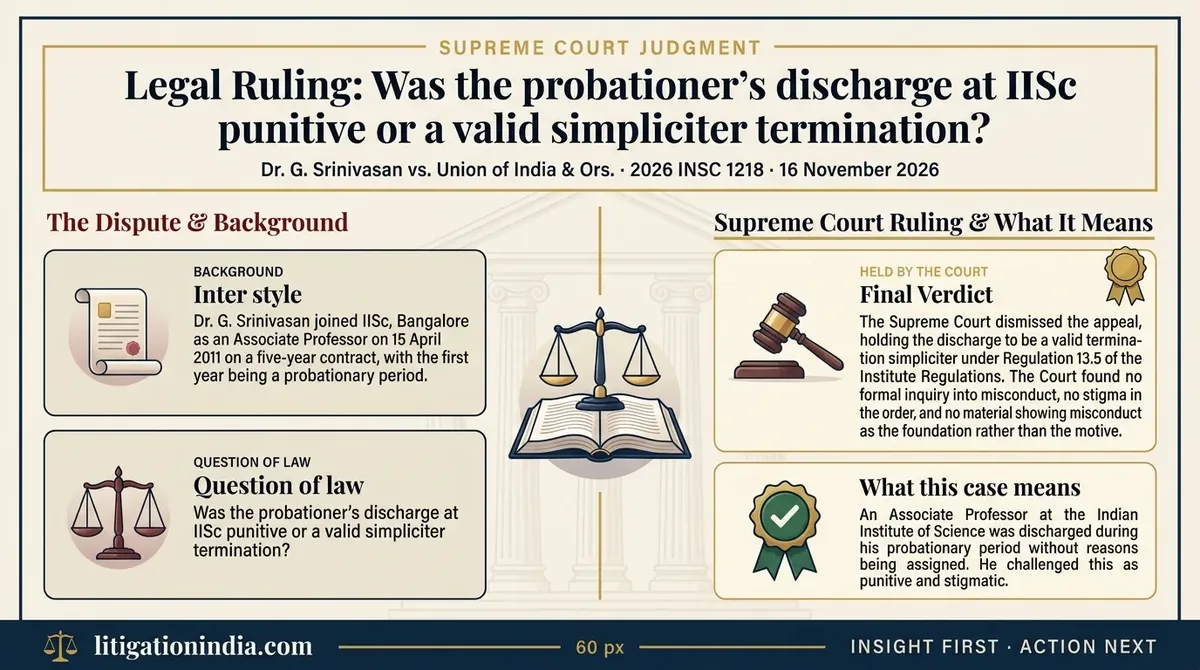
Supreme Court Upholds Termination of Probationer at IISc as Simpliciter — infographic summary

What this case means

An Associate Professor at the Indian Institute of Science was discharged during his probationary period without reasons being assigned. He challenged this as punitive and stigmatic. The Supreme Court upheld the termination as a valid simpliciter discharge, finding no formal inquiry into misconduct and no stigma attached.

What the Supreme Court held

The Supreme Court dismissed the appeal, holding the discharge to be a valid termination simpliciter under Regulation 13.5 of the Institute Regulations. The Court found no formal inquiry into misconduct, no stigma in the order, and no material showing misconduct as the foundation rather than the motive. The concurrent findings of the Single Judge and the Division Bench of the Karnataka High Court were upheld.

Case: Dr. G. Srinivasan vs. Union of India & Ors. (2026) Citation: 2026 INSC 1218

Want the full legal reasoning, citations and case documents?

Read the full judgment analysis
probationary termination
termination simpliciter
punitive discharge
motive vs foundation
stigma test
Institute Regulations
Article 311
Indian Institute of Science
Dr. G. Srinivasan
service jurisprudence
Article 226, Article 311(2), Constitution of India
Regulation 13.3, Regulation 13.5, Institute Regulations of the Indian Institute of Science
Service Law / Probationary Employment
Supreme Court legal news