
All insights

Could YES BANK's Administrator legally write down AT-1 Bonds after the Reconstruction Scheme?

Supreme Court Upholds Invalidation of YES BANK AT-1 Bond Write-Down by Administrator

YES BANK's Administrator wrote down AT-1 Bonds worth over Rs. 8,514 crore on 14 March 2020 after the bank's Reconstruction Scheme was notified. The Supreme Court held that this write-down was illegal

Litigation India Editorial 15 October 2026 1 min read 2026 INSC 1132

Story

Case at a glance1 / 6

Supreme Court of India

YES BANK AT-1 Bond Write-Down Declared Illegal

Yes Bank Limited vs Axis Trustee Services Limited — 2026 INSC 1132

Court: Supreme Court of India; Date: 15 October 2026Bench: Justice Dipankar Datta and Justice Augustine George MasihArea of Law: Banking and Finance Law / Regulatory LawAT-1 Bonds worth over Rs. 8,514 crore written down by Administrator on 14 March 2020 — held ultra vires
First Supreme Court judgment interpreting the RBI Master Circular on Basel III Capital Regulations.
Supreme Court Upholds Invalidation of YES BANK AT-1 Bond Write-Down by Administrator · 2026 INSC 11322026-10-15T18:17:01.016739+00:00
The legal question2 / 6

Could the Administrator Write Down AT-1 Bonds After the Scheme?

The central legal dispute between the parties

  • Appellant: Reconstruction Scheme kept Administrator's residuary powers intact, allowing write-down at any time during reconstruction.
  • Appellant: 'Before reconstitution' in Clause 2.15 means before reconstruction is fully complete, not just before Scheme's commencement.
  • Respondent: Central Government consciously deleted the write-down clause from the Draft Scheme — omission was deliberate.
  • Respondent: At Point of Non-Viability, only RBI — not the Administrator — has authority to write down AT-1 Bonds under the Master Circular.
Supreme Court Upholds Invalidation of YES BANK AT-1 Bond Write-Down by Administrator · 2026 INSC 11322026-10-15T18:17:01.016739+00:00
Statutory comparison3 / 6

Draft Scheme vs Final Reconstruction Scheme: Clause 6

The critical difference that determined the outcome

ProvisionDraft Scheme (6 March 2020)Final Reconstruction Scheme (13 March 2020)
AT-1 Bond Write-Down ClauseExplicitly included: 'AT-1 instruments shall stand written down permanently, in full, with effect from the Appointed date.'Completely omitted — no equivalent sub-clause present.
EffectAdministrator had specific textual authority to write down Bonds.No specific authority for write-down remained in the Scheme.
Reason for changeN/ARBI internal note: 'extant guidelines/rules/regulations of RBI and bond conditions apply … related provision in the draft scheme … may be dropped.'
The deletion of the write-down clause was a conscious governmental decision, not an oversight.
Supreme Court Upholds Invalidation of YES BANK AT-1 Bond Write-Down by Administrator · 2026 INSC 11322026-10-15T18:17:01.016739+00:00
The Court's reasoning4 / 6

Court's Reasoning: Why the Write-Down Was Illegal

Step-by-step legal logic leading to dismissal of appeals

  1. 1Step 1: Central Government deliberately deleted the AT-1 write-down clause from the Draft Scheme before finalising the Reconstruction Scheme.
  2. 2Step 2: General savings clause in Clause 6(1) of the Reconstruction Scheme cannot confer a specific power not expressly granted.
  3. 3Step 3: Clause 2.15, Annex 16 of Master Circular requires write-down 'before' reconstitution — meaning before the Scheme comes into force, not during its implementation.
  4. 4Step 4: At Point of Non-Viability, only the RBI — not the Administrator — has authority to trigger write-down under the Master Circular and Information Memorandum.
  5. 5Step 5: Administrator acting under Section 36ACA, Banking Regulation Act, 1949 could not assume the RBI's regulatory role — write-down was ultra vires and illegal.
Supreme Court Upholds Invalidation of YES BANK AT-1 Bond Write-Down by Administrator · 2026 INSC 11322026-10-15T18:17:01.016739+00:00
The verdict5 / 6

The Verdict: Appeals Dismissed

Supreme Court's final order

  • The Fact: Administrator wrote down Rs. 8,514 crore AT-1 Bonds on 14 March 2020, one day after the Reconstruction Scheme was notified without any write-down clause.
  • The Law: Under Clause 2.15, Annex 16 of the Master Circular and the Information Memorandum, write-down at PONV was exclusively the RBI's power; Administrator exceeded his Section 36ACA authority.
  • The Result: Bombay High Court's order setting aside the write-down is affirmed; annual coupon payments must continue; parties bear own costs.
Appeals dismissed. Interim orders vacated. Annual coupon on AT-1 Bonds must be paid as per Information Memoranda.
Supreme Court Upholds Invalidation of YES BANK AT-1 Bond Write-Down by Administrator · 2026 INSC 11322026-10-15T18:17:01.016739+00:00
Why it matters6 / 6

Why This Judgment Matters

Practical significance for investors and the banking system

  • Bank administrators cannot write down AT-1 Bonds unless the Reconstruction Scheme explicitly authorises it — protecting bondholder rights.
  • At Point of Non-Viability, only the RBI — not an administrator — can trigger AT-1 write-downs; regulatory roles cannot be informally transferred.
  • YES BANK violated the Master Circular by selling high-risk AT-1 instruments to individual retail investors — regulators must ensure proper risk disclosures.
  • Deliberate government omissions in reconstruction schemes carry legal weight — investors can rely on what the scheme says and does not say.
An administrator of a bank cannot exercise the RBI's exclusive regulatory power to write down AT-1 Bonds.
Supreme Court Upholds Invalidation of YES BANK AT-1 Bond Write-Down by Administrator · 2026 INSC 11322026-10-15T18:17:01.016739+00:00
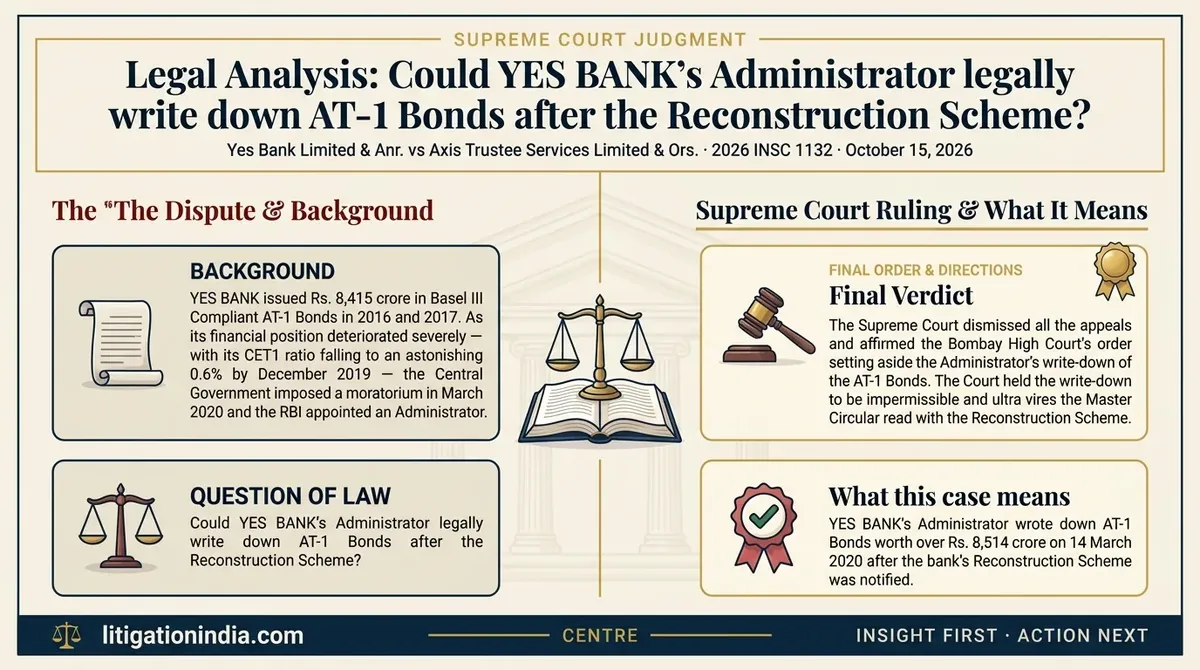
Supreme Court Upholds Invalidation of YES BANK AT-1 Bond Write-Down by Administrator — infographic summary

What this case means

YES BANK's Administrator wrote down AT-1 Bonds worth over Rs. 8,514 crore on 14 March 2020 after the bank's Reconstruction Scheme was notified. The Supreme Court held that this write-down was illegal because the Reconstruction Scheme had deliberately omitted any write-down clause, and only the RBI — not the Administrator — had authority to trigger write-down at the Point of Non-Viability. The judgment matters because it protects bond investors from arbitrary regulatory action and clarifies the boundaries of an Administrator's powers under the Banking Regulation Act.

What the Supreme Court held

The Supreme Court dismissed all the appeals and affirmed the Bombay High Court's order setting aside the Administrator's write-down of the AT-1 Bonds. The Court held the write-down to be impermissible and ultra vires the Master Circular read with the Reconstruction Scheme. It additionally directed that annual coupon payments on the Bonds must continue unaffected by the outcome of the appeals, and parties were left to bear their own costs.

Case: Yes Bank Limited & Anr. vs Axis Trustee Services Limited & Ors. (2026) Citation: 2026 INSC 1132

Want the full legal reasoning, citations and case documents?

Read the full judgment analysis
Yes Bank
AT-1 Bonds
Additional Tier 1
Basel III
write down
Reconstruction Scheme
Banking Regulation Act
RBI Master Circular
Point of Non-Viability
Administrator
Axis Trustee
bank reconstruction
Section 45, Section 36ACA, Section 44A, Section 53, Banking Regulation Act, 1949
Annex 16 (Clauses 2.12, 2.13, 2.14, 2.15, 3.1, 3.5); Annex 4; Paragraph 4, RBI Master Circular – Basel III Capital Regulations, 2015