
All insights

Can government employers change recruitment selection rules after the process begins?

Supreme Court Settles Law on Changing Recruitment Rules Mid-Process

This case examined whether a government employer can change the selection procedure — such as introducing minimum cut-off marks — after the recruitment process has begun or ended. A five-judge Constit

Litigation India Editorial 27 September 2026 1 min read 2024 INSC 847

Story

Case at a glance1 / 7

Supreme Court of India

Can Recruitment Rules Be Changed After the Game Begins?

Tej Prakash Pathak & Ors. v. Rajasthan High Court & Ors. — 2024 INSC 847

Court: Supreme Court of India — Five-Judge Constitution BenchDate: November 7, 2024Bench: CJI D.Y. Chandrachud, Hrishikesh Roy, P.S. Narasimha, Pankaj Mithal, Manoj Misra JJ.Area of Law: Constitutional Law / Service Law / Public Employment Recruitment
The ideal in recruitment is to do away with unfairness.
Supreme Court Settles Law on Changing Recruitment Rules Mid-Process · 2024 INSC 8472026-09-27T17:17:30.789537+00:00
The legal question2 / 7

Can cut-off marks be imposed after the exam is held?

The core legal dispute referred to a larger bench

  • Appellant: Post-exam introduction of 75% cut-off violated rules of the game; K. Manjusree correctly bars this.
  • Appellant: Change deprives candidates of fair notice and infringes Articles 14 and 16.
  • Respondent: Employer has discretion to set higher benchmarks to appoint a suitable candidate.
  • Respondent: No selected candidate has an indefeasible right to appointment; efficiency justifies the cut-off.
Supreme Court Settles Law on Changing Recruitment Rules Mid-Process · 2024 INSC 8472026-09-27T17:17:30.789537+00:00
Statutory comparison3 / 7

K. Manjusree vs Subash Chander Marwaha — Distinguishing the Two

The Court held they address different legal rights

Legal SubjectK. Manjusree (2008)Subash Chander Marwaha (1974)
Right at issueRight to be placed in the Select ListRight to be appointed from the Select List
What changedMinimum marks for interview prescribed after interviews were overState chose to appoint only top 7 of 40 qualifying candidates
Effect on select listEligibility criteria for placement changed post-facto — illegalSelect list prepared per rules; no change in eligibility
Court's conclusionChange clearly impermissible — violates Article 14State's policy decision valid; no arbitrary action found
The two cases deal with altogether different issues and K. Manjusree could not have been doubted for failing to consider Marwaha.
Supreme Court Settles Law on Changing Recruitment Rules Mid-Process · 2024 INSC 8472026-09-27T17:17:30.789537+00:00
The Court's reasoning4 / 7

Court's Reasoning: Step by Step

How the Constitution Bench reached its conclusions

  1. 1Step 1: Recruitment process runs from advertisement to filling vacancies; eligibility criteria fixed at start cannot change mid-process.
  2. 2Step 2: The bar on changing eligibility is rooted in Article 14 (non-arbitrariness) and Article 16 (equal opportunity); also in legitimate expectation doctrine.
  3. 3Step 3: K. Manjusree correctly held that prescribing minimum interview marks after interviews ended was impermissible — evaluators and candidates were both prejudiced.
  4. 4Step 4: Recruiting bodies may devise procedural steps and set benchmarks, but only before the relevant stage commences; statutory rules are always binding.
  5. 5Step 5: Placement in select list gives no indefeasible right to appointment, but denial must be bona fide and non-arbitrary.
Supreme Court Settles Law on Changing Recruitment Rules Mid-Process · 2024 INSC 8472026-09-27T17:17:30.789537+00:00
Key points5 / 7

Two Distinct Rights: Select List vs Appointment

A key legal distinction the Court expressly drew

  • Right to be placed in Select List: Eligibility criteria cannot be changed after commencement of recruitment — protected by Articles 14 and 16.
  • Right to be appointed from Select List: No indefeasible right; State may not fill vacancies for bona fide reasons.
  • But: If vacancies exist, the State cannot arbitrarily deny appointment to those within the zone of consideration.
  • Benchmark may be set to appoint only those above a threshold — but must be set before the relevant stage, not after.
Supreme Court Settles Law on Changing Recruitment Rules Mid-Process · 2024 INSC 8472026-09-27T17:17:30.789537+00:00
The verdict6 / 7

The Verdict: Six Authoritative Answers

Constitution Bench answers the reference

  • The Fact: After the exam, the Chief Justice imposed an unannounced 75% cut-off, excluding 18 of 21 candidates.
  • The Law: Eligibility criteria for the select list cannot change mid-process; K. Manjusree upheld; benchmarks must be set before the relevant stage begins.
  • The Result: K. Manjusree is good law; Subash Chander Marwaha is not in conflict; appeals sent to appropriate bench for final decision.
Recruiting bodies may set benchmarks for each stage, but must do so before that stage commences — not after the game has been played.
Supreme Court Settles Law on Changing Recruitment Rules Mid-Process · 2024 INSC 8472026-09-27T17:17:30.789537+00:00
Why it matters7 / 7

What This Means for You

Practical significance for government job applicants

  • If you apply for a government job, the eligibility rules and selection criteria cannot be secretly changed after you take the exam.
  • The government may choose not to fill vacancies for genuine reasons, but cannot arbitrarily deny you appointment if you are in the merit list.
  • Any benchmark such as minimum marks for interview must be announced before the interview, not after — both you and the interviewer must know the standard in advance.
  • Statutory recruitment rules are binding on the employer; administrative orders cannot override them.
Rules of the game must not be changed mid-way or after the game is played — this protects every government job applicant.
Supreme Court Settles Law on Changing Recruitment Rules Mid-Process · 2024 INSC 8472026-09-27T17:17:30.789537+00:00
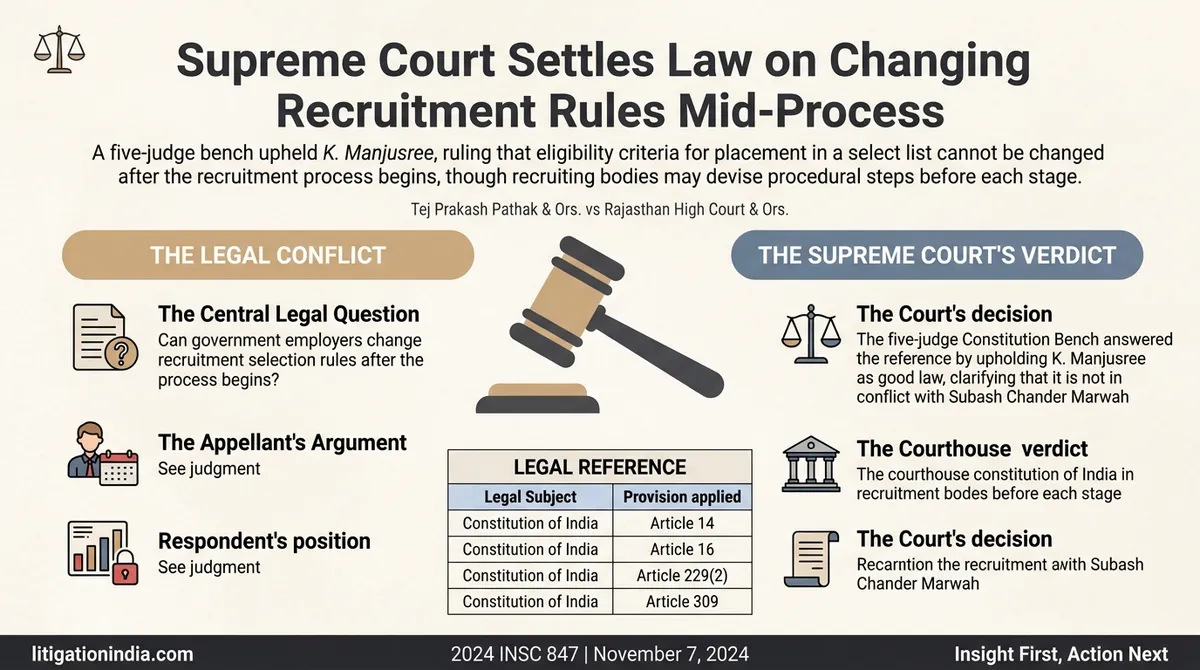
Supreme Court Settles Law on Changing Recruitment Rules Mid-Process — infographic summary

What this case means

This case examined whether a government employer can change the selection procedure — such as introducing minimum cut-off marks — after the recruitment process has begun or ended. A five-judge Constitution Bench upheld K. Manjusree as good law, ruling that eligibility criteria for the select list cannot be changed mid-process, while recruiting bodies retain flexibility to devise procedural steps before each stage begins. It matters because it protects job applicants from arbitrary post-facto changes in government hiring.

What the Supreme Court held

The five-judge Constitution Bench answered the reference by upholding K. Manjusree as good law, clarifying that it is not in conflict with Subash Chander Marwaha as the two cases address distinct rights. The Court laid down six conclusions covering when recruitment begins and ends, the immutability of eligibility criteria mid-process, the flexibility of recruiting bodies to devise procedural steps before each stage, the binding nature of statutory rules, and the absence of any indefeasible right to appointment from the select list. The appeals were directed to be placed before an appropriate bench for decision in terms of these answers.

Case: Tej Prakash Pathak & Ors. vs Rajasthan High Court & Ors. (2024) Citation: 2024 INSC 847

Want the full legal reasoning, citations and case documents?

Read the full judgment analysis
rules of the game
recruitment process
eligibility criteria
selection procedure
K. Manjusree
Subash Chander Marwaha
Article 14
Article 16
legitimate expectation
select list
cut-off marks
public employment
Article 14, Constitution of India
Article 16, Constitution of India