
All insights

Can courts order multi-expert psychological evaluation of a POCSO child victim in custody disputes?

Supreme Court Sets Child-Centric Guidelines for Psychological Evaluation in Custody Disputes Involving POCSO Allegations

A mother challenged Bombay High Court orders directing a four-member panel of experts to psychologically evaluate her minor daughter, who is an alleged POCSO victim, at the father's instance. The Supr

Litigation India Editorial 25 October 2026 1 min read 2026 INSC 638

Story

Case at a glance1 / 6

Supreme Court of India

Child Victim vs. Expert Panel: Supreme Court Redraws the Line

Sheetal Vasant Thakur v. Chirag Arora | 2026 INSC 638 | June 11, 2026

Court: Supreme Court of India; Bench: Justice Sanjay Karol and Justice N. Kotiswar SinghArea of law: Child Custody, POCSO, Family Law, Child PsychologyMother challenged Bombay High Court orders constituting four-member expert panel to evaluate her daughter, a POCSO victimCourt modified orders and issued 20 guidelines on psychological evaluation of child victims in custody proceedings
Supreme Court Sets Child-Centric Guidelines for Psychological Evaluation in Custody Disputes Involving POCSO Allegations · 2026 INSC 6382026-10-25T17:34:49.389848+00:00
The legal question2 / 6

Can a Court Order a Multi-Expert Panel to Evaluate a POCSO Child Victim?

Core legal question framed by the Supreme Court

  • Appellant: Panel evaluation exposes the POCSO victim child to re-traumatisation and secondary victimisation; minimum intrusion must govern.
  • Appellant: Panel was largely constituted from names suggested by the accused father, compromising institutional neutrality.
  • Respondent: Expert evaluation is necessary to facilitate reconnection between father and child and to assess parental alienation.
  • Respondent: The original single-expert order was never challenged and had attained finality; the modification was procedurally permissible.
The inquiry must focus on the child's welfare, not merely on the litigating parents' rights.
Supreme Court Sets Child-Centric Guidelines for Psychological Evaluation in Custody Disputes Involving POCSO Allegations · 2026 INSC 6382026-10-25T17:34:49.389848+00:00
Statutory comparison3 / 6

Single Expert vs. Panel of Experts: What the Court Said

Distinction drawn by the Supreme Court in this judgment

AspectSingle Independent Expert (Preferred)Panel of Multiple Experts (Exceptional Only)
StandardDefault; Court-appointed; neutralOnly where peculiar facts render it indispensable
Reasons requiredNecessity and purpose must be recordedSpecific reasons for each expert's role required
Child exposureMinimum intrusion; fewer interactionsRisk of repeated, multi-layered psychological exposure
NeutralityNo prior party engagement except professionalPanel from party-suggested names compromises independence
POCSO alignmentConsistent with Sections 24, 33(5), 36, 39Multi-expert process risks secondary victimisation
Supreme Court Sets Child-Centric Guidelines for Psychological Evaluation in Custody Disputes Involving POCSO Allegations · 2026 INSC 6382026-10-25T17:34:49.389848+00:00
The Court's reasoning4 / 6

How the Court Reached Its Decision: Step by Step

Reasoning pathway followed by the Supreme Court

  1. 1Step 1: Identify the child as an alleged POCSO victim; POCSO's statutory philosophy of minimum intrusion applies as doctrinal guidance even in custody proceedings.
  2. 2Step 2: Affirm that child welfare — including emotional and psychological security — is the paramount consideration overriding parental claims (Gaurav Nagpal, Sakshi).
  3. 3Step 3: Distinguish therapeutic intervention (recovery-oriented, child-centric) from adversarial evaluative exercises (forensic scrutiny for litigation advantage).
  4. 4Step 4: Find that the High Court erred by converting single-expert evaluation into a four-member panel without recording necessity, proportionality or re-traumatisation risk.
  5. 5Step 5: Modify orders; direct assessment of parents first, then child's therapist's report; Family Court decides necessity of child evaluation; issue 20 guidelines.
Supreme Court Sets Child-Centric Guidelines for Psychological Evaluation in Custody Disputes Involving POCSO Allegations · 2026 INSC 6382026-10-25T17:34:49.389848+00:00
The verdict5 / 6

What the Supreme Court Decided

Final order and operative directions

  • The Fact: A POCSO child victim was directed by the High Court to be evaluated by a four-member panel, mostly proposed by the accused father.
  • The Law: Child welfare is paramount; POCSO principles of minimum intrusion apply; courts must record necessity, proportionality and re-traumatisation risk before ordering evaluation.
  • The Result: Both High Court orders modified; Family Court to assess parents first, then decide on child evaluation; 20 guidelines issued for all courts in India.
Impugned orders dated 27.04.2023 and 07.12.2023 modified; matter remitted to Family Court; appeals partly allowed; no order as to costs.
Supreme Court Sets Child-Centric Guidelines for Psychological Evaluation in Custody Disputes Involving POCSO Allegations · 2026 INSC 6382026-10-25T17:34:49.389848+00:00
Why it matters6 / 6

Why This Judgment Matters for Every Indian Family

Practical significance of the 20 guidelines

  • A child in a custody dispute cannot be subjected to repeated psychological evaluation by multiple experts just because parents are fighting in court.
  • Courts must first assess both parents psychologically before directing any evaluation of the child, protecting the child from unnecessary exposure.
  • Any expert appointed must be court-selected, neutral and independent — a panel constituted from one party's suggestions is impermissible.
  • These 20 binding guidelines apply to all family courts and high courts across India in cases involving child victims and custody disputes.
The child's psychological safety and dignity must always come first — the court as parens patriae is the child's ultimate guardian.
Supreme Court Sets Child-Centric Guidelines for Psychological Evaluation in Custody Disputes Involving POCSO Allegations · 2026 INSC 6382026-10-25T17:34:49.389848+00:00
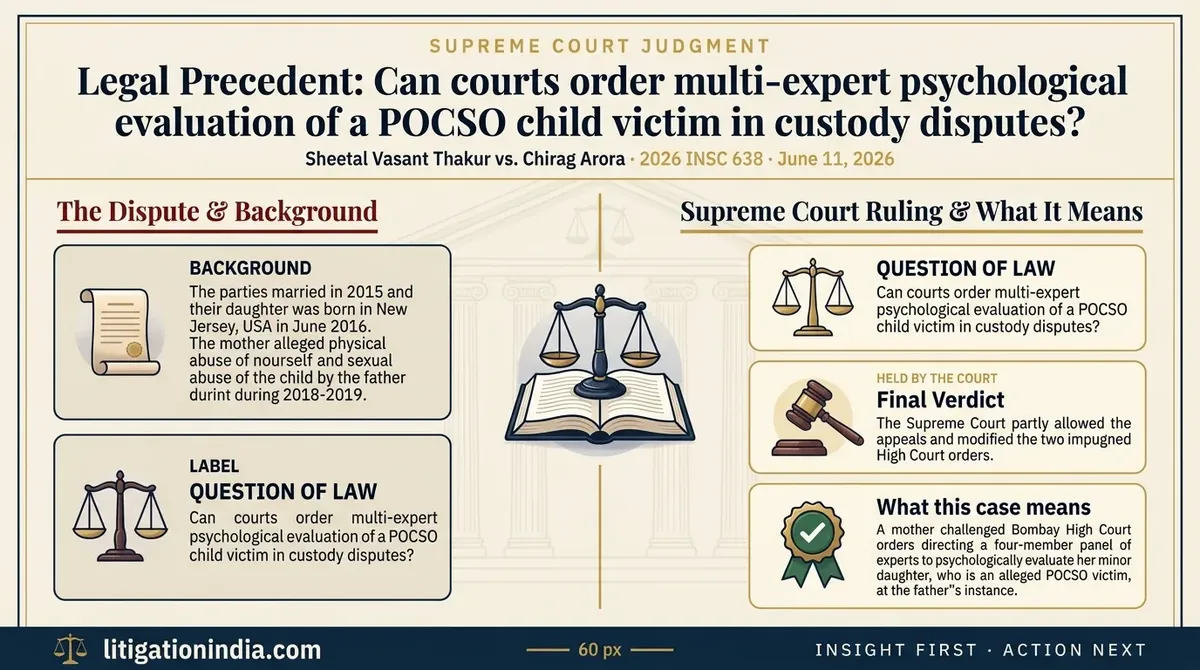
Supreme Court Sets Child-Centric Guidelines for Psychological Evaluation in Custody Disputes Involving POCSO Allegations — infographic summary

What this case means

A mother challenged Bombay High Court orders directing a four-member panel of experts to psychologically evaluate her minor daughter, who is an alleged POCSO victim, at the father's instance. The Supreme Court modified those orders, holding that multi-expert evaluations risk re-traumatisation and must satisfy necessity, minimum intrusion, and institutional neutrality. The Court issued nineteen guidelines to govern psychological evaluation of child victims in custody proceedings.

What the Supreme Court held

The Supreme Court partly allowed the appeals and modified the two impugned High Court orders. It directed the Family Court to appoint a psychologist to assess both parents, who will then interact with the child's treating therapist and submit a report, on the basis of which the Family Court will decide whether any direct evaluation of the child is necessary. Twenty guidelines were laid down governing judicial psychological evaluations of child victims in custody and access proceedings.

Case: Sheetal Vasant Thakur vs. Chirag Arora (2026) Citation: 2026 INSC 638

Want the full legal reasoning, citations and case documents?

Read the full judgment analysis
Sheetal Vasant Thakur
Chirag Arora
POCSO Act
child psychological evaluation
panel of experts
child custody
parental alienation syndrome
secondary victimisation
re-traumatisation
best interest of child
minimum intrusion
parens patriae
Sections 24, 33(5), 36 and 39, The Protection of Children from Sexual Offences Act, 2012
Section 13(1)(ia)(ib), The Hindu Marriage Act, 1955