
All insights

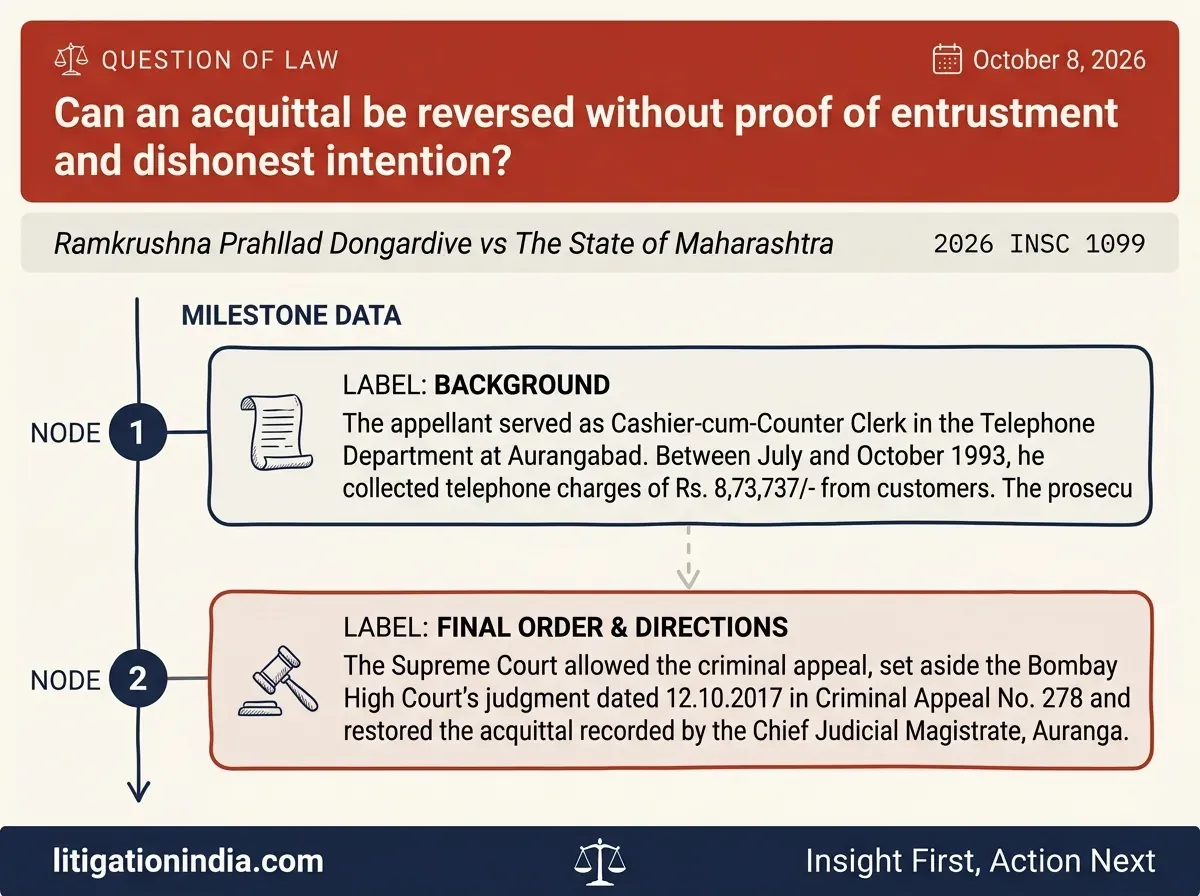
Can an acquittal be reversed without proof of entrustment and dishonest intention?

Supreme Court Restores Acquittal of Telephone Department Cashier Charged With Criminal Breach of Trust

A cashier in the Telephone Department was acquitted by the trial court of criminal breach of trust under Section 409 IPC, but the Bombay High Court reversed that acquittal. The Supreme Court set aside

Litigation India Editorial 8 October 2026 1 min read 2026 INSC 1099

Story

Case at a glance1 / 6

Supreme Court of India

Acquittal Restored: Criminal Breach of Trust Not Proved

Ramkrushna Prahllad Dongardive v. The State of Maharashtra | 2026 INSC 1099

Court: Supreme Court of India | Date: October 8, 2026Bench: Justice Ujjal Bhuyan and Justice Atul S. ChandurkarArea of Law: Criminal Law — Criminal Breach of Trust, Reversal of AcquittalOffence charged: Section 409, Indian Penal Code, 1860
Telephone Department cashier acquitted — High Court's reversal set aside by Supreme Court.
Supreme Court Restores Acquittal of Telephone Department Cashier Charged With Criminal Breach of Trust · 2026 INSC 10992026-10-08T19:17:29.046714+00:00
The legal question2 / 6

Can Acquittal Be Reversed Without Proving Entrustment and Dishonest Intent?

Core legal issue before the Supreme Court

  • Appellant: Prosecution never produced cashbook, registers or audit report to prove entrustment of Rs. 8,73,737/-.
  • Appellant: Seizure of 46 articles was irregular; both panch witnesses turned hostile.
  • Appellant: High Court wrongly shifted burden of proof to the accused to explain documents.
  • Respondent: Exhibits 7-9 and handwriting expert opinion proved appellant's guilt; High Court correctly reversed acquittal.
Supreme Court Restores Acquittal of Telephone Department Cashier Charged With Criminal Breach of Trust · 2026 INSC 10992026-10-08T19:17:29.046714+00:00
The Court's reasoning3 / 6

How the Supreme Court Reached Its Decision

Step-by-step reasoning

  1. 1Step 1: Identified essential elements — entrustment of property and dishonest intention — under Sections 405 and 409 IPC.
  2. 2Step 2: Found prosecution failed to produce original cashbook, daily registers and audit report; adverse inference drawn under Section 114(g) Evidence Act.
  3. 3Step 3: Found seizure of 46 articles unreliable — both panch witnesses hostile, Sections 100(4) and 100(7) CrPC violated.
  4. 4Step 4: Found Exhibit-9 (amount list) had no signature or handwriting of appellant, could not be linked to him.
  5. 5Step 5: Held High Court improperly shifted burden of proof; acquittal restored under settled principles of Chelloor Mankkal Narayan Ittiravi Nambudiri.
Supreme Court Restores Acquittal of Telephone Department Cashier Charged With Criminal Breach of Trust · 2026 INSC 10992026-10-08T19:17:29.046714+00:00
Key points4 / 6

Key Legal Distinction: Burden of Proof Cannot Shift to Accused

Prosecution's duty vs. accused's standard — as applied in this case

  • Prosecution must prove guilt beyond reasonable doubt; it cannot benefit from a weak or false defence.
  • Accused is presumed innocent; the onus on prosecution never shifts to the defence.
  • Accused need only raise a probable explanation that throws doubt on prosecution's case.
  • High Court erred by requiring appellant to explain seized documents when seizure itself was not validly proved.
The onus of the prosecution never shifts. — Rabindra Kumar Dey v. State of Orissa (1976 INSC 204)
Supreme Court Restores Acquittal of Telephone Department Cashier Charged With Criminal Breach of Trust · 2026 INSC 10992026-10-08T19:17:29.046714+00:00
The verdict5 / 6

The Verdict

What the Court decided

  • Fact: Prosecution did not produce cashbooks or registers to prove entrustment; panch witnesses for seizure turned hostile.
  • Law: Section 409 IPC requires proof of entrustment and dishonest intention; burden of proof remains on prosecution throughout.
  • Result: High Court's reversal of acquittal set aside; trial court's acquittal restored; bail bonds cancelled.
Judgment of Bombay High Court dated 12.10.2017 set aside; acquittal of appellant under Section 409 IPC restored.
Supreme Court Restores Acquittal of Telephone Department Cashier Charged With Criminal Breach of Trust · 2026 INSC 10992026-10-08T19:17:29.046714+00:00
Why it matters6 / 6

What This Means for Ordinary People

Practical significance of this judgment

  • Prosecution must gather and produce all key documents before trial; missing records will be held against them.
  • A person accused of a crime cannot be convicted merely because documents seized from their home are unexplained if the seizure itself was irregular.
  • When a higher court convicts someone for the first time, it must hear that person before sentencing — a basic right of every accused.
  • Appellate courts cannot replace a trial court's well-reasoned acquittal simply because another view is possible.
Conviction requires proof beyond reasonable doubt — not suspicion. Prosecution must prove its case; burden never shifts to the accused.
Supreme Court Restores Acquittal of Telephone Department Cashier Charged With Criminal Breach of Trust · 2026 INSC 10992026-10-08T19:17:29.046714+00:00
Supreme Court Restores Acquittal of Telephone Department Cashier Charged With Criminal Breach of Trust — infographic summary

What this case means

A cashier in the Telephone Department was acquitted by the trial court of criminal breach of trust under Section 409 IPC, but the Bombay High Court reversed that acquittal. The Supreme Court set aside the High Court's reversal and restored the original acquittal, finding that the prosecution failed to prove entrustment of property or dishonest intention. The case clarifies that key documents must be produced to prove criminal breach of trust and that burden of proof cannot be shifted to the accused.

What the Supreme Court held

The Supreme Court allowed the criminal appeal, set aside the Bombay High Court's judgment dated 12.10.2017 in Criminal Appeal No. 278 of 2002, and restored the acquittal recorded by the Chief Judicial Magistrate, Aurangabad in RCC No. 80163 of 1996 dated 20.02.2002. The appellant was acquitted for the offence under Section 409 IPC and his bail bonds were cancelled.

Case: Ramkrushna Prahllad Dongardive vs The State of Maharashtra (2026) Citation: 2026 INSC 1099

Want the full legal reasoning, citations and case documents?

Read the full judgment analysis
criminal breach of trust
Section 409 IPC
reversal of acquittal
entrustment
dishonest intention
Telephone Department cashier
adverse inference
seizure panchnama
Section 100 CrPC
Maharashtra
Sections 24, 405, 406, 409, 420, 477, Indian Penal Code, 1860
Section 313, Code of Criminal Procedure, 1872
Sections 100(4), 100(7), Code of Criminal Procedure, 1872
Section 386, Code of Criminal Procedure, 1872