
All insights

Can a third judge under Section 392 CrPC reopen findings both Division Bench judges agreed upon?

Supreme Court Refers Whether Third Judge Can Review Unanimous Findings on Reference Under Section 392 CrPC

This case concerned whether, when two High Court judges divide only on one accused in a composite criminal appeal, the third judge appointed under Section 392 CrPC 1973 can reopen findings on which bo

Litigation India Editorial 23 October 2026 1 min read 2026 INSC 632

Story

Case at a glance1 / 6

Supreme Court of India

Can a Third Judge Reopen Unanimous Findings Under Section 392 CrPC?

Dr. Rakesh Kumar Gupta v. State of UP & Ors. — 2026 INSC 632

Court: Supreme Court of India; Date: June 09, 2026Bench: Justice Dipankar Datta and Justice Satish Chandra SharmaArea of Law: Criminal Appellate Procedure — Scope of third judge under Section 392 CrPC 1973Sajjan Singh v. State of MP (1999) referred to a larger Bench for reconsideration
Supreme Court Refers Whether Third Judge Can Review Unanimous Findings on Reference Under Section 392 CrPC · 2026 INSC 6322026-10-23T11:01:48.270747+00:00
The legal question2 / 6

What Power Does a Third Judge Have Under Section 392 CrPC 1973?

Three legal questions the Supreme Court framed for decision

  • Appellant (complainant): The third judge delivered no independent opinion and exceeded jurisdiction by revisiting unanimous findings.
  • Appellant (complainant): Sajjan Singh requires reconsideration as it permits the third judge to examine the whole case without restriction.
  • Respondents (siblings): Sajjan Singh correctly holds the third judge must independently examine the entire case, not just the point of disagreement.
  • Respondents (siblings): Section 392 of the 1973 Code is not materially different from Section 429 of the 1898 Code except for the proviso.
Supreme Court Refers Whether Third Judge Can Review Unanimous Findings on Reference Under Section 392 CrPC · 2026 INSC 6322026-10-23T11:01:48.270747+00:00
Statutory comparison3 / 6

Section 429 (CrPC 1898) vs Section 392 (CrPC 1973): The Key Textual Difference

The Court held this difference changes the scope of the third judge's power

Legal SubjectCrPC 1898 — Section 429CrPC 1973 — Section 392
What is referred to third judge'The case' with opinions'The appeal' with opinions
Scope of referralEntire case of all accusedOnly the specific appeal where division occurred
Proviso for larger BenchAbsentPresent — third judge or any Division Bench judge may require re-hearing by larger Bench
Court's findingBroader language — whole case openAnaphoric 'the appeal' limits reference to appeal in dispute only
'An appeal' introduces the class; 'the appeal' refers back only to the specific appeal where judges divided.
Supreme Court Refers Whether Third Judge Can Review Unanimous Findings on Reference Under Section 392 CrPC · 2026 INSC 6322026-10-23T11:01:48.270747+00:00
The Court's reasoning4 / 6

How the Court Reasoned Its Way to a Larger Bench Reference

Step-by-step reasoning from statutory text to final order

  1. 1Step 1: Division Bench unanimously dismissed appeals of Anil and Ajay; divided only on Atul — so only Atul's appeal should have been referred.
  2. 2Step 2: Textual analysis — 'the appeal' in Section 392 CrPC 1973 anaphorically limits reference to the appeal where division occurred, not the composite appeal.
  3. 3Step 3: Sajjan Singh (1999) did not address this grammatical/textual point and is therefore distinguishable and not controlling.
  4. 4Step 4: Broad application of Sajjan Singh creates anomaly — composite appeal filers gain advantage over separate appeal filers, risking Article 14 breach.
  5. 5Step 5: Sajjan Singh referred to larger Bench; present appeals to await that Bench's opinion before final disposal.
Supreme Court Refers Whether Third Judge Can Review Unanimous Findings on Reference Under Section 392 CrPC · 2026 INSC 6322026-10-23T11:01:48.270747+00:00
The verdict5 / 6

The Supreme Court's Decision

Fact, Law, and Result

  • The Fact: The third judge acquitted all three siblings including Anil and Ajay, whose convictions the Division Bench had unanimously upheld.
  • The Law: Section 392 CrPC 1973 uses 'the appeal' anaphorically, limiting the third judge's jurisdiction to the specific appeal where the division occurred; Sajjan Singh (1999) did not address this and is distinguishable.
  • The Result: Sajjan Singh v. State of MP (1999) referred to a larger Bench; present appeals reserved pending that Bench's opinion.
Sajjan Singh (1999) referred to a larger Bench; appeals to be placed before appropriate Bench after larger Bench delivers its opinion.
Supreme Court Refers Whether Third Judge Can Review Unanimous Findings on Reference Under Section 392 CrPC · 2026 INSC 6322026-10-23T11:01:48.270747+00:00
Why it matters6 / 6

Why This Judgment Matters for Ordinary People

Practical significance of the referral to a larger Bench

  • Convicted persons in joint criminal appeals now face uncertainty about whether a third judge can reopen findings all earlier judges agreed upon.
  • Victims and the State risk seeing hard-won convictions overturned by a single third judge on a reference triggered only by a narrow dispute about a different co-accused.
  • Filing a composite appeal versus separate appeals should not determine whether unanimous findings can be reopened — this ruling prompts the law to be settled equally for all.
  • A larger Bench will now authoritatively clarify the full scope of Section 392 CrPC 1973, bringing certainty to criminal appellate procedure across all High Courts.
A unanimous dismissal of one co-accused's appeal should not be reopened by a third judge on a reference about a different co-accused.
Supreme Court Refers Whether Third Judge Can Review Unanimous Findings on Reference Under Section 392 CrPC · 2026 INSC 6322026-10-23T11:01:48.270747+00:00
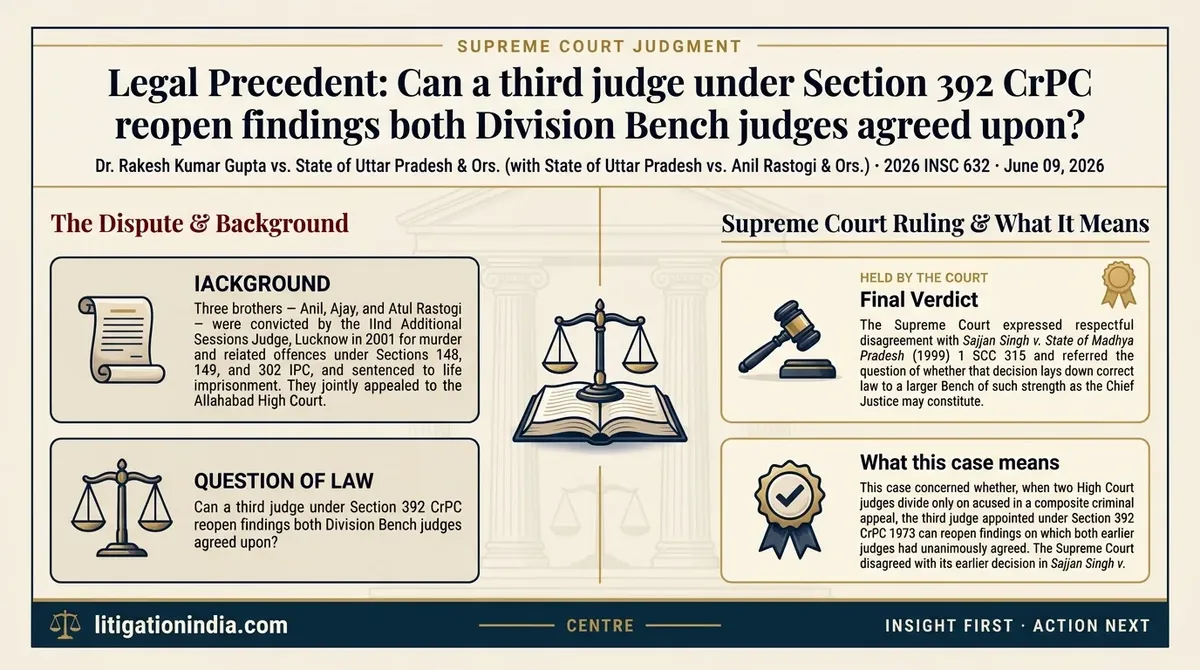
Supreme Court Refers Whether Third Judge Can Review Unanimous Findings on Reference Under Section 392 CrPC — infographic summary

What this case means

This case concerned whether, when two High Court judges divide only on one accused in a composite criminal appeal, the third judge appointed under Section 392 CrPC 1973 can reopen findings on which both earlier judges had unanimously agreed. The Supreme Court disagreed with its earlier decision in Sajjan Singh v. State of Madhya Pradesh (1999) and referred the question to a larger Bench. The ruling matters because it could affect the scope of third-judge references in criminal appeals across all High Courts.

What the Supreme Court held

The Supreme Court expressed respectful disagreement with Sajjan Singh v. State of Madhya Pradesh (1999) 1 SCC 315 and referred the question of whether that decision lays down correct law to a larger Bench of such strength as the Chief Justice may constitute. The Court reserved its answers to questions (ii) and (iii) formulated in paragraph 8, directing that the appeals be laid before an appropriate Bench after the larger Bench delivers its opinion.

Case: Dr. Rakesh Kumar Gupta vs. State of Uttar Pradesh & Ors. (with State of Uttar Pradesh vs. Anil Rastogi & Ors.) (2026) Citation: 2026 INSC 632

Want the full legal reasoning, citations and case documents?

Read the full judgment analysis
Section 392 CrPC 1973
third Judge reference
divided opinion
composite appeal
Sajjan Singh
larger Bench reference
anaphoric article
Section 429 CrPC 1898
murder conviction
Rastogi brothers
Allahabad High Court
stare decisis
Section 392, Code of Criminal Procedure, 1973
Section 374(2), Code of Criminal Procedure, 1973