
All insights

How can the Supreme Court streamline over 800 pending forest case applications?

Supreme Court Orders Streamlining of 800-Plus Pending Forest Case Applications

The Supreme Court issued directions to reorganise the landmark Godavarman forest case, which has accumulated over 800 pending interlocutory applications since 1995. The Court directed the Amicus Curia

Litigation India Editorial 18 October 2026 1 min read Writ Petition(s)(Civil) No(s). 202/1995

Story

Case at a glance1 / 5

Supreme Court of India

Godavarman Forest Case: Court Orders Structural Overhaul

In Re T.N. Godavarman Thirumulpad v. Union of India & Ors. | WP (Civil) 202/1995 | 13 April 2026

Court: Supreme Court of India; Bench: Hon'ble The Chief Justice and Justice Joymalya Bagchi.Case filed in 1995 for forest protection; evolved into a national continuing mandamus over 30 years.Over 800 interlocutory applications pending, many for nearly 25 years.Area of law: Environmental Law / Forest Conservation / Judicial Administration.
India's oldest and most consequential environmental case is being restructured for modern forest governance.
Supreme Court Orders Streamlining of 800-Plus Pending Forest Case Applications · Writ Petition(s)(Civil) No(s). 202/19952026-10-18T11:28:11.689728+00:00
The Court's reasoning2 / 5

How the Court Decided to Restructure This Case

Step-by-step reasoning from the judgment

  1. 1Step 1: Traced how a 1995 local petition expanded into a national continuing mandamus with 800-plus IAs.
  2. 2Step 2: Noted court-created bodies are now legislatively formalised under the Environment (Protection) Act, 1986 and Compensatory Afforestation Fund Act, 2016.
  3. 3Step 3: Identified three challenges — volume of IAs, interconnected issues, and overlap with new suo moto proceedings.
  4. 4Step 4: Drew parallel with disposal of M.C. Mehta petitions (2026) using a categorisation methodology.
  5. 5Step 5: Adopted Amicus Curiae's recommendation for an online questionnaire; non-response leads to dismissal as infructuous.
Supreme Court Orders Streamlining of 800-Plus Pending Forest Case Applications · Writ Petition(s)(Civil) No(s). 202/19952026-10-18T11:28:11.689728+00:00
Statutory comparison3 / 5

Court-Created Mechanisms Later Legislatively Formalised

How judicial innovation became statute

MechanismCourt's InitiativeLegislative Recognition
Central Empowered CommitteeCreated by court order dated 09.05.2002 as an Expert BodyFormally constituted under Section 3(3), Environment (Protection) Act, 1986
Compensatory Afforestation FundAd hoc mechanism created by this Court to manage fundsNational and State Authorities created by Compensatory Afforestation Fund Act, 2016
Judicial creativity in the Godavarman case directly shaped Indian forest legislation.
Supreme Court Orders Streamlining of 800-Plus Pending Forest Case Applications · Writ Petition(s)(Civil) No(s). 202/19952026-10-18T11:28:11.689728+00:00
The verdict4 / 5

The Court's Final Order

Directions issued on 13 April 2026

  • The Fact: Over 800 IAs pending in a 1995 forest petition, many for nearly 25 years, creating severe backlog and access-to-justice issues.
  • The Law: The Court's continuing mandamus jurisdiction and constitutional obligation to supervise forest protection at the national level.
  • The Result: Amicus to prepare online questionnaire; deadline 15.06.2026; non-response means dismissal; matter listed for three-judge bench from 20.07.2026.
AORs/parties must fill the online form by 15.06.2026 or their IA will be dismissed as infructuous.
Supreme Court Orders Streamlining of 800-Plus Pending Forest Case Applications · Writ Petition(s)(Civil) No(s). 202/19952026-10-18T11:28:11.689728+00:00
Why it matters5 / 5

Why This Order Matters for Everyone

Practical significance of the restructuring

  • Citizens and communities with forest disputes may now be directed to more accessible High Courts or the National Green Tribunal.
  • The Court's restructuring prevents important forest issues from being buried under hundreds of stale, infructuous applications.
  • New suo moto proceedings on distinct forest issues will allow focused, faster adjudication on ecology and conservation.
  • Thirty years of Supreme Court-supervised forest jurisprudence is being rationalised into a modern, efficient framework.
India's forests are better protected when justice is fast, focused, and accessible — not buried in a 30-year backlog.
Supreme Court Orders Streamlining of 800-Plus Pending Forest Case Applications · Writ Petition(s)(Civil) No(s). 202/19952026-10-18T11:28:11.689728+00:00
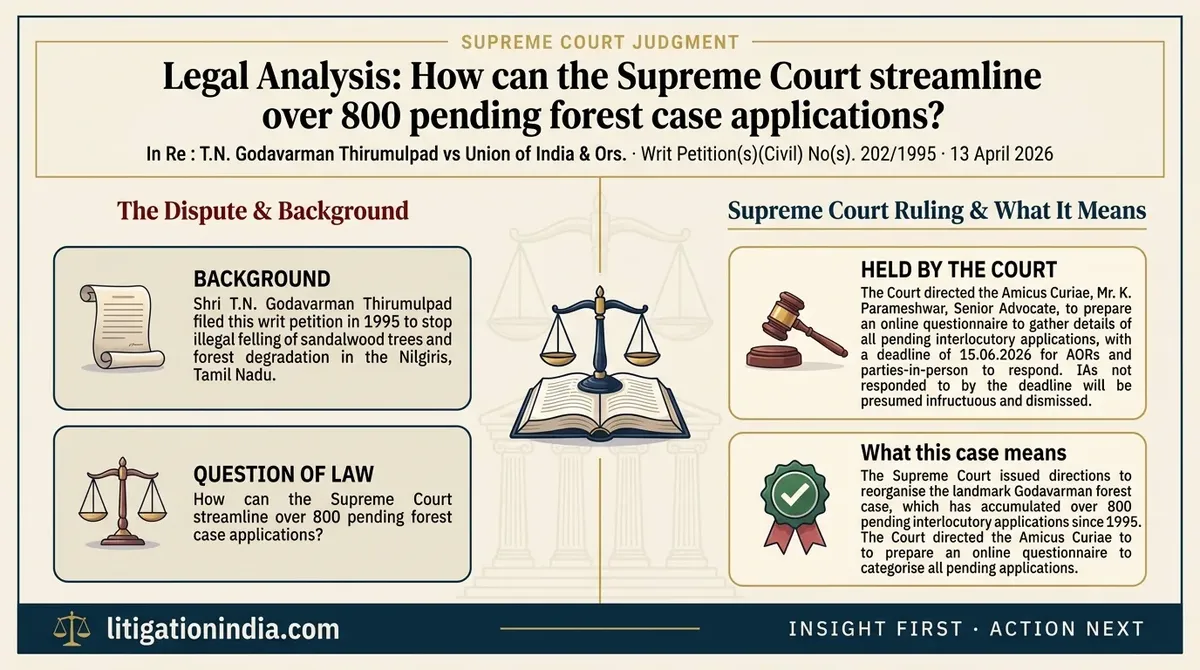
Supreme Court Orders Streamlining of 800-Plus Pending Forest Case Applications — infographic summary

What this case means

The Supreme Court issued directions to reorganise the landmark Godavarman forest case, which has accumulated over 800 pending interlocutory applications since 1995. The Court directed the Amicus Curiae to prepare an online questionnaire to categorise all pending applications. The aim is to eventually dispose of the main petition and initiate separate suo moto proceedings for distinct forest-related issues.

What the Supreme Court held

The Court directed the Amicus Curiae, Mr. K. Parameshwar, Senior Advocate, to prepare an online questionnaire to gather details of all pending interlocutory applications, with a deadline of 15.06.2026 for AORs and parties-in-person to respond. IAs not responded to by the deadline will be presumed infructuous and dismissed. The matter will be listed before a three-judge bench in the week commencing 20.07.2026 for further directions.

Case: In Re : T.N. Godavarman Thirumulpad vs Union of India & Ors. (2026) Citation: Writ Petition(s)(Civil) No(s). 202/1995

Want the full legal reasoning, citations and case documents?

Read the full judgment analysis
Godavarman
forest conservation
continuing mandamus
interlocutory applications
categorisation
National Green Tribunal
Wildlife Protection Act 1972
Environment Protection Act 1986
Compensatory Afforestation Fund Act 2016
suo moto writ petition
judicial streamlining
forest degradation
Provisions relating to National Parks, Wildlife Sanctuaries, Conservation Reserves, Community Reserves, and Tiger Reserves, Wildlife Protection Act, 1972
Section 3(3), Environment (Protection) Act, 1986