
All insights

Can courts order fresh de novo investigation after acquittal if prior investigations were biased?

Supreme Court Orders Fresh SIT Probe into 2012 Rape-Murder After Failed Investigations

A 17-year-old girl was brutally raped and murdered in 2012 in Karnataka. Despite three investigations by local police, CID, and CBI, the accused Santhosh Rao was acquitted due to shoddy investigation,

Litigation India Editorial 21 September 2026 1 min read 2026 INSC 1030

Story

Case at a glance1 / 5

Supreme Court of India

De Novo Investigation Ordered in 2012 Brutal Rape-Murder

Kusumavati Gowda vs Government of Karnataka & Ors. — 2026 INSC 1030

Court: Supreme Court of India; Date: September 21, 2026Bench: Justice Sanjay Kumar and Justice Sanjeev SachdevaArea of Law: Criminal Law — De Novo Investigation, Constitutional Rights, Fair TrialThree agencies (Belthangady Police, CID, CBI) failed; accused acquitted; real culprits unidentified
A 17-year-old rape-murder victim was denied justice for over a decade due to tainted investigations by three successive agencies.
Supreme Court Orders Fresh SIT Probe into 2012 Rape-Murder After Failed Investigations · 2026 INSC 10302026-09-21T19:45:35.538577+00:00
The legal question2 / 5

Can Courts Order De Novo Investigation After Acquittal?

Core legal issue decided by the Supreme Court

  • Appellant: Three agencies shielded real culprits; evidence still available for DNA matching; SIT reinvestigation needed.
  • Appellant: High Court wrongly held that golden-hour evidence is unavailable; DNA expert said matching is still possible.
  • Respondent/High Court: Golden-hour evidence lost; reinvestigation would serve no useful purpose.
The Supreme Court held the High Court's finding was clearly erroneous — DNA evidence from the victim's garment can still be matched.
Supreme Court Orders Fresh SIT Probe into 2012 Rape-Murder After Failed Investigations · 2026 INSC 10302026-09-21T19:45:35.538577+00:00
The Court's reasoning3 / 5

Court's Reasoning: From Failed Investigation to SIT Order

Step-by-step reasoning of the Supreme Court

  1. 1Step 1: Sessions Court acquitted Santhosh Rao — no evidence connecting him to rape/murder; investigation was deeply flawed.
  2. 2Step 2: DNA expert PW-18 deposed that hair in Material Object No. 15 can still be matched — High Court's 'no evidence' finding was wrong.
  3. 3Step 3: Law (Neetu Kumar Nagaich, 2020) — fair investigation is a right under Article 21; de novo investigation permissible in exceptional cases.
  4. 4Step 4: Three agencies conducted tainted investigation shielding real culprits — exceptional circumstances established.
  5. 5Step 5: SIT directed; prior investigators excluded; Santhosh Rao protected by Article 20(2) and Section 300 CrPC.
Supreme Court Orders Fresh SIT Probe into 2012 Rape-Murder After Failed Investigations · 2026 INSC 10302026-09-21T19:45:35.538577+00:00
The verdict4 / 5

Supreme Court's Final Order

Fact, Law, and Result

  • The Fact: Three agencies investigated the 2012 rape-murder; all filed charge-sheets against Santhosh Rao who was acquitted in 2023; real culprits remain unidentified.
  • The Law: Fair investigation is a constitutional right under Article 21; de novo investigation can be ordered in exceptional circumstances where investigation was tainted.
  • The Result: High Court's dismissal order set aside; State of Karnataka directed to constitute fresh SIT; investigation to be completed within three months.
State of Karnataka to constitute fresh SIT; no prior investigator to be included; investigation completed within three months; Santhosh Rao not to be re-prosecuted.
Supreme Court Orders Fresh SIT Probe into 2012 Rape-Murder After Failed Investigations · 2026 INSC 10302026-09-21T19:45:35.538577+00:00
Why it matters5 / 5

Why This Judgment Matters

Practical significance for citizens and victims

  • Victims' families have a constitutional right to a fair and unbiased investigation — courts can enforce this even after acquittal.
  • Tainted or shoddy investigations by powerful agencies are not the final word — higher courts can order a completely fresh probe.
  • An acquitted person cannot be re-prosecuted (double jeopardy), but the search for real culprits can continue through fresh investigation.
  • Courts can constitute an SIT and exclude all officers from flawed prior investigations to ensure genuinely independent inquiry.
Fair investigation is a fundamental right — when agencies fail or shield culprits, constitutional courts will intervene to ensure justice.
Supreme Court Orders Fresh SIT Probe into 2012 Rape-Murder After Failed Investigations · 2026 INSC 10302026-09-21T19:45:35.538577+00:00
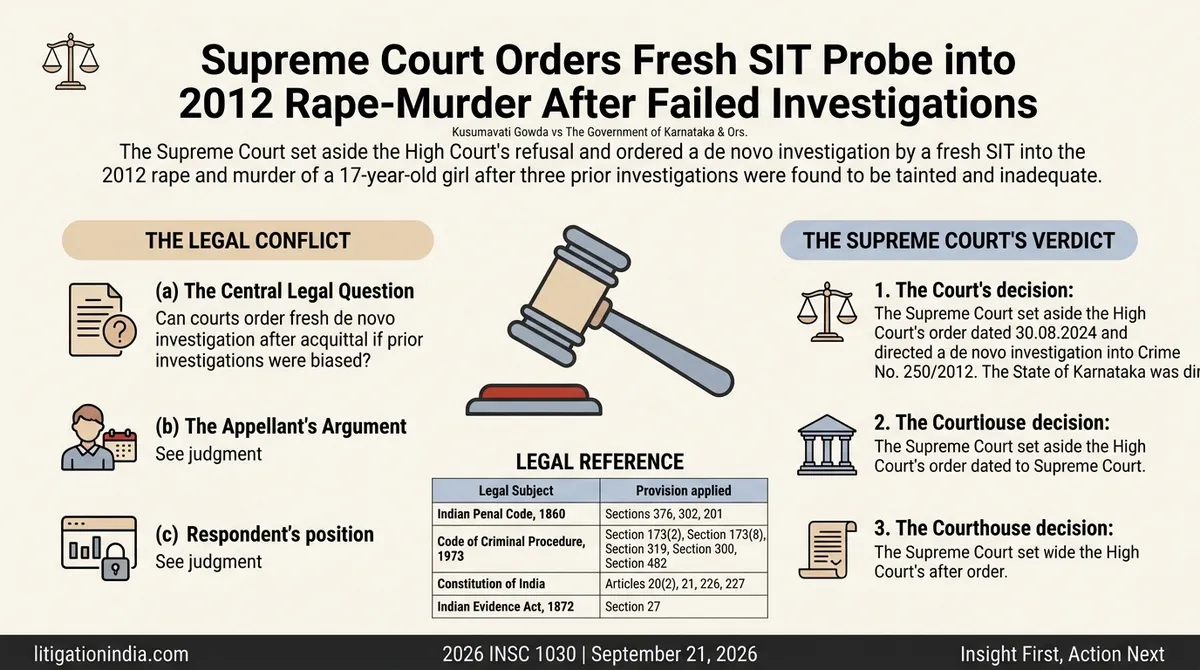
Supreme Court Orders Fresh SIT Probe into 2012 Rape-Murder After Failed Investigations — infographic summary

What this case means

A 17-year-old girl was brutally raped and murdered in 2012 in Karnataka. Despite three investigations by local police, CID, and CBI, the accused Santhosh Rao was acquitted due to shoddy investigation, and the real perpetrators were never identified. The Supreme Court ordered a fresh de novo investigation by a newly constituted SIT, holding that fair investigation is a constitutional right under Article 21.

What the Supreme Court held

The Supreme Court set aside the High Court's order dated 30.08.2024 and directed a de novo investigation into Crime No. 250/2012. The State of Karnataka was directed to constitute a fresh SIT of efficient investigators headed by a senior police officer, with no officer from the earlier investigations to be included. The investigation must be completed within three months and Santhosh Rao, being acquitted, cannot be subjected to further investigation or prosecution.

Case: Kusumavati Gowda vs The Government of Karnataka & Ors. (2026) Citation: 2026 INSC 1030

Want the full legal reasoning, citations and case documents?

Read the full judgment analysis
Kusumavati Gowda
Government of Karnataka
de novo investigation
rape and murder
Special Investigation Team
CBI investigation
Article 21
fair investigation
Belthangady
reinvestigation
2026 INSC 1030
Section 173 CrPC
Sections 376, 302, 201, Indian Penal Code, 1860
Section 173(2), Section 173(8), Section 319, Section 300, Section 482, Code of Criminal Procedure, 1973