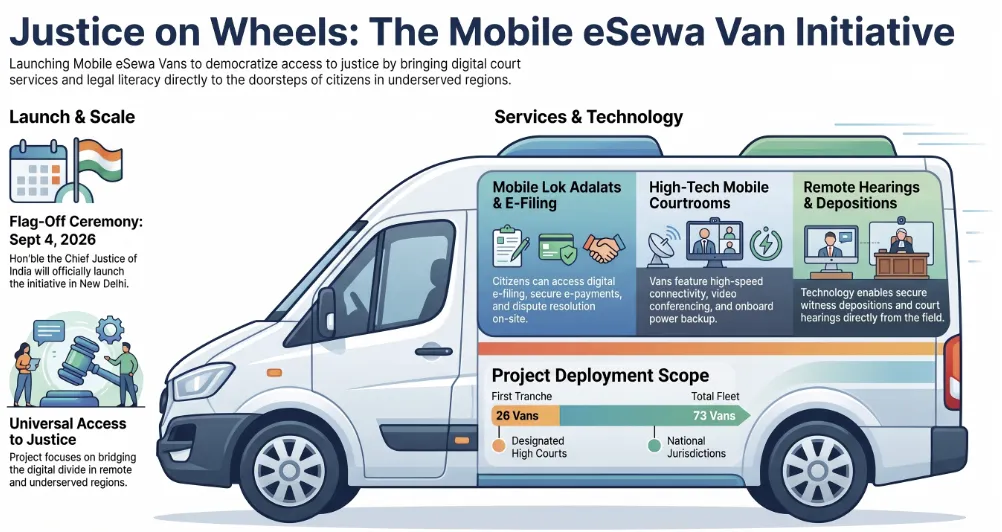
The Supreme Court of India has launched the Mobile eSewa Van initiative as an extension of the eCourts Project, alignment with the National Policy and Action Plan for Implementation of Information and Communication Technology in the Indian Judiciary (2005) . Designed to bridge the digital divide, the initiative brings court services, legal literacy, and dispute resolution directly to citizens in remote areas . Key Features and Reach of Mobile eSewa Vans The flagship initiative expands technology-driven legal services into underserved jurisdictions across India . Fleet Deployment: The ceremony launched 26 Mobile eSewa Vans from the Supreme Court, serving as the first tranche of a 73-van fleet to be deployed across High Courts and District Courts nationwide . Onboard Technology: Each van is fitted with high-speed connectivity, video conferencing equipment, and onboard power backup . Comprehensive Services: Facilities include digital e-filing, secure e-payments, Mobile Lok Adalats, legal literacy programs, and remote hearing or witness deposition capabilities from the field . Institutional Leadership and Dignitaries The flag-off ceremony was led by key judicial leaders and executive representatives . Judicial Flag-Off: Hon’ble the Chief Justice of India and Hon’ble Mr. Justice Surya Kant (Patron-in-Chief, eCommittee) flagged off the fleet . Key Leadership Present: Attended by Hon’ble Mr. Justice Vikram Nath (Chairman, eCommittee), Shri Arjun Ram Meghwal (Minister of State, Ministry of Law and Justice), and Hon’ble Mr. Justice Anjani Kumar Mishra (Vice Chairman, eCommittee) . Inter-Agency Support: Attended by Supreme Court Judges, senior officials from the Department of Justice, NALSA, Ministry of Home Affairs, MeitY, NIC, the Attorney General, Solicitor General, and the Bar Council of India . "The Mobile eSewa Van initiative is conceived as an extension of the eCourts Project... designed to bring eCourts services, legal aid and dispute resolution directly to citizens’ doorsteps, bridging the digital divide and ensuring universal access to justice." The initiative reflects the judiciary's ongoing commitment to leveraging technology to enhance efficiency, transparency, and accessibility in justice delivery