Supreme Court Junior Court Assistant Recruitment 2026: Official Notification, 250 Vacancies, Eligibility & Exam Scheme;
- Recruitment Overview & Core Value Proposition
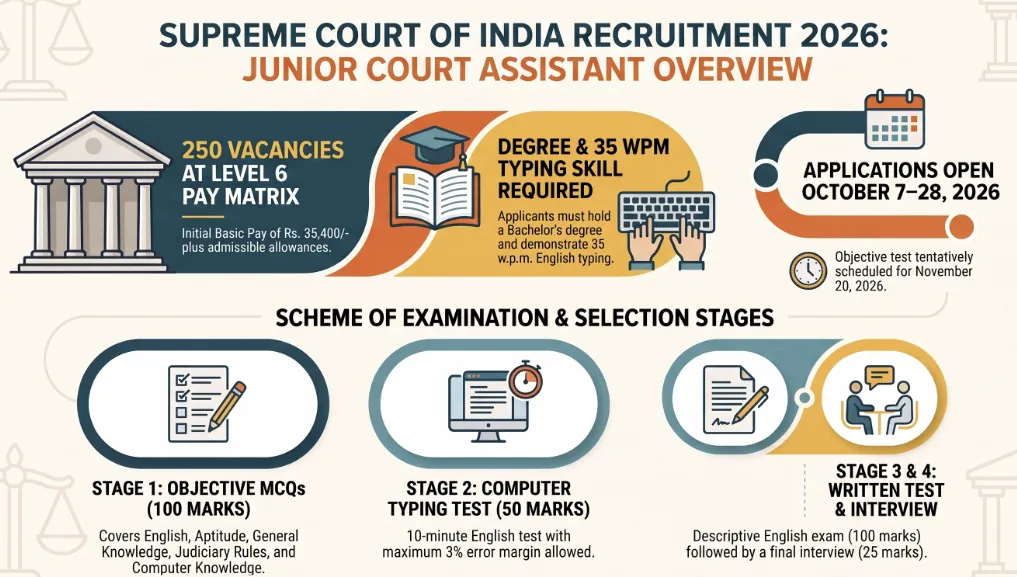
The Registry of the Supreme Court of India has officially released Advertisement No. F.6/2026-SC (RC) (dated September 30, 2026), inviting online applications from eligible Indian citizens to build a selection panel for filling 250 tentative vacancies for the post of Junior Court Assistant. Classified as a Group-B Non-Gazetted post, this selection drive offers a premier opportunity for ambitious individuals seeking an impactful career within the apex judicial institution of the country.
📌 At-a-Glance Summary
- Post Title: Junior Court Assistant (Group-B, Non-Gazetted)
- Tentative Vacancies: 250 posts (The Registry reserves the right to cancel, restrict, enlarge, modify, or alter the selection process and vacancy count based on administrative exigencies)
- Pay Level: Level 6 of the Pay Matrix
- Initial Basic Pay: Rs. 35,400/- per month (plus applicable government allowances)
- Cut-off Date for Eligibility: September 1, 2026
- Official Portal: www.sci.gov.in
Why This Opportunity Matters
Securing a Group-B appointment within the Supreme Court Registry is a landmark career achievement. Beyond the competitive remuneration starting at an initial basic pay of Rs. 35,400/- under Pay Level 6 (plus admissible central allowances), serving in the highest court of the land provides unparalleled professional prestige, administrative stability, and deep operational insight into the Indian judicial framework.
Before initiating the application process, candidates must systematically verify their eligibility parameters against the official benchmarks detailed below.
- Eligibility Criteria, Age Limits & Relaxations
All academic, technical, and age requirements are assessed strictly as of the official cutoff date: 1st September, 2026.
Mandatory Educational & Technical Qualifications
- Academic Degree: Bachelor’s degree from a recognized University in India.
- Technical Proficiency: Essential knowledge of computer operations with a required typing speed of 35 words per minute (w.p.m.) on a computer.
Age Profile & Category Relaxations
Candidates must be at least 18 years of age and must not have crossed 30 years of age as of September 1, 2026. Age relaxations apply strictly according to category designations:
Candidate Category Age Limit / Relaxation Parameters (as of Sept 1, 2026) General / Unreserved Minimum 18 years; Maximum 30 years. SC / ST / OBC (Non-Creamy Layer) / Physically Challenged / Ex-Servicemen Standard upper age relaxation admissible as per Government of India Rules. Dependents of Freedom Fighters Relaxation up to a maximum of 5 years over the 30-year limit. Departmental Candidates (Supreme Court Registry) No upper age limit. Other Govt. / PSU / Nationalized Bank Employees No age relaxation admissible.
Statutory Reservation Framework
The statutory benefits of reservation for eligible categories will be administered strictly in accordance with Rule 4A of the Supreme Court Officers and Servants (Conditions of Service and Conduct) Rules, 1961.
Crucial Mandatory Compliance for Employed Candidates
- No Objection Certificate (NOC): Candidates currently employed in Central/State Government Departments, Public Sector Undertakings (PSUs), or Nationalized Banks do not qualify for age relaxations and must submit a formal 'No Objection Certificate' from their employer during document verification.
- Immediate Intimation of Employment Changes: Any candidate who was unemployed during initial application submission but obtains employment in a Government/PSU/Bank setting during or after the examination process must immediately inform the Branch Officer, Recruitment Cell via email (recruitment.cell@sci.nic.in). Failure to do so will lead to adverse inference by the Registry.
- The 4-Stage Examination Scheme & Selection Methodology
Selection to the post of Junior Court Assistant comprises a comprehensive 4-stage evaluation designed to test objective domain knowledge, technical typing efficiency, descriptive writing capability, and personal suitability.
Comprehensive Examination Scheme
Stage / Test Subject / Details Duration Max Marks Minimum Qualifying Marks Stage 1: Objective Type Test 100 Multiple Choice Questions covering:<br>• General English (incl. comprehension): 20 Qs<br>• General Aptitude: 15 Qs<br>• General Knowledge: 15 Qs<br>• Judiciary Provisions in Constitution of India: 15 Qs<br>• Supreme Court Rules, 2013: 10 Qs<br>• SC Officers & Servants Rules, 1961: 10 Qs<br>• Computer Knowledge: 15 Qs 1 ½ Hours<br>(90 Mins) 100 50 Stage 2: Computer Typing Speed Test Typing Speed Test on Computer in English Language<br>• Required Speed: Min 35 w.p.m.<br>• Allowed Error Margin: Max 3% of total words typed 10 Minutes 50 25 Stage 3: Written Test (Descriptive) English Language Test comprising:<br>• Comprehension Passage<br>• Precis Writing<br>• Essay Writing 2 Hours 100 50 Stage 4: Personal Interview Interview before the Selection Board N/A 25 13
Strategic Pedagogical Insight: Target the Judicial Modules
Candidates should note that the specialized legal and administrative sections in Stage 1—Provisions relating to Judiciary in the Constitution of India (15 Qs), Supreme Court Rules, 2013 (10 Qs), and Supreme Court Officers & Servants Rules, 1961 (10 Qs)—account for 35 out of 100 marks (35% of Stage 1). Mastering these domain-specific legal subjects provides a decisive competitive edge over candidates focusing solely on standard general aptitude topics.
Critical Examination Rules & Shortlisting Logic
- Negative Marking Penalty: Stage 1 carries a deduction of 0.25 marks for every incorrect objective answer.
- Shortlisting for Stage 2 & Stage 3 (1:10 Ratio): Among candidates scoring \ge 50 marks in Stage 1, shortlisting for Stage 2 (Typing) and Stage 3 (Descriptive) will be made in a 1:10 ratio against the total tentative vacancies based on objective merit.
- Conditional Evaluation Rule for Descriptive Answer Sheets: Answer sheets for Stage 3 (Written Descriptive Test) will only be evaluated if the candidate successfully qualifies Stage 2 (Computer Typing Speed Test). Achieving a typing speed of 35 w.p.m. within the 3% error threshold is mandatory.
- Shortlisting for Personal Interview (1:3 Ratio): Shortlisting for Stage 4 (Interview) will be conducted in a 1:3 ratio against tentative vacancies, restricted to candidates who successfully clear Stage 1, Stage 2, and Stage 3.
- Typing Error Assessment Criteria:
Full Mistake: Any error in typing an entire word or numerical figure. Half Mistake: Swapping capital letters for small letters (or vice versa), or omitting, adding, or substituting punctuation marks.
- Important Dates, Application Fees & Exam Centers
With the multi-stage evaluation framework clearly mapped, candidates must align their preparation with the official administrative timeline, fee structures, and testing center logistics detailed below.
Recruitment Timeline Summary
Administrative Event / Milestone Scheduled Date / Deadline Online Registration Window Opens 7th October, 2026 Last Date for Form Submission & Fee Payment 28th October, 2026 (up to 11:55 p.m.) Tentative Objective Exam Date (Stage 1) 20th November, 2026 Answer Key Upload Date 22nd November, 2026 Answer Key Objection Window 22nd Nov 2026 to 23rd Nov 2026 (up to 11:55 p.m.)
Non-Refundable Fee Structure
- General / Unreserved Candidates: Rs. 1,500/- (plus applicable bank charges).
- SC / ST / OBC (NCL) / Ex-Servicemen / Physically Challenged: Rs. 750/- (plus applicable bank charges).
- Payment Mode: Payment must be executed strictly online via the official payment gateway provided by UCO Bank. No postal orders, drafts, or cash submissions will be accepted.
Answer Key Challenge Protocol
Following the Objective Test on November 20, official answer keys will be published on 22nd November, 2026. Objections can be submitted online through 23rd November, 2026 (11:55 p.m.) accompanied by a fee of Rs. 100/- per challenged question. This fee is fully refunded if the objection is validated by the competent authority.
Exam Center Allocation Rules & Jurisdiction
- Objective Test Locations: Conducted across 131 designated test cities spanning all States and Union Territories (as listed in Annexure-A). Candidates must select city choices in order of preference. The Registry reserves the right to alter center allocations or shift candidates due to administrative reasons.
- Typing & Descriptive Test Locations: Conducted exclusively in Delhi/NCR.
- Interview Location: Conducted either physically in Delhi or via online mode, as determined by the competent Authority.
- No TA/DA: No Travelling Allowance or Daily Allowance is payable for attending any stage of the test or interview.
- Legal Jurisdiction Clause: Pursuant to Paragraph 25 of the official advertisement, the legal jurisdiction for any dispute arising out of this recruitment process rests strictly in Delhi.
- Step-by-Step Online Application Process & Critical Compliance Directives
To avoid summary rejection, candidates must complete the online application process on the Supreme Court portal with meticulous precision.
Step-by-Step Application Blueprint
- Portal Access: Visit the official website (www.sci.gov.in) and click on the Recruitment portal link.
- Personal Profile Registration: Enter core demographic data matching your Class X / High School Certificate exactly (Full Candidate Name, Father's Name, Mother's Name, and Date of Birth).
- Document Scans Upload: Upload sharp, clear scanned copies of:
Recent passport-size photograph and official signature. Class X Certificate, Class XII Certificate, and Graduation Degree Certificate. * Caste/Community Certificate and Disability Certificate (where applicable).
- Online Fee Payment: Complete the payment transaction via the integrated UCO Bank gateway.
- Form Review & Final Submission: Utilize the preview option to verify every data field. Once submitted, forms cannot be edited, modified, or withdrawn.
- Record Retention: Save and print the completed Application Form. Do not send hard copies by post to the Registry. Securely record your generated Application Number for downloading Admit Cards.
⚠️ Critical Rejection Pitfalls & Administrative Directives
- Multiple Form Submissions: If a candidate submits more than one application, only the form carrying the latest Application Number submitted prior to the closing deadline will be evaluated.
- Name Discrepancies: Any variation in name or surname between submitted certificates and identity documents must be formally supported by an official Gazette Notification.
- Binding Entries: No post-submission requests for changing selected categories, test cities, or examination dates will be entertained.
- Communication Credentials: Candidates must maintain an active personal Email ID and Mobile Number, as updates, exam alerts, and admit card notifications will be issued exclusively via SMS and email.
- Scribe Provisions for Persons with Benchmark Disabilities (PwD): Concessions and facilities for PwD candidates are governed by Ministry of Social Justice and Empowerment (Department of Empowerment of Persons with Disabilities) Office Memorandum No. F.No.P-13013/75/2023-Policy-DD-III dated 1st August, 2025.
Candidates with physical limitations that hamper writing/typing must submit Annexure-I. Candidates with specified disabilities covered under Section 2(s) of the RPwD Act, 2016 (having less than 40% disability but experiencing difficulty in writing) must submit Annexure-IA. * The qualification of an arranged scribe must be a minimum of 2 academic years below and a maximum of 3 academic years below the minimum entry qualification of the examination. An "own scribe" cannot be a co-candidate for the examination, nor can a scribe assist more than one candidate. Compensatory time will be granted to eligible PwD candidates as admissible under rules.