
Story
What this case means
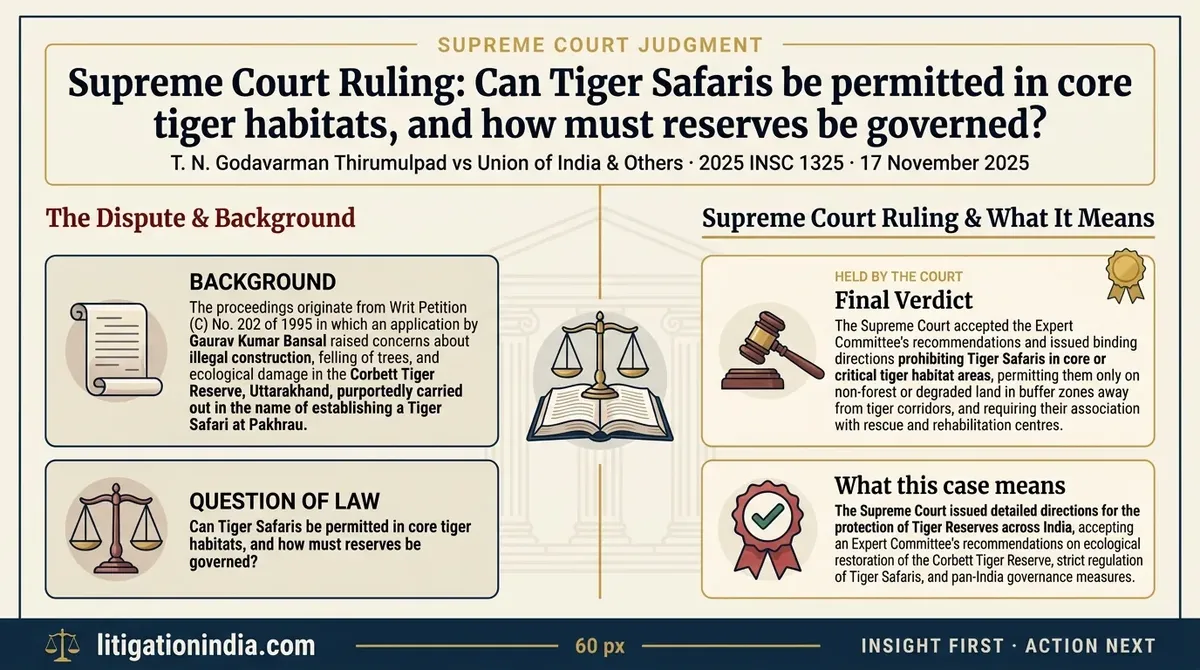
The Supreme Court issued detailed directions for the protection of Tiger Reserves across India, accepting an Expert Committee's recommendations on ecological restoration of the Corbett Tiger Reserve, strict regulation of Tiger Safaris, and pan-India governance measures. Tiger Safaris were prohibited in core tiger habitats and restricted to non-forest or degraded land in buffer zones, away from tiger corridors. The judgment matters because it sets binding national standards for tiger conservation, forest staff welfare, eco-sensitive zone notification, and accountability for ecological damage.
What the Supreme Court held
The Supreme Court accepted the Expert Committee's recommendations and issued binding directions prohibiting Tiger Safaris in core or critical tiger habitat areas, permitting them only on non-forest or degraded land in buffer zones away from tiger corridors, and requiring their association with rescue and rehabilitation centres. The State of Uttarakhand was directed to restore the Corbett Tiger Reserve under CEC supervision, and the CBI chargesheet against eight officials was noted as bringing the matter to its logical end. All States were given time-bound directions to notify Eco-Sensitive Zones, prepare Tiger Conservation Plans, declare Tiger Reserves as Silence Zones, fill staff vacancies, and implement pan-India welfare and governance reforms for Tiger Reserves.
Case: T. N. Godavarman Thirumulpad vs Union of India & Others (2025) Citation: 2025 INSC 1325
Want the full legal reasoning, citations and case documents?
Read the full judgment analysis