
All insights

Does the State's duty to bonded labourers end at rescue, or extend to rehabilitation?

Supreme Court Issues Binding Directions for Timely Rehabilitation of Bonded Labourers

A bonded labour survivor from Bihar petitioned the Supreme Court after rescued labourers waited years for rehabilitation money. The Court held that release alone does not fulfil the State's constituti

Litigation India Editorial 2 November 2026 1 min read 2026 INSC 1185

Story

Case at a glance1 / 6

Supreme Court of India

Rescue Is Not Enough: Bonded Labour Rehabilitation Must Be Timely

Surendra Manjhi & Anr. v. Union of India & Ors. — 2026 INSC 1185

Court: Supreme Court of India; Date: 02 November 2026Bench: Justice Vikram Nath and Justice Aparesh Kumar SinghArea of Law: Constitutional Law, Bonded Labour, Fundamental RightsPetitioner rescued in 2019 received rehabilitation money only in 2022; 17 labourers still unpaid
Rehabilitation delayed may, in substance, amount to rehabilitation denied.
Supreme Court Issues Binding Directions for Timely Rehabilitation of Bonded Labourers · 2026 INSC 11852026-11-02T14:12:50.967008+00:00
The legal question2 / 6

Does the State's Duty End at Rescue, or Continue Through Rehabilitation?

Core legal question decided by the Court

  • Appellant: Rescue without timely financial assistance forces labourers back into exploitation due to economic necessity.
  • Appellant: Delays of years in paying Rs. 20,000 and non-payment to 17 labourers show systemic failure.
  • Respondent: A revised SOP dated 14.05.2026 and NAVJIVAN Portal reflect ongoing remedial steps.
  • Respondent: Union of India expressed willingness to revise the Rehabilitation Scheme including enhancement of assistance.
The obligation of the State extends beyond securing physical liberty to ensuring liberty is meaningful and dignified.
Supreme Court Issues Binding Directions for Timely Rehabilitation of Bonded Labourers · 2026 INSC 11852026-11-02T14:12:50.967008+00:00
Statutory comparison3 / 6

Key Statutory Provisions and How the Court Applied Them

Bonded Labour System (Abolition) Act, 1976 and the Constitution

ProvisionWhat it providesHow the Court applied it
Article 23, ConstitutionProhibits trafficking and forced labourHeld to impose positive duty on State to rehabilitate, not merely release, bonded labourers
Article 21, ConstitutionGuarantees life and personal liberty with dignityRead with Article 23 to require meaningful, enduring freedom backed by rehabilitation
Section 4, BLS(A) Act 1976Abolishes bonded labour system; releases every bonded labourerDirected that release be followed by immediate financial assistance within 7 days of release certificate
Sections 13-14, BLS(A) Act 1976Constitution and functions of Vigilance CommitteesDirected all States to ensure Vigilance Committees are duly constituted and functioning
Supreme Court Issues Binding Directions for Timely Rehabilitation of Bonded Labourers · 2026 INSC 11852026-11-02T14:12:50.967008+00:00
The Court's reasoning4 / 6

Court's Reasoning: From Rescue to Enforceable Rehabilitation

Step-by-step legal logic of the judgment

  1. 1Step 1: Articles 21 and 23 impose a positive State duty — not just prohibit bondage but ensure dignified rehabilitation.
  2. 2Step 2: Bandhua Mukti Morcha (1984) and Neeraja Chaudhary (1984) confirm identification, release and rehabilitation are one continuing obligation.
  3. 3Step 3: Facts show systemic failure — 3-year delay for the petitioner, 17 labourers still unpaid despite rescue in 2019.
  4. 4Step 4: Rehabilitation assistance is independent of criminal proceedings; it must not be withheld pending investigation.
  5. 5Step 5: Uniform national SOP, 7-day disbursement rule, inter-State nodal officers and digital monitoring are constitutionally necessary.
Supreme Court Issues Binding Directions for Timely Rehabilitation of Bonded Labourers · 2026 INSC 11852026-11-02T14:12:50.967008+00:00
The verdict5 / 6

The Court's Final Directions

Operative order issued in Writ Petition (Civil) No. 511 of 2022

  • The Fact: Rescued bonded labourers including the petitioner and 17 others waited years for legally mandated financial assistance due to inter-State administrative failures.
  • The Law: Articles 21 and 23, Constitution; Sections 4, 13-14, Bonded Labour System (Abolition) Act, 1976; Central Rehabilitation Scheme — all impose continuing obligations on the State.
  • The Result: Binding national directions issued for 7-day disbursement, 6-month SOP implementation, nodal officers, monthly monitoring and specific payment to 17 unpaid labourers.
Financial assistance shall be disbursed within seven days of the release certificate; it shall not be withheld because criminal proceedings are pending.
Supreme Court Issues Binding Directions for Timely Rehabilitation of Bonded Labourers · 2026 INSC 11852026-11-02T14:12:50.967008+00:00
Why it matters6 / 6

What This Means for Ordinary People

Practical significance of the judgment

  • Any rescued bonded labourer is legally entitled to Rs. 20,000 immediate assistance within 7 days of receiving a release certificate.
  • Authorities cannot deny assistance because a police investigation or court case is still going on.
  • If rescued in another State, the labourer cannot be deprived of benefits due to administrative disputes between States.
  • Grievances about delayed assistance must be resolved within 30 days by a designated district officer, and all cases are monitored digitally on the NAVJIVAN Portal.
Rescue without rehabilitation is not enough — the State must ensure every freed bonded labourer can actually live a life of dignity.
Supreme Court Issues Binding Directions for Timely Rehabilitation of Bonded Labourers · 2026 INSC 11852026-11-02T14:12:50.967008+00:00
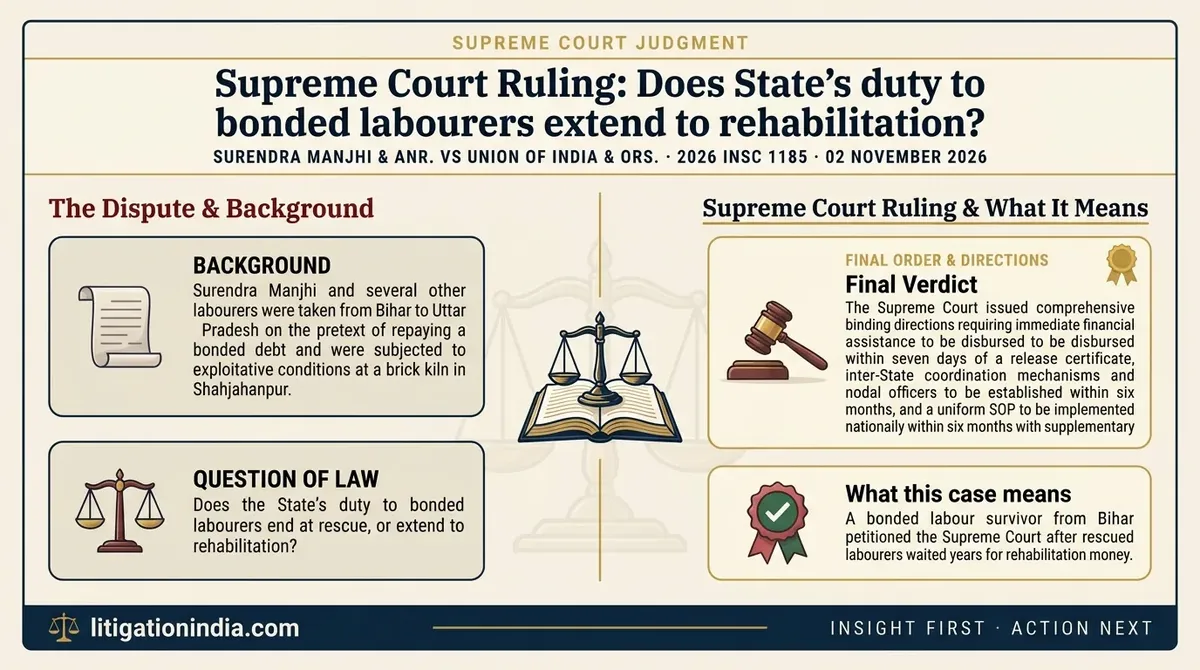
Supreme Court Issues Binding Directions for Timely Rehabilitation of Bonded Labourers — infographic summary

What this case means

A bonded labour survivor from Bihar petitioned the Supreme Court after rescued labourers waited years for rehabilitation money. The Court held that release alone does not fulfil the State's constitutional duty and issued detailed directions on timelines for financial assistance, inter-State coordination and digital monitoring. The judgment establishes that rehabilitation delayed is rehabilitation denied.

What the Supreme Court held

The Supreme Court issued comprehensive binding directions requiring immediate financial assistance to be disbursed within seven days of a release certificate, inter-State coordination mechanisms and nodal officers to be established within six months, and a uniform SOP to be implemented nationally within six months with supplementary guidelines issued within three months in consultation with the NHRC. The States of Uttar Pradesh and Bihar were directed to jointly verify and disburse outstanding payments to the 17 unpaid labourers within six months. Both writ petitions were retained pending before the Court for continued monitoring of compliance.

Case: Surendra Manjhi & Anr. vs Union of India & Ors. (2026) Citation: 2026 INSC 1185

Want the full legal reasoning, citations and case documents?

Read the full judgment analysis
bonded labour
Surendra Manjhi
Union of India
Bonded Labour System Abolition Act 1976
rehabilitation
Article 23
Article 21
inter-State coordination
NAVJIVAN Portal
Vigilance Committees
immediate financial assistance
forced labour
Article 21, Article 23, Article 24, Article 32, Constitution of India
Sections 4, 5, 6, 10, 11, 12, 13, 14, Bonded Labour System (Abolition) Act, 1976