All insights

Can a statutory remission policy override an earlier constitutional one?

Supreme Court holds Haryana's 2002 remission policy is constitutional, cannot be superseded by 2008 statutory policy

The Supreme Court ruled that Haryana's 2002 policy for early release of life convicts is based on the Governor's constitutional power (Article 161) and was not replaced by the 2008 policy, which is ba

Litigation India Editorial 12 September 2026 1 min read 2026 INSC 667

Story

Case at a glance1 / 6

Supreme Court of India

Remission Policies: Constitution vs. Statute

PARVEEN KUMAR vs STATE OF HARYANA & ORS. (2026 INSC 667)

Court: Supreme Court of IndiaDate of Decision: July 1, 2026Bench: Justice Sanjay Karol, Justice Nongmeikapam Kotiswar SinghArea of Law: Criminal Law / Constitutional Law
Supreme Court holds Haryana's 2002 remission policy is constitutional, cannot be superseded by 2008 statutory policy · 2026 INSC 6672026-09-12T13:18:01.582463+00:00
The legal question2 / 6

Which Remission Policy Applies?

The 2002 Constitutional Policy vs. the 2008 Statutory Policy

  • Appellant's Argument: The 2002 policy, derived from Article 161, is constitutional and cannot be taken away by a later statutory policy.
  • State's Argument: The 2008 policy supersedes all earlier policies. The policy on the date of conviction is what matters.
  • Legal Conflict: A 3-judge bench (Jagdish) saw such policies as constitutional, while a 2-judge bench (Raj Kumar) saw them as statutory.
Supreme Court holds Haryana's 2002 remission policy is constitutional, cannot be superseded by 2008 statutory policy · 2026 INSC 6672026-09-12T13:18:01.582463+00:00
Statutory comparison3 / 6

Comparing the Policies

Feature2002 Policy2008 Policy
Source of PowerImplied to be Article 161 (requires orders from Governor).Explicitly stated as Section 432 & 433 CrPC.
Final AuthorityGovernor of Haryana.Chief Minister of Haryana.
NatureHeld to be Constitutional by this judgment.Statutory.
Supreme Court holds Haryana's 2002 remission policy is constitutional, cannot be superseded by 2008 statutory policy · 2026 INSC 6672026-09-12T13:18:01.582463+00:00
The Court's reasoning4 / 6

The Court's Reasoning

  1. 1The Court compared the 2002 policy with the 1993 policy discussed in 'Jagdish' and found them identical in their constitutional basis (reliance on Governor's power).
  2. 2It concluded the 2002 policy must therefore be constitutional.
  3. 3As a constitutional policy, it cannot be superseded by the 2008 policy, which is merely statutory (based on CrPC).
  4. 4The 'Raj Kumar' judgment, which held otherwise, was declared per incuriam for failing to follow the larger bench principle in 'Jagdish'.
  5. 5Therefore, the appellant is eligible to be considered under the more liberal 2002 policy.
Supreme Court holds Haryana's 2002 remission policy is constitutional, cannot be superseded by 2008 statutory policy · 2026 INSC 6672026-09-12T13:18:01.582463+00:00
The verdict5 / 6

The Verdict

  • The Fact: A life convict was denied remission under the 2002 policy on the ground that the 2008 policy applied.
  • The Law: A constitutional policy (2002) under Article 161 cannot be superseded by a statutory policy (2008) under the CrPC.
  • The Result: The appeal was allowed. The State must reconsider the appellant's case for premature release under the 2002 policy.
The State shall take a decision regarding the remission application of the appellant consistent with this judgment within four weeks.
Supreme Court holds Haryana's 2002 remission policy is constitutional, cannot be superseded by 2008 statutory policy · 2026 INSC 6672026-09-12T13:18:01.582463+00:00
Why it matters6 / 6

Key Takeaways

  • Policies based on the Governor's constitutional powers are superior to those made under ordinary statutes.
  • A later law or policy does not automatically override an earlier one if the earlier one is based on a higher source of power.
  • This decision ensures that benefits granted under older, potentially more liberal constitutional policies remain available to eligible convicts.
  • It reinforces the principle of judicial discipline, where smaller benches must follow the law laid down by larger benches.
Power exercised under Article 161 of the Constitution is a mandate of the Constitution.
Supreme Court holds Haryana's 2002 remission policy is constitutional, cannot be superseded by 2008 statutory policy · 2026 INSC 6672026-09-12T13:18:01.582463+00:00
Litigation India Legal Explainer

Remission Policies: Constitution Over Statute

The Supreme Court holds Haryana's 2002 remission policy, based on the Governor's constitutional power, prevails over the later 2008 statutory policy.

Supreme Court holds Haryana's 2002 remission policy is constitutional, cannot be superseded by 2008 statutory policy

The Legal Conflict

The Central Legal Question

Can a statutory remission policy (like Haryana's 2008 policy under CrPC) supersede an earlier policy based on constitutional power (the 2002 policy under Article 161)?

Appellant's Argument

The 2002 policy is constitutional and more beneficial, and it cannot be overridden by a later statutory policy.

What is Per Incuriam?

A legal term for a court judgment that has been decided without reference to a statutory provision or a previous judgment that would have been relevant.

The Supreme Court's Verdict

2002 Policy is Constitutional

Like the 1993 policy, the 2002 policy is an exercise of the Governor's power under Article 161 of the Constitution.

Constitution Prevails

A statutory policy (2008, under CrPC) cannot override a policy framed under a distinct and independent constitutional power (2002, under Art. 161).

Precedent Clarified

The Court held that the 'Raj Kumar' (2021) judgment was per incuriam as it contradicted the larger bench's reasoning in 'Jagdish' (2010).

Legal Reference

Legal SubjectProvision Applied
Governor's Pardoning PowerArticle 161, Constitution
Govt's Remission PowerSection 432 CrPC
litigationindia.com2026 INSC 667 · 2026-09-12T13:18:01.582463+00:00Insight First, Action Next

What this case means

The Supreme Court ruled that Haryana's 2002 policy for early release of life convicts is based on the Governor's constitutional power (Article 161) and was not replaced by the 2008 policy, which is based on a statute (CrPC). Therefore, eligible convicts can still seek benefits under the more liberal 2002 policy.

What the Supreme Court held

The Supreme Court allowed the appeal, ruling that the 2002 policy is constitutional and cannot be overridden by the 2008 statutory policy. The Court declared a previous co-ordinate bench judgment to the contrary as per incuriam. The State was directed to decide the appellant's remission application under the 2002 policy within four weeks.

Case: PARVEEN KUMAR@ PARVEEN CHAUHAN vs STATE OF HARYANA & ORS. (2026) Citation: 2026 INSC 667

Want the full legal reasoning, citations and case documents?

Read the full judgment analysis
Parveen Kumar
State of Haryana
Remission Policy
Premature Release
Article 161
Section 432 CrPC
2002 Policy
2008 Policy
State of Haryana v. Jagdish
State of Haryana v. Raj Kumar
Per Incuriam
Article 161, The Constitution of India
432, 433, Code of Criminal Procedure, 1973
Criminal Law / Constitutional Law

More in Criminal Law / Constitutional Law

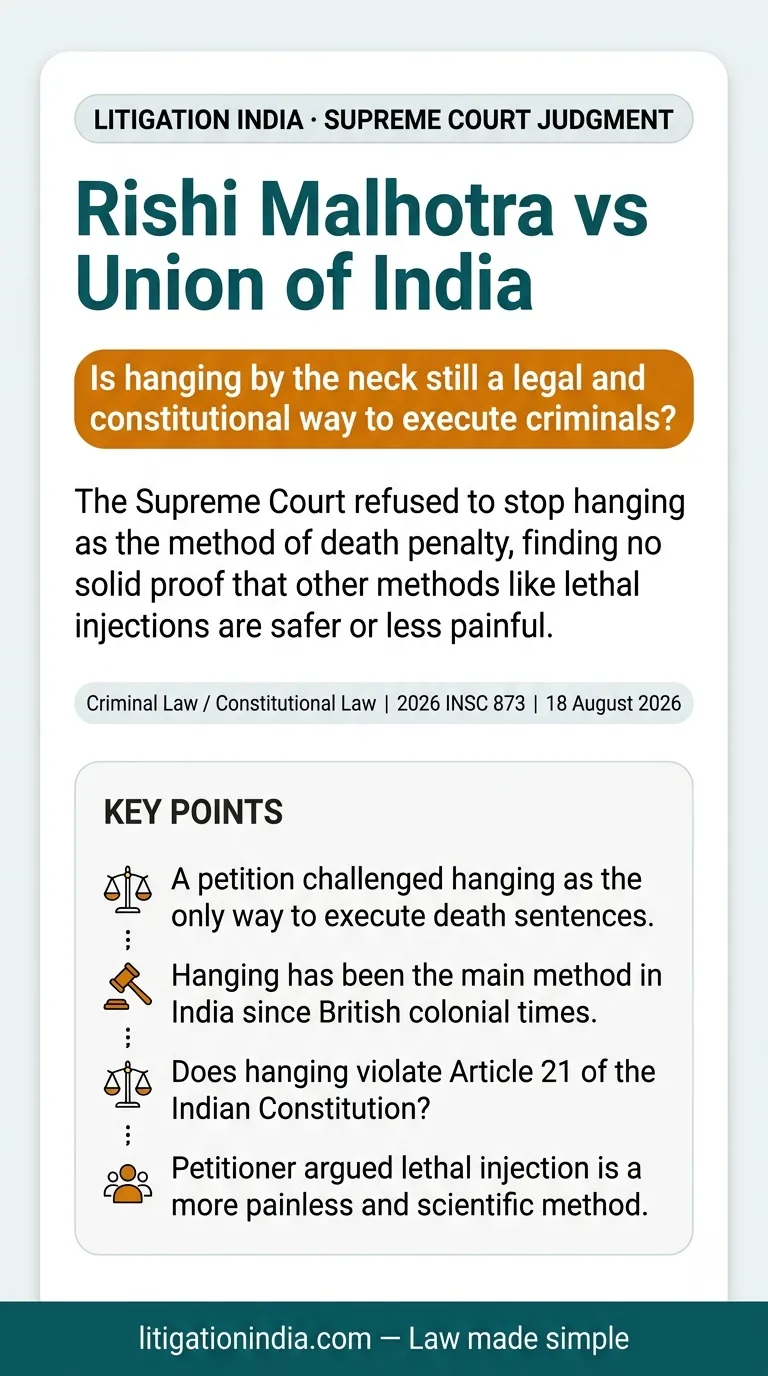
Rishi Malhotra vs Union of India
Criminal Law / Constitutional Law
18 Aug 2026

Rishi Malhotra vs Union of India

The Supreme Court refused to stop hanging as the method of death penalty, finding no solid proof that other methods like lethal injections are safer or less painful.