
All insights

Does the 24-hour arrest rule begin from detention or formal arrest?

Supreme Court Holds 24-Hour Constitutional Deadline Runs From Detention, Not Formal Arrest

Three persons arrested under the NDPS Act for smuggling Yaba tablets challenged their detention, arguing they were held by officers for over 24 hours before being produced before a magistrate. The Sup

Litigation India Editorial 15 November 2026 1 min read 2026 INSC 1195

Story

Case at a glance1 / 6

Supreme Court of India

24-Hour Rule: Liberty Curtailed = Arrest Begins

Sri Sujit Das and Ors. vs Union of India | 2026 INSC 1195

Court: Supreme Court of India | Date: November 05, 2026Bench: Justice Ujjal Bhuyan and Justice Atul S. ChandurkarNDPS accused held beyond 24 hours before magistrate production; Article 22(2) breach foundArea of law: Constitutional Law / Fundamental Rights / Criminal Law / Bail
Supreme Court Holds 24-Hour Constitutional Deadline Runs From Detention, Not Formal Arrest · 2026 INSC 11952026-11-15T16:36:21.968272+00:00
The legal question2 / 6

When does the 24-hour constitutional clock start?

Core dispute: detention at 2:00 pm on 29.09.2025 vs formal arrest at 11:00 am on 30.09.2025

  • Appellant: Liberty was curtailed at 2:00 pm on 29.09.2025; production at 4:45 pm next day breaches Article 22(2).
  • Appellant: Distinction between detention and arrest is an artificial, unconstitutional circumvention of the 24-hour mandate.
  • Respondent: Formal arrest occurred at 11:00/11:15 am on 30.09.2025; production before magistrate at 4:45 pm was within 24 hours.
  • Respondent: Pre-arrest period was needed to complete mandatory NDPS Act and Rule 3 procedural formalities; no constitutional breach.
Supreme Court Holds 24-Hour Constitutional Deadline Runs From Detention, Not Formal Arrest · 2026 INSC 11952026-11-15T16:36:21.968272+00:00
Statutory comparison3 / 6

Detention vs Arrest: Correct vs Incorrect Interpretations

Supreme Court approved and disapproved High Court positions

Legal PositionApproved by Supreme CourtDisapproved by Supreme Court
24-hour clock startsFrom moment liberty is curtailed (Niranjan Singh; Ashak Hussain; Biswajit Mandal; T. Ramadevi)Only from formally recorded arrest (Aryaman Pattnayak; Kannan; Arun K. Thomas)
Detention vs Arrest distinctionNo such distinction; both words in Article 22(2) are conjunctive and synonymousDetention is investigatory/temporary; arrest is accusatory; buffer zone permissible
NDPS procedural formalitiesCannot suspend 24-hour constitutional mandate; production before magistrate then continue formalitiesPre-arrest procedural time under Section 42, 67 NDPS Act and Rule 3 excludable from 24 hours
Article 21 vs Section 37 NDPS ActArticle 21 overrides Section 37 when there is constitutional violation (K.A. Najeeb and others)Article 21 must be exercised within framework of Section 37 (Sukhwinder Singh — Court expressed reservations)
The Constitution does not permit any buffer zone where liberty is curtailed but the 24-hour clock is kept in abeyance.
Supreme Court Holds 24-Hour Constitutional Deadline Runs From Detention, Not Formal Arrest · 2026 INSC 11952026-11-15T16:36:21.968272+00:00
The Court's reasoning4 / 6

Court's Reasoning: From Facts to Constitutional Breach

  1. 1Step 1: At 2:00 pm on 29.09.2025, appellants were intercepted and their liberty was effectively curtailed — this constitutes arrest under Article 22(2).
  2. 2Step 2: Article 22(2) uses conjunctive 'arrested and detained'; the Constitution recognises no detention independent of arrest — both words are synonymous.
  3. 3Step 3: Only the journey time from place of arrest to court may be excluded from 24 hours; no other exclusion — including NDPS procedural formalities — is constitutionally permitted.
  4. 4Step 4: Appellants produced before magistrate at 4:45 pm on 30.09.2025 — more than 24 hours after liberty was curtailed — clear breach of Article 22(2).
  5. 5Step 5: Additional breach under Section 58 BNSS — 18-hour gap between seizure completion (5:00 pm 29.09.2025) and formal arrest (11:00 am 30.09.2025) with no explanation is unreasonable; bail ordered.
Supreme Court Holds 24-Hour Constitutional Deadline Runs From Detention, Not Formal Arrest · 2026 INSC 11952026-11-15T16:36:21.968272+00:00
The verdict5 / 6

The Court's Final Verdict

  • The Fact: Appellants' liberty was curtailed at 2:00 pm on 29.09.2025; they were produced before the magistrate at 4:45 pm on 30.09.2025 — over 24 hours later.
  • The Law: Article 22(2) mandates production within 24 hours from curtailment of liberty; Section 58 BNSS additionally requires detention to not exceed what is reasonable; both were breached.
  • The Result: High Court's order rejecting bail set aside; appellants to be produced before Special Court within 7 days and released on bail; judgment circulated to all DGPs and High Court Registrar Generals.
Appellants shall be produced before the Special Court within 7 days and released on bail on such terms as deemed appropriate.
Supreme Court Holds 24-Hour Constitutional Deadline Runs From Detention, Not Formal Arrest · 2026 INSC 11952026-11-15T16:36:21.968272+00:00
Why it matters6 / 6

What This Means for You

Practical significance of the judgment

  • Police or any agency cannot detain you for hours without judicial oversight by calling it 'investigation' and delaying formal arrest paperwork.
  • The moment an officer stops you and you are not free to leave, the 24-hour constitutional clock starts — regardless of what the officer labels it.
  • Even in serious NDPS drug cases, the constitutional right under Article 22(2) cannot be suspended by citing procedural requirements.
  • Magistrates must actively verify the actual time of curtailment of liberty and release detainees if the 24-hour rule is breached.
Your liberty is protected from the moment it is curtailed — not from when police paperwork says you were arrested.
Supreme Court Holds 24-Hour Constitutional Deadline Runs From Detention, Not Formal Arrest · 2026 INSC 11952026-11-15T16:36:21.968272+00:00
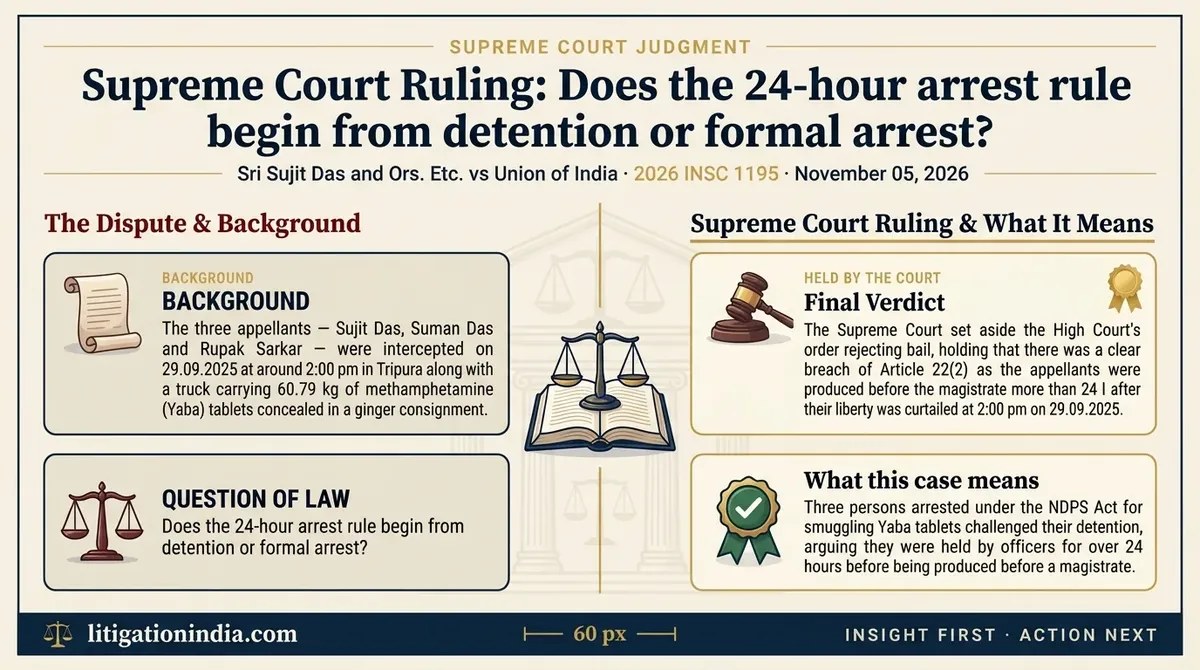
Supreme Court Holds 24-Hour Constitutional Deadline Runs From Detention, Not Formal Arrest — infographic summary

What this case means

Three persons arrested under the NDPS Act for smuggling Yaba tablets challenged their detention, arguing they were held by officers for over 24 hours before being produced before a magistrate. The Supreme Court held that the 24-hour deadline under Article 22(2) begins from the moment a person's liberty is curtailed by the detaining authority, not from the time of formal arrest. The Court found a clear constitutional breach and ordered the appellants' release on bail.

What the Supreme Court held

The Supreme Court set aside the High Court's order rejecting bail, holding that there was a clear breach of Article 22(2) as the appellants were produced before the magistrate more than 24 hours after their liberty was curtailed at 2:00 pm on 29.09.2025. The Court further found that the 18-hour gap between completion of search and seizure and formal arrest was unreasonable under Section 58 BNSS. The appellants were directed to be produced before the jurisdictional Special Court within 7 days and released on bail on such terms and conditions as deemed appropriate.

Case: Sri Sujit Das and Ors. Etc. vs Union of India (2026) Citation: 2026 INSC 1195

Want the full legal reasoning, citations and case documents?

Read the full judgment analysis
Sujit Das vs Union of India
NDPS Act bail
Article 22(2) Constitution
24 hours arrest rule
detention vs arrest
BNSS Section 58
CrPC Section 57
methamphetamine Yaba tablets
custodial rights
2026 INSC 1195
Article 22(2), Constitution of India
Article 21, Constitution of India
Sections 21(C), 22(C), 23(C), 25, 25A, 28, 29, 37, 42, 43, 50, 51, 67, Narcotic Drugs and Psychotropic Substances Act, 1985
Sections 36, 58, 187, Bharatiya Nagarik Suraksha Sanhita, 2023