
All insights

Can gravity of allegations alone justify denying bail when investigation is complete?

Supreme Court Grants Bail in Rajasthan Jal Jeevan Mission Tender Fraud Case

Two accused in a Rs. 979.45 crore public tender fraud involving forged certificates sought bail after the High Court rejected their applications. The Supreme Court granted bail, finding that the inves

Litigation India Editorial 16 October 2026 1 min read 2026 INSC 1141

Story

Case at a glance1 / 5

Supreme Court of India

Bail Granted in Rs. 979 Crore Jal Jeevan Mission Tender Fraud

Mahesh Chandra Joshi & Mukesh Pathak vs. State of Rajasthan | 2026 INSC 1141

Court: Supreme Court of India | Date: 16 October 2026Bench: Justice Dipankar Datta and Justice Sheel NaguArea of law: Criminal Law / BailFIR involved forged IRCON certificates used to win tenders worth Rs. 979.45 crore under Jal Jeevan Mission
Supreme Court Grants Bail in Rajasthan Jal Jeevan Mission Tender Fraud Case · 2026 INSC 11412026-10-16T13:37:57.609938+00:00
The legal question2 / 5

Can Gravity of Allegations Alone Deny Bail When Investigation Is Complete?

Core legal question decided by the Court

  • Appellant: Investigation complete, chargesheets filed, evidence already seized, prolonged custody unjustified.
  • Appellant: Already on bail in connected PMLA and CBI cases involving the same facts.
  • Respondent: Allegations are grave, large-scale public fraud, financial impropriety in a public welfare scheme.
  • Respondent: Institutional collusion warrants serious scrutiny and justifies opposing bail.
Supreme Court Grants Bail in Rajasthan Jal Jeevan Mission Tender Fraud Case · 2026 INSC 11412026-10-16T13:37:57.609938+00:00
The Court's reasoning3 / 5

Court's Reasoning: Why Bail Was Granted

Four-step analysis leading to the decision

  1. 1Step 1: Investigation complete — chargesheets filed, all documentary and electronic evidence already seized.
  2. 2Step 2: Both appellants already on bail in connected PMLA and CBI proceedings on the very same facts.
  3. 3Step 3: Trial unlikely to conclude soon — 22 accused, 124 witnesses, 20,000 pages, charges not yet framed.
  4. 4Step 4: Several co-accused already granted bail; parity demands consistent treatment.
  5. 5Conclusion: Article 21 prohibits indefinite pre-trial detention; bail with stringent conditions sufficient.
Supreme Court Grants Bail in Rajasthan Jal Jeevan Mission Tender Fraud Case · 2026 INSC 11412026-10-16T13:37:57.609938+00:00
The verdict4 / 5

Supreme Court's Final Decision

Fact, Law, and Result

  • Fact: Two accused in a Rs. 979.45 crore tender fraud had been in custody for 5 and 8 months respectively, with investigation complete and chargesheets filed.
  • Law: Gravity of allegations alone cannot eclipse all other bail considerations; Article 21 guarantees right against punishment without trial.
  • Result: High Court's order rejecting bail set aside; both appellants directed to be released on stringent conditions.
Bail granted with conditions: passport surrender, no departure from India, no witness contact, regular court appearance.
Supreme Court Grants Bail in Rajasthan Jal Jeevan Mission Tender Fraud Case · 2026 INSC 11412026-10-16T13:37:57.609938+00:00
Why it matters5 / 5

What This Means for Ordinary Citizens

Practical significance of the judgment

  • Even in serious fraud cases, bail cannot be indefinitely denied once investigation is complete and chargesheets are filed.
  • Courts must consider the total picture — length of custody, trial prospects, parity with co-accused — not just the seriousness of charges.
  • The Constitution's Article 21 protects every accused from becoming a prisoner awaiting a trial that may take years to begin.
  • Being denied bail in one proceeding does not mean bail will be denied in every related proceeding on the same facts.
Gravity of allegations alone cannot justify keeping an accused in jail indefinitely before trial.
Supreme Court Grants Bail in Rajasthan Jal Jeevan Mission Tender Fraud Case · 2026 INSC 11412026-10-16T13:37:57.609938+00:00
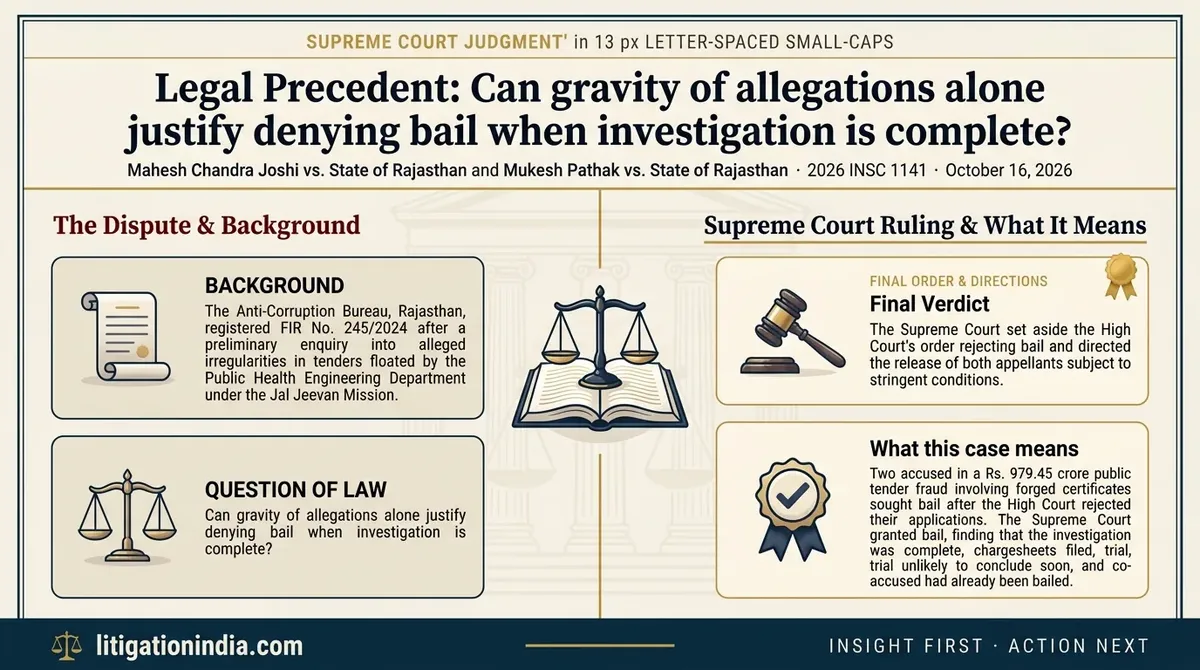
Supreme Court Grants Bail in Rajasthan Jal Jeevan Mission Tender Fraud Case — infographic summary

What this case means

Two accused in a Rs. 979.45 crore public tender fraud involving forged certificates sought bail after the High Court rejected their applications. The Supreme Court granted bail, finding that the investigation was complete, chargesheets filed, trial unlikely to conclude soon, and co-accused had already been bailed. The case reinforces that gravity of allegations alone cannot justify indefinite pre-trial detention.

What the Supreme Court held

The Supreme Court set aside the High Court's order rejecting bail and directed the release of both appellants subject to stringent conditions. The conditions include surrender of passports, prohibition from leaving India without court permission, cooperation with the investigation, non-interference with witnesses, and regular appearance before the trial court. The Court clarified that its observations were confined solely to bail and shall not be taken as an expression on the merits of the case.

Case: Mahesh Chandra Joshi vs. State of Rajasthan and Mukesh Pathak vs. State of Rajasthan (2026) Citation: 2026 INSC 1141

Want the full legal reasoning, citations and case documents?

Read the full judgment analysis
Mahesh Chandra Joshi
Mukesh Pathak
State of Rajasthan
bail
Prevention of Corruption Act
Jal Jeevan Mission
PHED tender fraud
forged IRCON certificates
Article 21
pre-trial detention
Prevention of Money Laundering Act
IPC
Sections 7(c), 9, 10, 12, 13(1)(a) read with Section 13(2), and Section 17A, Prevention of Corruption Act, 1988 (as amended in 2018)
Sections 409, 466, 467, 468, 471, 477A, and 120B, Indian Penal Code, 1860

More in Criminal Law / Bail