
All insights

Must election commissioner appointment law be tested by a five-judge Constitution Bench?

Supreme Court Divided on Referring Election Commissioners Appointment Act to Constitution Bench

Public interest petitions challenged the Chief Election Commissioner and other Election Commissioners (Appointment, Conditions of Service and Term of Office) Act, 2023 as unconstitutional for giving t

Litigation India Editorial 23 September 2026 1 min read 2026 INSC 1040

Story

Case at a glance1 / 6

Supreme Court of India

Election Commission Appointment Law: Constitution Bench or Not?

Dr. Jaya Thakur & Ors. vs Union of India & Anr. — 2026 INSC 1040

Court: Supreme Court of India, Civil Original JurisdictionDate: 23 September 2026Bench: Justice Dipankar Datta and Justice Satish Chandra Sharma (divided opinion)Area: Constitutional Law / Election Law — validity of Election Commissioners Appointment Act 2023
Two judges, two opinions — the divided bench referred the matter to the Chief Justice for a Constitution Bench.
Supreme Court Divided on Referring Election Commissioners Appointment Act to Constitution Bench · 2026 INSC 10402026-09-23T17:22:07.898225+00:00
The legal question2 / 6

Should the 2023 Appointment Act Be Tested by a Five-Judge Bench?

The core procedural issue before the two-judge bench

  • Appellant: Constitutional principles on ECI independence already settled by Anoop Baranwal; only application remains, no reference needed.
  • Appellant: Eleventh-hour reference plea after two years of hearing is a delay tactic and must be deprecated.
  • Respondent: No court has yet ruled on the constitutional validity of the 2023 Act; a substantial question of interpretation arises for the first time.
  • Respondent: Article 145(3) and Order XXXVIII, SCR 2013 mandatorily require at least five judges for such constitutional questions.
Supreme Court Divided on Referring Election Commissioners Appointment Act to Constitution Bench · 2026 INSC 10402026-09-23T17:22:07.898225+00:00
Statutory comparison3 / 6

Anoop Baranwal Committee vs 2023 Act Committee

How the Selection Committee composition changed

FeatureAnoop Baranwal (Interim, Art. 142)2023 Act (Section 7)
Legal basisSupreme Court direction under Article 142 as pro tem measureParliamentary legislation under Article 324(2)
Member 1Prime Minister (Chairperson)Prime Minister (Chairperson)
Member 2Leader of Opposition in Lok SabhaLeader of Opposition in Lok Sabha
Member 3Chief Justice of India (neutral selector)Union Cabinet Minister nominated by the Prime Minister
NatureTemporary, subject to Parliament enacting a lawPermanent statutory arrangement
Executive majorityNo — CJI provided neutral balanceYes — two of three members from executive
Justice Datta: Parliament was not bound to replicate the CJI-inclusive committee; but the 2023 Act prima facie fails the perception test of independence.
Supreme Court Divided on Referring Election Commissioners Appointment Act to Constitution Bench · 2026 INSC 10402026-09-23T17:22:07.898225+00:00
The Court's reasoning4 / 6

Justice Datta's Reasoning: No Reference Required

Step-by-step path from question to conclusion

  1. 1Step 1: Anoop Baranwal's Selection Committee was an Article 142 pro tem measure, not a binding norm Parliament had to follow.
  2. 2Step 2: Once Parliament enacted the 2023 Act, the interim arrangement ceased; Parliament validly exercised its Article 324(2) power.
  3. 3Step 3: Core constitutional principle — ECI independence from executive control is basic structure — is already settled law.
  4. 4Step 4: What remains is application of that settled standard to the 2023 Act, not fresh constitutional interpretation warranting a reference under Article 145(3).
  5. 5Step 5: Section 7's Cabinet Minister cannot defy the Prime Minister; the mechanism prima facie fails the independence perception test.
Supreme Court Divided on Referring Election Commissioners Appointment Act to Constitution Bench · 2026 INSC 10402026-09-23T17:22:07.898225+00:00
The verdict5 / 6

The Court's Final Order

Divided bench — joint order directing reference to Chief Justice

  • The Fact: Six public interest writ petitions challenged the 2023 Act's Selection Committee as giving the executive unconstitutional dominance over Election Commission appointments.
  • The Law: Article 145(3) requires five judges for a substantial unsettled question of constitutional interpretation; whether that threshold was met divided the bench.
  • The Result: Papers directed to be placed before the Chief Justice of India to constitute a Constitution Bench; CJI also requested to explore a permanent five-judge constitutional bench.
Papers to be placed before the Chief Justice of India for constitution of a Constitution Bench to decide the vires of the 2023 Act.
Supreme Court Divided on Referring Election Commissioners Appointment Act to Constitution Bench · 2026 INSC 10402026-09-23T17:22:07.898225+00:00
Why it matters6 / 6

Why This Case Matters for Every Citizen

Practical significance of the judgment

  • Who appoints election commissioners directly affects whether your vote is counted fairly — a captured ECI harms every voter.
  • The court found prima facie that a Selection Committee where 2 of 3 members are from the ruling executive fails the appearance of independence.
  • Constitutional references languishing for 5 to 20 years are themselves an institutional problem; the court urged a permanent Constitution Bench as a remedy.
  • The judgment clarifies that once the Supreme Court settles a constitutional principle, Parliament can legislate differently but must still meet that constitutional standard.
For democracy to work, the Election Commission must not only be independent — it must also appear independent to every citizen.
Supreme Court Divided on Referring Election Commissioners Appointment Act to Constitution Bench · 2026 INSC 10402026-09-23T17:22:07.898225+00:00
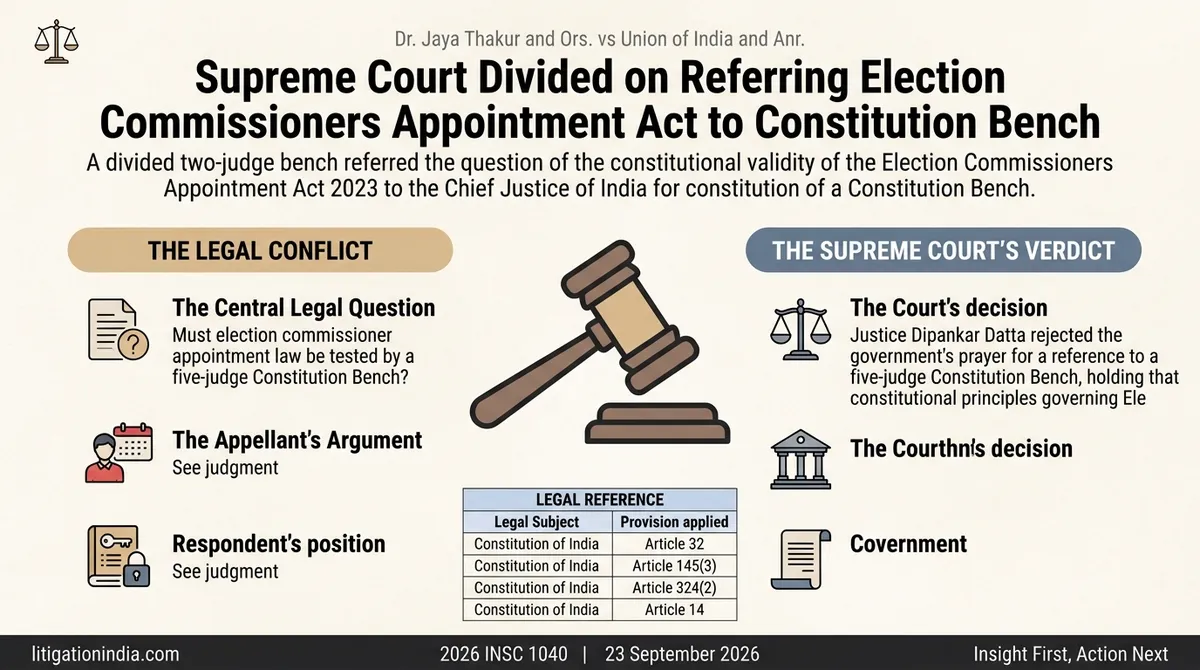
Supreme Court Divided on Referring Election Commissioners Appointment Act to Constitution Bench — infographic summary

What this case means

Public interest petitions challenged the Chief Election Commissioner and other Election Commissioners (Appointment, Conditions of Service and Term of Office) Act, 2023 as unconstitutional for giving the executive dominant control over Election Commission appointments. A two-judge bench was divided: Justice Datta held no reference to a five-judge Constitution Bench was needed as constitutional principles were settled, while Justice Sharma held a reference was mandatory. Given the division, both judges jointly directed the papers to be placed before the Chief Justice of India to constitute a Constitution Bench.

What the Supreme Court held

Justice Dipankar Datta rejected the government's prayer for a reference to a five-judge Constitution Bench, holding that constitutional principles governing Election Commission independence were already settled and only their application to the new Act remained. Justice Satish Chandra Sharma dissented, holding a reference mandatory under Article 145(3) as no court had yet ruled on the constitutional validity of the 2023 Act itself. Both judges, in a joint order, directed the papers to be placed before the Chief Justice of India for constitution of a Constitution Bench, and recommended the CJI explore a permanent five-judge bench for constitutional matters.

Case: Dr. Jaya Thakur and Ors. vs Union of India and Anr. (2026) Citation: 2026 INSC 1040

Want the full legal reasoning, citations and case documents?

Read the full judgment analysis
Election Commission appointment
Chief Election Commissioner
2023 Act
Article 324
Article 145(3)
Constitution Bench reference
Anoop Baranwal
executive dominance
Selection Committee
basic structure
free and fair elections
Election Commissioners Act 2023
Article 32, Constitution of India
Article 145(3), Constitution of India

More in Constitutional Law / Election Law