
All insights

Can Supreme Court dissolve marriage and quash all pending cases under Article 142?

Supreme Court Dissolves Marriage and Quashes All Pending Cases Between Estranged Spouses

A wife filed transfer petitions to move criminal and domestic violence cases from Odisha to Mumbai. The husband sought divorce on grounds of irretrievable breakdown under Article 142. The Supreme Cour

Litigation India Editorial 28 September 2026 1 min read 2026 INSC 1060

Story

Case at a glance1 / 6

Supreme Court of India

Marriage Dissolved and 18 Cases Quashed in One Supreme Court Order

Shikha vs. State of Odisha & Ors. — 2026 INSC 1060

Court: Supreme Court of India | Date: September 28, 2026Bench: Justice B.V. Nagarathna and Justice R. MahadevanArea of Law: Family / Matrimonial Law — Article 142 of the ConstitutionParties separated since 2022; 18 civil and criminal cases pending across four states
Supreme Court Dissolves Marriage and Quashes All Pending Cases Between Estranged Spouses · 2026 INSC 10602026-09-28T12:51:15.715837+00:00
The legal question2 / 6

Can the Supreme Court dissolve a marriage and quash all cases in one order under Article 142?

Core legal issue decided

  • Appellant/Wife: Transfer the criminal and DV cases from Odisha to Mumbai for convenience of litigation.
  • Respondent/Husband: Marriage has irretrievably broken down; grant divorce under Article 142 and quash all 18 pending cases.
  • Wife (ultimately): Consent to divorce provided sufficient permanent alimony is paid for medical needs.
Supreme Court Dissolves Marriage and Quashes All Pending Cases Between Estranged Spouses · 2026 INSC 10602026-09-28T12:51:15.715837+00:00
The Court's reasoning3 / 6

How the Court Reached Its Decision

Step-by-step reasoning under Article 142

  1. 1Step 1: Noted mutual consent — wife accepted divorce; husband filed Article 142 application for dissolution.
  2. 2Step 2: Found irretrievable breakdown — separated since 2022, mediation failed multiple times, 18 cases pending.
  3. 3Step 3: Resolved alimony dispute — Rs. 35 lakh directed and fully paid before final order.
  4. 4Step 4: Applied Shilpa Sailesh (2023) and Rinku Baheti (2025) — Article 142 power confirmed to be exercisable.
  5. 5Step 5: Dissolved marriage, quashed all listed cases, barred fresh filings — complete justice in one order.
Mediation failed; only complete dissolution brought justice to both parties.
Supreme Court Dissolves Marriage and Quashes All Pending Cases Between Estranged Spouses · 2026 INSC 10602026-09-28T12:51:15.715837+00:00
Statutory comparison4 / 6

Article 142 Power: Existence vs. Exercise

As explained in Shilpa Sailesh and applied here

AspectExistence of PowerExercise of Power
NatureGenerally a matter of law — confirmed in Shilpa Sailesh (2023)Mixed question of law and facts — assessed case by case
RequirementSubstantive conditions of Section 13-B, HMA 1955 must be fulfilledMutual consent, no coercion, alimony settled, irretrievable breakdown shown
EffectCourt can pass decree a Family Court/trial court could passAll pending civil and criminal cases can be quashed in one order
Right or DiscretionPower existsCannot be claimed as a matter of right — purely discretionary
Supreme Court Dissolves Marriage and Quashes All Pending Cases Between Estranged Spouses · 2026 INSC 10602026-09-28T12:51:15.715837+00:00
The verdict5 / 6

The Court's Final Order

Transfer Petition (Criminal) No. 493 of 2025 and Transfer Petition (Civil) No. 2564 of 2025

  • The Fact: Marriage of 04.12.2016 had irretrievably broken down; parties separated since 2022; 18 cases pending across multiple courts.
  • The Law: Article 142(1) of the Constitution empowers complete justice; Section 13-B, Hindu Marriage Act 1955 conditions fulfilled; Shilpa Sailesh (2023) and Rinku Baheti (2025) applied.
  • The Result: Marriage dissolved; all 18 pending cases quashed; parties barred from filing fresh cases against each other; Rs. 35 lakh permanent alimony paid in full.
Marriage dissolved; all 18 pending cases quashed; parties directed not to file fresh cases against each other.
Supreme Court Dissolves Marriage and Quashes All Pending Cases Between Estranged Spouses · 2026 INSC 10602026-09-28T12:51:15.715837+00:00
Why it matters6 / 6

What This Means for Ordinary People

Practical significance of the judgment

  • Couples trapped in long matrimonial disputes across multiple states can get complete relief from a single Supreme Court order under Article 142.
  • Once both spouses genuinely consent and alimony is settled, the Supreme Court will not force them to visit multiple lower courts for case closure.
  • Permanent alimony fixed by the Supreme Court in such proceedings is fully binding and must be paid before the final divorce decree is drawn up.
  • Settlement — not prolonged litigation — is the court-preferred path in matrimonial disputes, even when multiple family members are involved.
The Supreme Court can end an entire matrimonial dispute — including all family cases — in one order when both parties genuinely consent.
Supreme Court Dissolves Marriage and Quashes All Pending Cases Between Estranged Spouses · 2026 INSC 10602026-09-28T12:51:15.715837+00:00
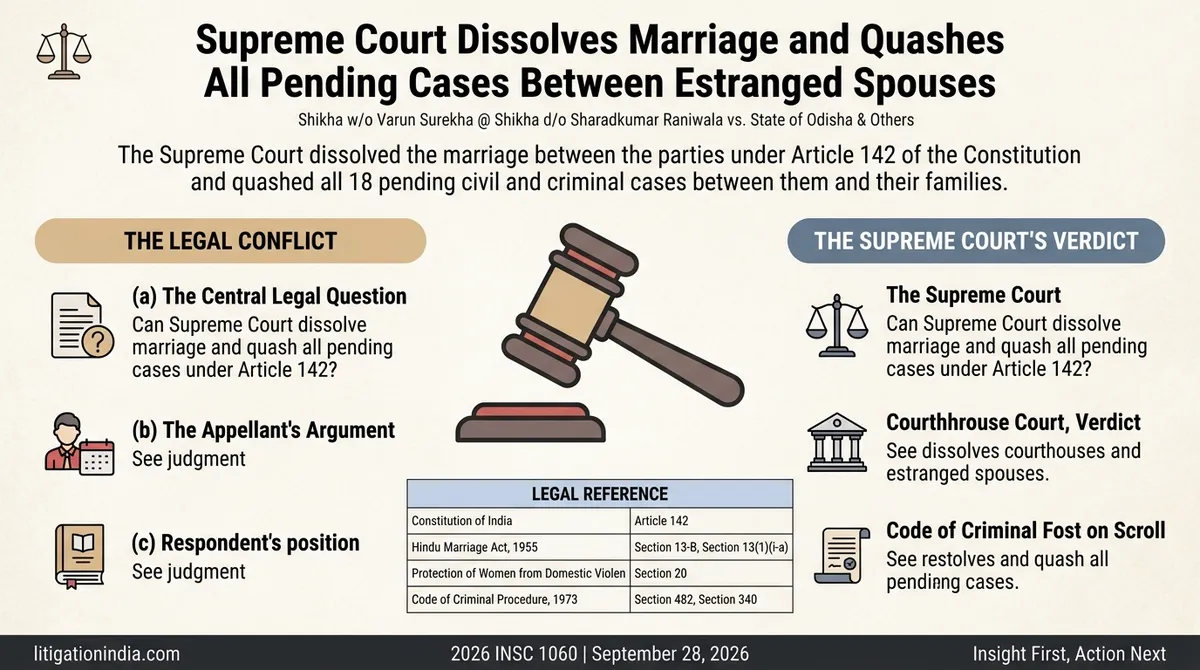
Supreme Court Dissolves Marriage and Quashes All Pending Cases Between Estranged Spouses — infographic summary

What this case means

A wife filed transfer petitions to move criminal and domestic violence cases from Odisha to Mumbai. The husband sought divorce on grounds of irretrievable breakdown under Article 142. The Supreme Court, noting mutual consent and full payment of Rs. 35 lakh alimony, dissolved the marriage and quashed all 18 pending cases between the parties and their families.

What the Supreme Court held

The Supreme Court allowed the interlocutory application filed by the husband under Article 142 of the Constitution and dissolved the marriage solemnized on 04.12.2016. All 18 pending civil and criminal cases listed in the judgment, as well as any other cases filed inter se between the parties, were quashed, and the parties were directed not to file any fresh cases against each other. The Registry was directed to draw up a decree.

Case: Shikha w/o Varun Surekha @ Shikha d/o Sharadkumar Raniwala vs. State of Odisha & Others (2026) Citation: 2026 INSC 1060

Want the full legal reasoning, citations and case documents?

Read the full judgment analysis
Transfer Petition
Article 142
divorce mutual consent
irretrievable breakdown of marriage
Hindu Marriage Act
permanent alimony
quashing pending cases
Shilpa Sailesh
Rinku Baheti
Protection of Women from Domestic Violence Act
Article 142, Constitution of India
Section 13-B, Section 13(1)(i-a), Hindu Marriage Act, 1955
Section 20, Protection of Women from Domestic Violence Act, 2005
Section 482, Section 340, Code of Criminal Procedure, 1973