
All insights

Can a court intervene when a Rajya Sabha nomination is rejected mid-election?

Supreme Court dismisses writ against Rajya Sabha nomination rejection citing Article 329(b) bar

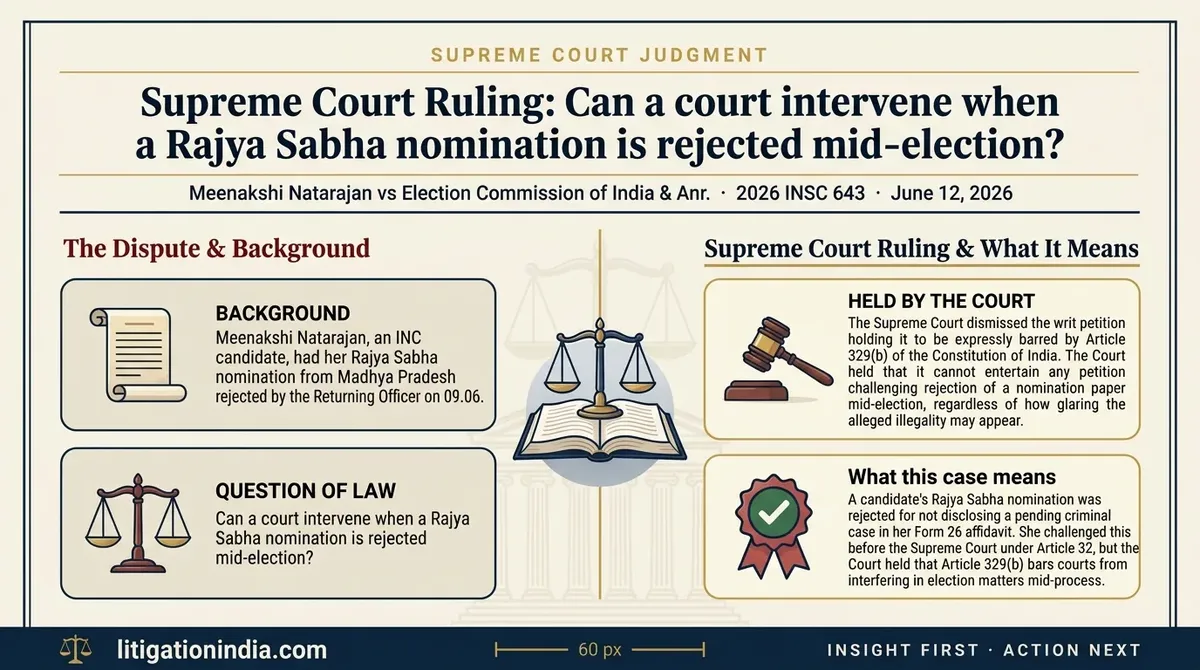
A candidate's Rajya Sabha nomination was rejected for not disclosing a pending criminal case in her Form 26 affidavit. She challenged this before the Supreme Court under Article 32, but the Court held

Litigation India Editorial 1 November 2026 1 min read 2026 INSC 643

Story

Case at a glance1 / 6

Supreme Court of India

No Writ Lies Against Nomination Rejection During Election

Meenakshi Natarajan vs Election Commission of India & Anr. — 2026 INSC 643

Court: Supreme Court of India, Civil Original JurisdictionDate: June 12, 2026; Bench: Justice Prashant Kumar Mishra and Justice Atul S. ChandurkarArea of Law: Election Law / Constitutional LawIssue: Whether Article 32 writ lies against Rajya Sabha nomination rejection mid-election
Supreme Court dismisses writ against Rajya Sabha nomination rejection citing Article 329(b) bar · 2026 INSC 6432026-11-01T13:18:40.243771+00:00
The legal question2 / 6

Can Supreme Court Intervene When a Nomination is Rejected Mid-Election?

Rival Arguments on Maintainability

  • Appellant: Article 329(b) bar not attracted; petition seeks fair election completion, not obstruction.
  • Appellant: Section 33A requires disclosure only when charges are framed; charges not framed here, so rejection is illegal.
  • Respondent: Right to contest election is statutory, not a fundamental right; Article 32 petition is not maintainable.
  • Respondent: Law settled since Ponnuswami (1952) — only remedy for nomination rejection is an election petition after the election.
Supreme Court dismisses writ against Rajya Sabha nomination rejection citing Article 329(b) bar · 2026 INSC 6432026-11-01T13:18:40.243771+00:00
Statutory comparison3 / 6

What Must Be Disclosed in Form 26?

Section 33A vs Form 26 Clause 5 — Scope of Disclosure Obligation

ProvisionWhat it requiresPetitioner's Argument
Section 33A, Representation of the People Act 1951Disclose pending cases where charges have been framed by court of competent jurisdiction for offences punishable with 2+ yearsCharges not framed; no obligation to disclose; rejection illegal
Form 26 Clause 5, Conduct of Election Rules 1961Disclose ALL pending criminal cases at any stage, including case number, court, sections, and whether charges framedRespondents: non-disclosure at any stage warrants rejection
The Court did not decide this dispute on merits — it held the writ itself was barred by Article 329(b).
Supreme Court dismisses writ against Rajya Sabha nomination rejection citing Article 329(b) bar · 2026 INSC 6432026-11-01T13:18:40.243771+00:00
The Court's reasoning4 / 6

Court's Reasoning: Why the Writ Was Dismissed

Step-by-step reasoning from question to conclusion

  1. 1Step 1: Article 329(b) uses 'notwithstanding anything in this Constitution' — it overrides even Article 32 and Article 226.
  2. 2Step 2: Ponnuswami (1952) held 'election' means the entire process; rejection of nomination is part of that process.
  3. 3Step 3: Improper rejection of nomination is a ground to void an election under Section 100 of the 1951 Act — so the remedy is an election petition.
  4. 4Step 4: Creating an exception for 'glaring' cases of improper rejection would introduce a distinction Article 329 does not permit.
  5. 5Step 5: Right to contest elections is statutory, not a fundamental right — Article 32 writ is not available.
Supreme Court dismisses writ against Rajya Sabha nomination rejection citing Article 329(b) bar · 2026 INSC 6432026-11-01T13:18:40.243771+00:00
The verdict5 / 6

The Court's Final Decision

  • The Fact: Petitioner's Rajya Sabha nomination was rejected for non-disclosure of a pending criminal case in Form 26 affidavit.
  • The Law: Article 329(b) expressly bars courts from entertaining any challenge to an election at an intermediate stage; the right to contest is statutory not fundamental.
  • The Result: Writ petition dismissed; any future election petition before the High Court will be decided on its own merits unaffected by this order.
Writ petition dismissed; Article 329(b) bars Supreme Court from entertaining nomination rejection challenges mid-election.
Supreme Court dismisses writ against Rajya Sabha nomination rejection citing Article 329(b) bar · 2026 INSC 6432026-11-01T13:18:40.243771+00:00
Why it matters6 / 6

What This Means for Citizens

  • If your nomination is rejected in any parliamentary or state election, you cannot rush to the High Court or Supreme Court mid-election.
  • Your only legal remedy is to contest the election and then file an election petition before the appropriate High Court after the results.
  • The bar applies regardless of how obvious or serious the alleged illegality in rejection appears to be.
  • Observations made by the Supreme Court in such dismissed petitions do not bind or affect the later election petition.
Elections cannot be stopped mid-way by courts; grievances about nomination rejection must be raised only through an election petition after the election.
Supreme Court dismisses writ against Rajya Sabha nomination rejection citing Article 329(b) bar · 2026 INSC 6432026-11-01T13:18:40.243771+00:00
Supreme Court dismisses writ against Rajya Sabha nomination rejection citing Article 329(b) bar — infographic summary

What this case means

A candidate's Rajya Sabha nomination was rejected for not disclosing a pending criminal case in her Form 26 affidavit. She challenged this before the Supreme Court under Article 32, but the Court held that Article 329(b) bars courts from interfering in election matters mid-process. The only remedy available is an election petition after the election.

What the Supreme Court held

The Supreme Court dismissed the writ petition holding it to be expressly barred by Article 329(b) of the Constitution of India. The Court held that it cannot entertain any petition challenging rejection of a nomination paper mid-election, regardless of how glaring the alleged illegality may appear. The Court clarified that its observations would not affect any election petition that may be filed before the concerned High Court.

Case: Meenakshi Natarajan vs Election Commission of India & Anr. (2026) Citation: 2026 INSC 643

Want the full legal reasoning, citations and case documents?

Read the full judgment analysis
Meenakshi Natarajan
Election Commission of India
Rajya Sabha nomination rejection
Article 329(b)
Article 32
Section 33A Representation of the People Act 1951
election petition
writ jurisdiction bar
Form 26 affidavit
criminal case disclosure
Article 329(b), Constitution of India
Article 32, Constitution of India
Section 33A, Representation of the People Act, 1951
Rule 4A, Form 26 Clause 5, Conduct of Election Rules, 1961

More in Election Law / Constitutional Law

Election Law / Constitutional Law
23 Aug 2026

Pranesh M.K. vs A.V. Gayathri

The Supreme Court ruled that nominated members of local municipal bodies do not have the right to vote in Legislative Council elections, and their invalid votes must be excluded for a recount.