
All insights

Can social media platforms escape liability by sharing links to child abuse material instead of hosting it?

Supreme Court Directs Framework to Detect and Remove Child Sexual Exploitation Material Online

The Supreme Court found that despite its 2024 directions, social media platforms continued to circulate child sexual exploitation and abuse material (CSEAM) through indirect links and paid advertiseme

Litigation India Editorial 18 October 2026 1 min read 2026 INSC 1149

Story

Case at a glance1 / 6

Supreme Court of India

Child Safety Online: Court Orders National CSEAM Detection Framework

Just Rights for Children Alliance v. S. Harish — 2026 INSC 1149

Court: Supreme Court of India, Criminal Appellate JurisdictionArea of law: Child protection, cyber law, intermediary liabilityKey issue: Persistent circulation of CSEAM on social media despite 2024 directionsAssistance sought from Ministry of Electronics and Information Technology and Ministry of Law and Justice
Two years after the 2024 judgment, CSEAM was still being promoted on platforms via paid ads and redirect links.
Supreme Court Directs Framework to Detect and Remove Child Sexual Exploitation Material Online · 2026 INSC 11492026-10-18T10:47:37.434406+00:00
The legal question2 / 6

Can Sharing a Link to Child Abuse Material Escape Legal Liability?

Core legal issue decided by the Court

  • Appellant: Social media intermediaries were allowing ads and links to CSEAM to remain, claiming no explicit depiction meant no violation of advertising standards.
  • Appellant: Intermediaries reported to NCMEC (a US NGO) rather than local SJPU, claiming this satisfied their legal duty.
  • Respondent/Court: Section 67B(d) of the IT Act penalises any act likely to facilitate online abuse of children — including ads promoting tools to create CSEAM.
  • Respondent/Court: Reporting only to NCMEC does not discharge the mandatory obligation under Sections 19-21 of POCSO to report to SJPU or local police.
The absence of an explicit image in an advertisement promoting CSEAM tools is a deliberate design to escape detection — not a defence.
Supreme Court Directs Framework to Detect and Remove Child Sexual Exploitation Material Online · 2026 INSC 11492026-10-18T10:47:37.434406+00:00
Statutory comparison3 / 6

CSEAM Obligations: POCSO Act vs. IT Act and IT Rules

Key distinction drawn by the Court on scope of intermediary obligations

Legal SubjectPOCSO Act 2012IT Act 2000 and IT Rules 2021
Nature of statutePurely penal — must be strictly construedPartly penal, substantially regulatory — purposive construction applies
What is CSEAMRequires visual depiction of sexual exploitation or abuse of a childAny electronic material facilitating, promoting or enabling exploitation of children, even without explicit depiction
Ads promoting CSEAM toolsNot covered unless visual depiction presentCovered under Section 67B(d) — likelihood of facilitating abuse is sufficient
Reporting authoritySJPU or local police (Section 19, Rule 11 POCSO Rules)SJPU, local police, cyber-crime portal AND Hash & URL Database authority
Timeline for reportingNone prescribed (identified as a gap)Court directs: 2 hours for unknown-origin CSEAM; weekly for known-origin
Supreme Court Directs Framework to Detect and Remove Child Sexual Exploitation Material Online · 2026 INSC 11492026-10-18T10:47:37.434406+00:00
The Court's reasoning4 / 6

How the National Hash and URL Database Will Work

The Court's three-step detection and removal process

  1. 1Step 1 — Source: CSEAM reported by user, flagged by intermediary, forwarded by law enforcement, or proactively found.
  2. 2Step 2 — Verification: Preliminary screening by specialised software, then independent assessment by at least two or three trained human analysts.
  3. 3Step 3 — Entry: On confirmation, hash identifier and/or URL entered into the national database via encrypted channels; no CSEAM stored in the database itself.
  4. 4Step 4 — Cross-platform removal: All connected intermediaries check content against database; matches (Known Origin) removed immediately without further verification.
  5. 5Step 5 — Accountability: Weekly consolidated reports by intermediaries; periodic independent audits; wrongly entered items de-listed and removals reversed.
The database stores only hash identifiers and URLs — never the harmful material itself.
Supreme Court Directs Framework to Detect and Remove Child Sexual Exploitation Material Online · 2026 INSC 11492026-10-18T10:47:37.434406+00:00
The verdict5 / 6

The Court's Verdict and Directions

What the Supreme Court decided in M.A. Nos. 2553-2554 of 2026

  • The Fact: Despite 2024 directions, CSEAM continued circulating on social media via ads and redirect links; grievance mechanisms dismissed reported content as compliant.
  • The Law: Section 67B(d) IT Act covers indirect facilitation of child abuse; IT Rules require proactive detection; Section 79 IT Act alone is insufficient to deter systemic non-compliance.
  • The Result: Court directs creation of national Hash and URL Database, two-hour reporting timelines, dedicated CSEAM grievance officers, standardised reporting format, and exemplary monetary fines for non-compliance.
Intermediaries must report CSEAM of unknown origin to SJPU or local police within two hours of removal; Known-origin removals reported weekly.
Supreme Court Directs Framework to Detect and Remove Child Sexual Exploitation Material Online · 2026 INSC 11492026-10-18T10:47:37.434406+00:00
Why it matters6 / 6

What This Means for Ordinary People and Children

Practical significance of the order

  • Sharing a link to CSEAM — even without downloading or hosting it — is illegal under Section 67B of the IT Act.
  • Social media platforms will face direct financial penalties for failing to remove CSEAM promptly, not just loss of immunity.
  • A national database will ensure content removed from one platform is automatically flagged and removed from all others.
  • Anyone can report CSEAM anonymously through a simple two-step mechanism; platforms must acknowledge and track every report.
No platform can permit content that facilitates child abuse to remain live — there are no loopholes, only responsibility.
Supreme Court Directs Framework to Detect and Remove Child Sexual Exploitation Material Online · 2026 INSC 11492026-10-18T10:47:37.434406+00:00
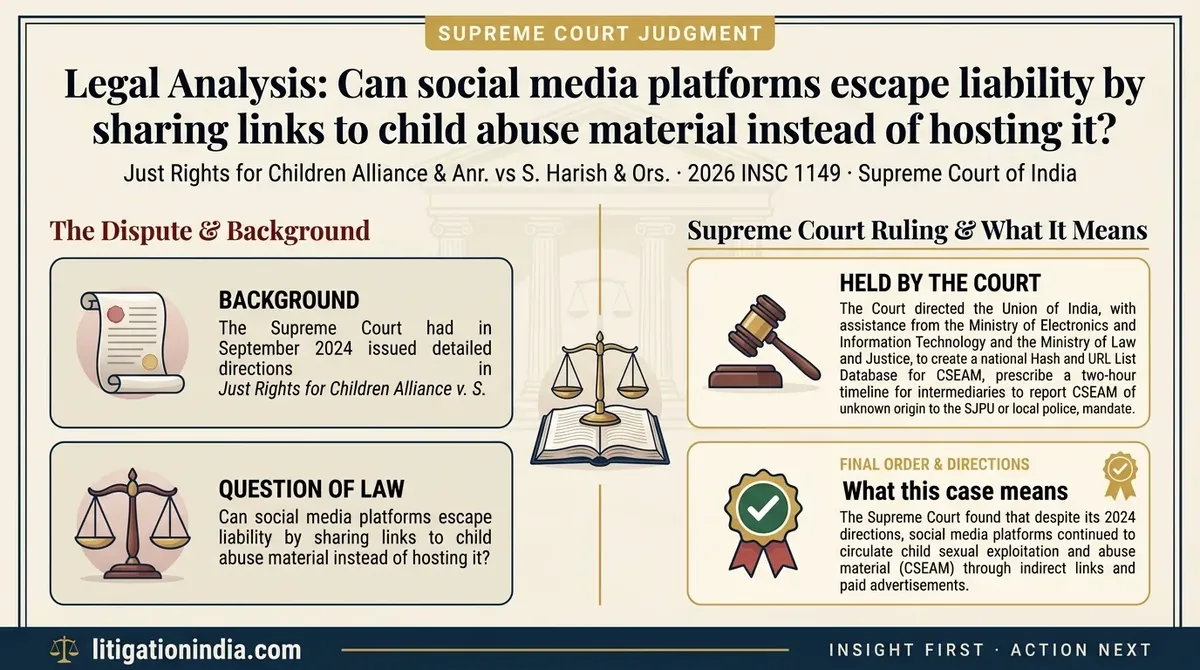
Supreme Court Directs Framework to Detect and Remove Child Sexual Exploitation Material Online — infographic summary

What this case means

The Supreme Court found that despite its 2024 directions, social media platforms continued to circulate child sexual exploitation and abuse material (CSEAM) through indirect links and paid advertisements. The Court directed the Union of India to create a national Hash and URL List Database, establish dedicated grievance officers for CSEAM, prescribe timelines for reporting, and impose exemplary fines on non-compliant intermediaries. The order matters because it seeks to close loopholes that allowed platforms to avoid liability by sharing links rather than storing harmful content.

What the Supreme Court held

The Court directed the Union of India, with assistance from the Ministry of Electronics and Information Technology and the Ministry of Law and Justice, to create a national Hash and URL List Database for CSEAM, prescribe a two-hour timeline for intermediaries to report CSEAM of unknown origin to the SJPU or local police, mandate dedicated CSEAM grievance officers, and frame a comprehensive Standard Operating Procedure for the database. It also called for exemplary monetary fines for persistent non-compliance by intermediaries, replacing the sole consequence of loss of safe harbour under Section 79 of the IT Act, and sought responses from the Union of India on all these issues.

Case: Just Rights for Children Alliance & Anr. vs S. Harish & Ors. (2026) Citation: 2026 INSC 1149

Want the full legal reasoning, citations and case documents?

Read the full judgment analysis
CSEAM
child sexual exploitation and abuse material
social media intermediaries
POCSO Act
Information Technology Act
safe harbour
hash and URL listing
Sahyog Portal
grievance redressal
IT Rules 2021
Sections 15, 19, 20, 21, The Protection of Children from Sexual Offences Act, 2012
Rule 11, The Protection of Children from Sexual Offences Rules, 2020
Sections 67, 67A, 67B, 79, The Information Technology Act, 2000
Rules 3(1)(b), 3(1)(c), 3(1)(d), 3(2)(a), 3(2)(b), 3(3), 3A, 4(1), 4(4), 4(6), The Information Technology (Intermediary Guidelines and Digital Media Ethics Code) Rules, 2021