
All insights

Can the Supreme Court compel a regulatory framework for pharmaceutical marketing ethics?

Supreme Court Directs Committee on Unethical Pharmaceutical Marketing Practices

This case challenged the absence of an enforceable legal framework to regulate unethical marketing by pharmaceutical companies to doctors. The Supreme Court directed the Union of India to constitute a

Litigation India Editorial 8 October 2026 1 min read 2026 INSC 1097

Story

Case at a glance1 / 6

Supreme Court of India

Regulating Pharma Marketing: Right to Health at Stake

Federation of Medical & Sales Representatives Association of India vs Union of India, 2026 INSC 1097

Court: Supreme Court of India, Civil Original JurisdictionDate: 08 October 2026; Bench: Justice Vikram Nath and Justice Sandeep MehtaArea of law: Constitutional Law, Public Health, Pharmaceutical RegulationWrit Petition under Article 32 seeking enforcement of right to health under Article 21
Supreme Court Directs Committee on Unethical Pharmaceutical Marketing Practices · 2026 INSC 10972026-10-08T19:17:27.397744+00:00
The legal question2 / 6

Is the Absence of Enforceable Pharma Marketing Rules Unconstitutional?

Core legal issue before the Supreme Court

  • Appellant: Pharmaceutical companies give gifts, travel and money to doctors, causing irrational prescriptions and harming patients.
  • Appellant: UCPMP 2015 is voluntary; no enforceable law regulates pharmaceutical companies, violating Article 21.
  • Respondent: UCPMP 2024 strengthens disclosure, oversight and the Apex Committee; a new Committee is proposed to recommend further statutory changes.
  • Respondent: Policy choices on regulatory framework belong to the executive; the earlier High-Level Committee's work led to UCPMP 2024.
Supreme Court Directs Committee on Unethical Pharmaceutical Marketing Practices · 2026 INSC 10972026-10-08T19:17:27.397744+00:00
Statutory comparison3 / 6

Regulatory Framework: Doctors vs Pharmaceutical Companies

The asymmetry the Court identified in existing law

Legal SubjectFor DoctorsFor Pharmaceutical Companies
Governing InstrumentIMC (Professional Conduct, Etiquette and Ethics) Regulations, 2002, Regulation 6.8.1Uniform Code for Pharmaceutical Marketing Practices, 2024 (UCPMP 2024) — voluntary/self-regulatory
RestrictionsProhibits acceptance of gifts, travel, hospitality, cash from pharma industryRestricts gifting, brand reminders, physician samples, CME activities
EnforcementStatutory disciplinary action; removal from Indian Medical Register possibleNo corresponding enforceable statutory mechanism; self-declaration and audit mechanisms only
Oversight BodyMedical Council / State Medical CouncilsApex Committee for Pharma Marketing Practices (ACPMP)
Doctors face removal from medical register for violations; pharma companies face no equivalent statutory consequence.
Supreme Court Directs Committee on Unethical Pharmaceutical Marketing Practices · 2026 INSC 10972026-10-08T19:17:27.397744+00:00
The Court's reasoning4 / 6

How the Court Reached Its Decision

Step-by-step reasoning under Articles 21, 32 and 142

  1. 1Step 1: Right to health under Article 21 is enforceable; unethical pharma marketing directly affects public health.
  2. 2Step 2: Regulatory efficacy requires not just rules but effective implementation, monitoring and enforcement.
  3. 3Step 3: Existing gap — doctors bound by enforceable IMC Regulations; pharma companies only by voluntary UCPMP.
  4. 4Step 4: Separation of powers — policy choices belong to the executive; Court cannot substitute its own judgment.
  5. 5Step 5: Court's role is to facilitate a meaningful consultative process; directed constitution of expert Committee under Articles 32 and 142.
Supreme Court Directs Committee on Unethical Pharmaceutical Marketing Practices · 2026 INSC 10972026-10-08T19:17:27.397744+00:00
The verdict5 / 6

The Court's Final Directions

Operative order under Articles 32 and 142, Constitution of India

  • The Fact: Unethical pharmaceutical marketing practices persist; no enforceable law targets pharmaceutical companies directly.
  • The Law: Article 21 mandates effective regulation; Articles 32 and 142 empower the Court to issue directions to facilitate this.
  • The Result: Committee to be constituted within two weeks; recommendations within two months; Union of India to take a reasoned decision and file compliance affidavit.
Union of India to constitute Committee within two weeks; Committee to submit recommendations within two months of first meeting.
Supreme Court Directs Committee on Unethical Pharmaceutical Marketing Practices · 2026 INSC 10972026-10-08T19:17:27.397744+00:00
Why it matters6 / 6

What This Means for Ordinary People

Practical significance of the judgment

  • Patients may soon benefit from stronger rules ensuring doctors prescribe based on medical need, not pharma inducements.
  • The judgment affirms that the right to affordable, ethical healthcare is a constitutional right under Article 21.
  • A mandatory consultation with civil society and health groups ensures patient voices inform any new regulatory framework.
  • Pharma companies may face enforceable consequences — not just voluntary codes — if the Committee recommends statutory changes.
Regulation works only when rules are enforced — the Court insists the right to health demands accountability, not just policy promises.
Supreme Court Directs Committee on Unethical Pharmaceutical Marketing Practices · 2026 INSC 10972026-10-08T19:17:27.397744+00:00
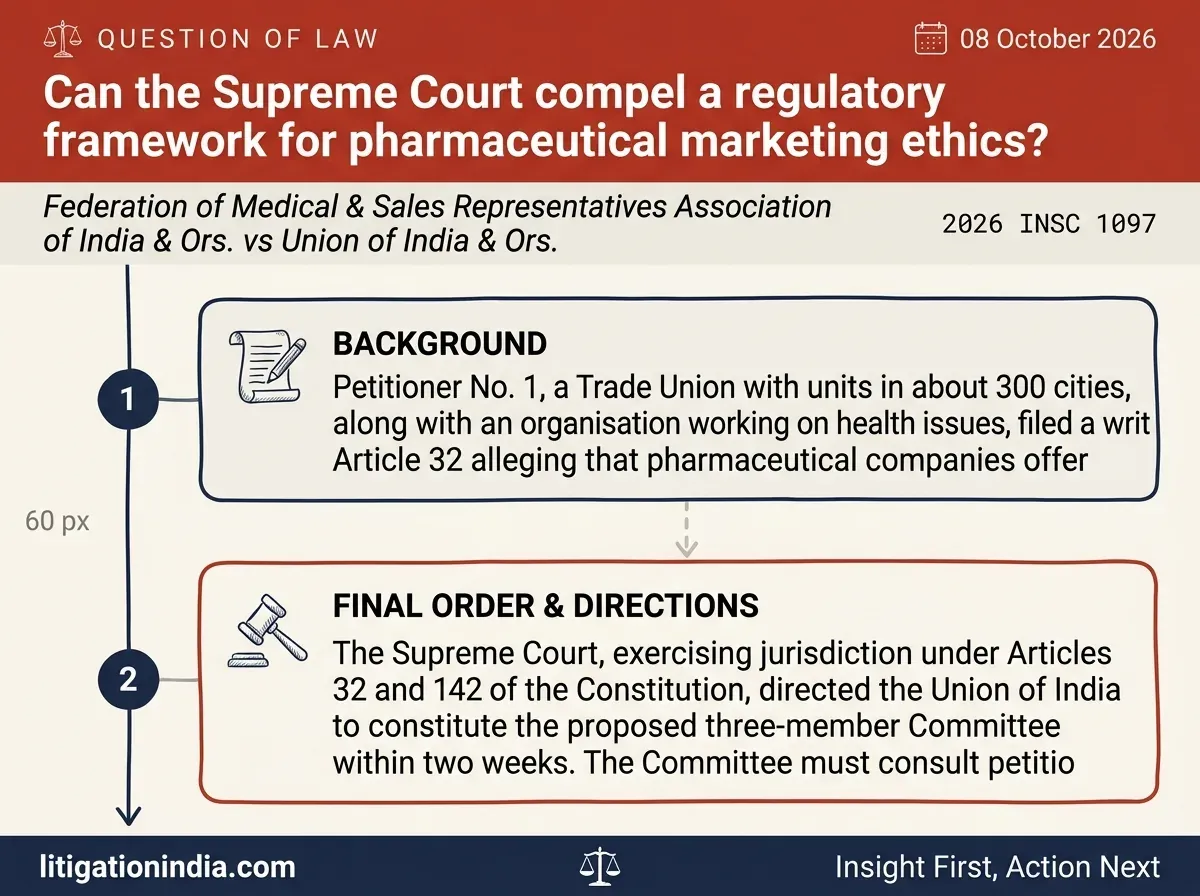
Supreme Court Directs Committee on Unethical Pharmaceutical Marketing Practices — infographic summary

What this case means

This case challenged the absence of an enforceable legal framework to regulate unethical marketing by pharmaceutical companies to doctors. The Supreme Court directed the Union of India to constitute a committee within two weeks to examine the regulatory framework and recommend statutory or regulatory changes. The judgment reinforces that the right to health under Article 21 demands effective, transparent, and accountable pharmaceutical marketing regulation.

What the Supreme Court held

The Supreme Court, exercising jurisdiction under Articles 32 and 142 of the Constitution, directed the Union of India to constitute the proposed three-member Committee within two weeks. The Committee must consult petitioners, intervenors and other stakeholders, may seek expert assistance, and is required to submit its recommendations to the Union of India within two months of its first meeting. The Union of India must then take a reasoned decision and file a compliance affidavit; the matter is listed for 29 January 2027.

Case: Federation of Medical & Sales Representatives Association of India & Ors. vs Union of India & Ors. (2026) Citation: 2026 INSC 1097

Want the full legal reasoning, citations and case documents?

Read the full judgment analysis
pharmaceutical marketing practices
UCPMP
right to health
Article 21
unethical marketing
drug prescription
pharmaceutical regulation
Federation of Medical & Sales Representatives Association of India
Writ Petition
Article 32
Article 142
Committee constitution
Articles 21, 32, 141, 142, 144, Constitution of India
Trade Unions Act, 1926