
All insights

Is the right to walk on a footpath a fundamental right under the Constitution?

Supreme Court Declares Right to Walk on Footpaths a Fundamental Right

A five-year-old boy was killed by a tanker while being walked to school on a road with no footpath. The Supreme Court used this tragedy to declare that the right to walk on demarcated footpaths is a f

Litigation India Editorial 26 September 2026 1 min read 2026 INSC 647

Story

Case at a glance1 / 6

Supreme Court of India

Right to Walk Declared a Fundamental Right

Maniyar Iliyaz @ Shaik Riyaz & Anr. vs P. Ayyappan & Ors. — 2026 INSC 647

Court: Supreme Court of India — Decided: June 19, 2026Bench: Justice P.S. Narasimha and Justice Atul S. ChandurkarArea of Law: Constitutional Law — Fundamental Rights / Motor Accident CompensationA child killed on a road with no footpath prompted a landmark declaration on pedestrian rights
Supreme Court Declares Right to Walk on Footpaths a Fundamental Right · 2026 INSC 6472026-09-26T18:19:42.427319+00:00
The legal question2 / 6

Does a citizen have a fundamental right to walk on a footpath?

The core constitutional question decided by the Court

  • Appellant: High Court wrongly reduced MACT compensation; pedestrian had no safe footpath to walk on.
  • Appellant: The state and local bodies owe citizens safe walking infrastructure as a constitutional guarantee.
  • Respondent/Insurance Co.: Compensation should be reduced as MACT over-awarded on speculative income of a child.
  • Court (suo motu): Is walking on a demarcated footpath a fundamental right, and who bears the duty to provide it?
Supreme Court Declares Right to Walk on Footpaths a Fundamental Right · 2026 INSC 6472026-09-26T18:19:42.427319+00:00
Statutory comparison3 / 6

Motor Vehicles Act vs Constitutional Right to Walk

Why the Motor Vehicles Act is not the right framework for pedestrian rights

AspectMotor Vehicles Act, 1988Constitutional Right (Art. 19(1)(d) & 21)
Primary SubjectThe motor vehicle — licensing, registration, insuranceThe human being — right to walk freely and safely
Pedestrian RoleIncidental — driver has duty to avoid harming pedestriansPrimary — pedestrian right has priority over motorised vehicles
Footpath RecognitionNot recognised; Regulations 3,5,9 are guiding principles onlyDemarcated footpath is an entitlement wherever a road exists
Duty BearerDriver of motor vehicleUrban development authorities, municipal corporations, panchayats
RemedyCompensation via MACT under Chapter XIIConstitutional writ and Sections 38-40, Specific Relief Act, 1963
The Motor Vehicles Act is built upon the vehicle as the subject; human interests are incidental.
Supreme Court Declares Right to Walk on Footpaths a Fundamental Right · 2026 INSC 6472026-09-26T18:19:42.427319+00:00
The Court's reasoning4 / 6

How the Court Reached Its Declaration

Step-by-step legal reasoning

  1. 1Step 1: A child dies on a road with no footpath — the trigger for constitutional examination.
  2. 2Step 2: Article 19(1)(d) protects movement; walking preceded wheels and is the primary form of movement.
  3. 3Step 3: Walking also engages Articles 19(1)(a),(b),(c) and Article 21 — life, dignity, expression, assembly.
  4. 4Step 4: The Motor Vehicles Act, 1988 fails to recognise or protect this right; a statutory gap exists.
  5. 5Step 5: Declaration — right to walk on demarcated footpaths is fundamental; municipal bodies bear an enforceable duty.
Supreme Court Declares Right to Walk on Footpaths a Fundamental Right · 2026 INSC 6472026-09-26T18:19:42.427319+00:00
The verdict5 / 6

The Court's Final Decision

Fact, Law, and Result

  • The Fact: A five-year-old boy was killed by a tanker on a road with no footpath; compensation was wrongly reduced by the High Court.
  • The Law: The right to walk on demarcated footpaths is a fundamental right under Articles 19(1)(d) and 21; municipal bodies have an enforceable duty to provide footpaths wherever roads exist.
  • The Result: Compensation enhanced to Rs. 11,44,628 payable in two months; case renamed 'Re: Fundamental Right to Walk and Footpath' under Article 32; judgment sent to three Ministries and Law Commission.
Citizens may enforce the right to a footpath through constitutional courts and Specific Relief Act, independently of Motor Vehicles Act claims.
Supreme Court Declares Right to Walk on Footpaths a Fundamental Right · 2026 INSC 6472026-09-26T18:19:42.427319+00:00
Why it matters6 / 6

What This Means for Ordinary Citizens

Practical significance of the judgment

  • Every Indian has a constitutional right to a safe footpath wherever a road exists — not a privilege, but a right.
  • Municipal bodies, panchayats, and urban development authorities can be sued for failing to build or maintain footpaths.
  • Victims of accidents caused by absent or defective footpaths can claim compensation independently of vehicle accident claims.
  • The Law Commission and three central Ministries have been directed to draft legislation to enforce and regulate this right.
If a road exists, a footpath must exist — this is now an enforceable fundamental right, not a wish.
Supreme Court Declares Right to Walk on Footpaths a Fundamental Right · 2026 INSC 6472026-09-26T18:19:42.427319+00:00
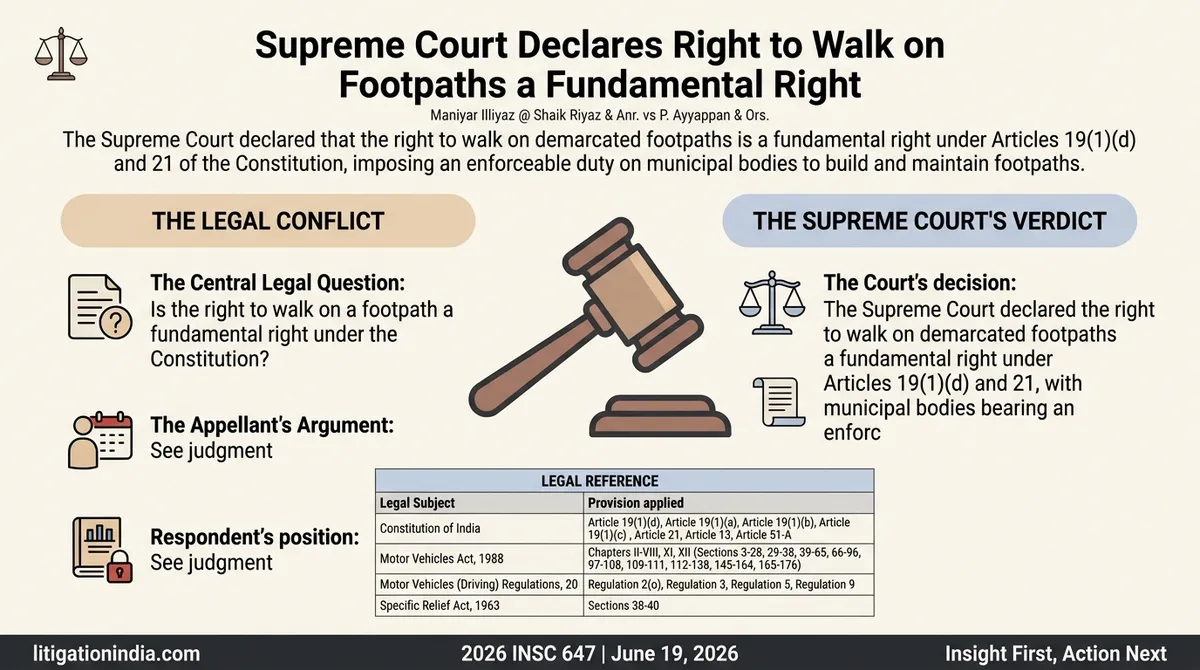
Supreme Court Declares Right to Walk on Footpaths a Fundamental Right — infographic summary

What this case means

A five-year-old boy was killed by a tanker while being walked to school on a road with no footpath. The Supreme Court used this tragedy to declare that the right to walk on demarcated footpaths is a fundamental right under Articles 19(1)(d) and 21 of the Constitution, imposing a duty on municipal bodies to build and maintain footpaths. The Court also enhanced the father's compensation from Rs. 4,70,000 to Rs. 11,44,628.

What the Supreme Court held

The Supreme Court declared the right to walk on demarcated footpaths a fundamental right under Articles 19(1)(d) and 21, with municipal bodies bearing an enforceable duty to provide footpaths wherever roads exist. The Court enhanced the compensation to Rs. 11,44,628 payable within two months. It directed the case to be renumbered under Article 32 as 'Re: Fundamental Right to Walk and Footpath' and sent copies of the judgment to three central Ministries and the Law Commission.

Case: Maniyar Iliyaz @ Shaik Riyaz & Anr. vs P. Ayyappan & Ors. (2026) Citation: 2026 INSC 647

Want the full legal reasoning, citations and case documents?

Read the full judgment analysis
right to walk
fundamental right
footpath
Article 19(1)(d)
pedestrian rights
Motor Vehicles Act 1988
motor accident compensation
Maniyar Iliyaz
demarcated footpath
municipal duty
Specific Relief Act
Constitution of India
Article 19(1)(d), Article 19(1)(a), Article 19(1)(b), Article 19(1)(c), Article 21, Article 13, Article 51-A, Constitution of India
Chapters II-VIII, XI, XII (Sections 3-28, 29-38, 39-65, 66-96, 97-108, 109-111, 112-138, 145-164, 165-176), Motor Vehicles Act, 1988