
All insights

Can a contemnor appeal to a Division Bench against a Single Judge's contempt order?

Supreme Court clarifies when Special Appeal lies against contempt court orders

This case concerned whether an alleged contemnor could file a Special Appeal before a Division Bench against an interim order passed by a Single Judge in contempt proceedings. The Supreme Court held t

Litigation India Editorial 14 October 2026 1 min read 2026 INSC 1128

Story

Case at a glance1 / 6

Supreme Court of India

Contempt Orders and Intra-Court Appeals: A Landmark Clarification

Sanjay Prasad v. Madhusudan Dwivedi & Ors. | 2026 INSC 1128

Court: Supreme Court of India | Date: October 14, 2026Bench: Justice Dipankar Datta and Justice Sheel NaguArea of law: Contempt of Court, Intra-Court Appeals, Letters PatentCivil Appeal arising out of SLP (C) No. 33319 of 2026
Supreme Court clarifies when Special Appeal lies against contempt court orders · 2026 INSC 11282026-10-14T18:38:59.986788+00:00
The legal question2 / 6

Can a Special Appeal be filed against a Single Judge's contempt order?

Core legal issue before the Supreme Court

  • Appellant: Contempt jurisdiction is criminal in nature; Rule 5 bars Special Appeal; only Article 136 remains.
  • Appellant: Appeal under Section 19, Contempt of Courts Act 1971 not maintainable as no punishment was imposed.
  • Respondent: Not called upon to answer as Court confined itself to the jurisdictional question.
  • Court's query: Whether Rule 5, Allahabad High Court Rules 1952 bars a Special Appeal from this order.
Supreme Court clarifies when Special Appeal lies against contempt court orders · 2026 INSC 11282026-10-14T18:38:59.986788+00:00
Statutory comparison3 / 6

When Does an Intra-Court Appeal Lie Against a Contempt Order?

Appealable vs Non-Appealable Contempt Orders

Type of OrderAppeal under Section 19 (1971 Act)Special Appeal / Intra-Court Appeal
Order imposing punishment for contemptMaintainableNot needed
Order deciding substantive rights of parties beyond contemptNot maintainableMaintainable if rules permit
Order rejecting compliance affidavit and re-examining correctness of compliance orderNot maintainableMaintainable — falls under category (ii)
Order declining to initiate / dropping contempt proceedingsNot maintainableMay be challenged under Article 136
The key test: Was the Court deciding contempt guilt/punishment, or was it adjudicating upon substantive rights of the parties?
Supreme Court clarifies when Special Appeal lies against contempt court orders · 2026 INSC 11282026-10-14T18:38:59.986788+00:00
The Court's reasoning4 / 6

Court's Reasoning: From Contempt Order to Special Appeal

Step-by-step legal reasoning

  1. 1Step 1: Contempt jurisdiction under Article 215 is sui generis — neither strictly civil nor strictly criminal.
  2. 2Step 2: Section 19, Contempt of Courts Act 1971 only covers appeals against punishment orders — not interim or substantive-rights orders.
  3. 3Step 3: Chunilal Nanda (2006) held that where a contempt court decides merits of the underlying dispute, an intra-court appeal lies subject to the high court's rules.
  4. 4Step 4: The impugned order rejected the compliance affidavit and re-examined correctness of compliance — this decides substantive rights and qualifies as a 'judgment'.
  5. 5Step 5: Rule 5 bar on 'criminal jurisdiction' does not apply to civil contempt — the ratio of Ram Kishan Fauji cannot be extended to contempt proceedings; referred to larger Bench.
Supreme Court clarifies when Special Appeal lies against contempt court orders · 2026 INSC 11282026-10-14T18:38:59.986788+00:00
The verdict5 / 6

The Supreme Court's Final Decision

  • The Fact: Single Judge rejected compliance affidavit in contempt proceedings and directed appearance of Additional Chief Secretary for framing of charges.
  • The Law: An intra-court Special Appeal lies against a contempt order that decides substantive rights; civil contempt is not exercise of 'criminal jurisdiction' under Rule 5.
  • The Result: Appellant directed to file Special Appeal before Division Bench within a fortnight; contempt proceedings stayed for two months; Ram Kishan Fauji referred to larger Bench.
Appeal disposed of; appellant may file Special Appeal within a fortnight; contempt petition stayed for two months; Ram Kishan Fauji reference to appropriate Bench.
Supreme Court clarifies when Special Appeal lies against contempt court orders · 2026 INSC 11282026-10-14T18:38:59.986788+00:00
Why it matters6 / 6

Why This Judgment Matters for Ordinary People

Practical significance

  • Government officials facing contempt proceedings now have a clearer path to challenge orders that decide their substantive rights within the High Court itself.
  • Litigants need not always rush to the Supreme Court under Article 136 — a Division Bench remedy within the same High Court is available in appropriate cases.
  • The reference to a larger Bench on Ram Kishan Fauji may expand intra-court appeal rights in writ matters touching criminal law, improving access to justice.
  • Access to justice is protected: the Court expressly noted that forcing people to Delhi for every Article 136 petition creates practical and financial barriers.
A contempt court that decides substantive rights crosses into appealable territory — the High Court's Division Bench, not only the Supreme Court, can correct such overreach.
Supreme Court clarifies when Special Appeal lies against contempt court orders · 2026 INSC 11282026-10-14T18:38:59.986788+00:00
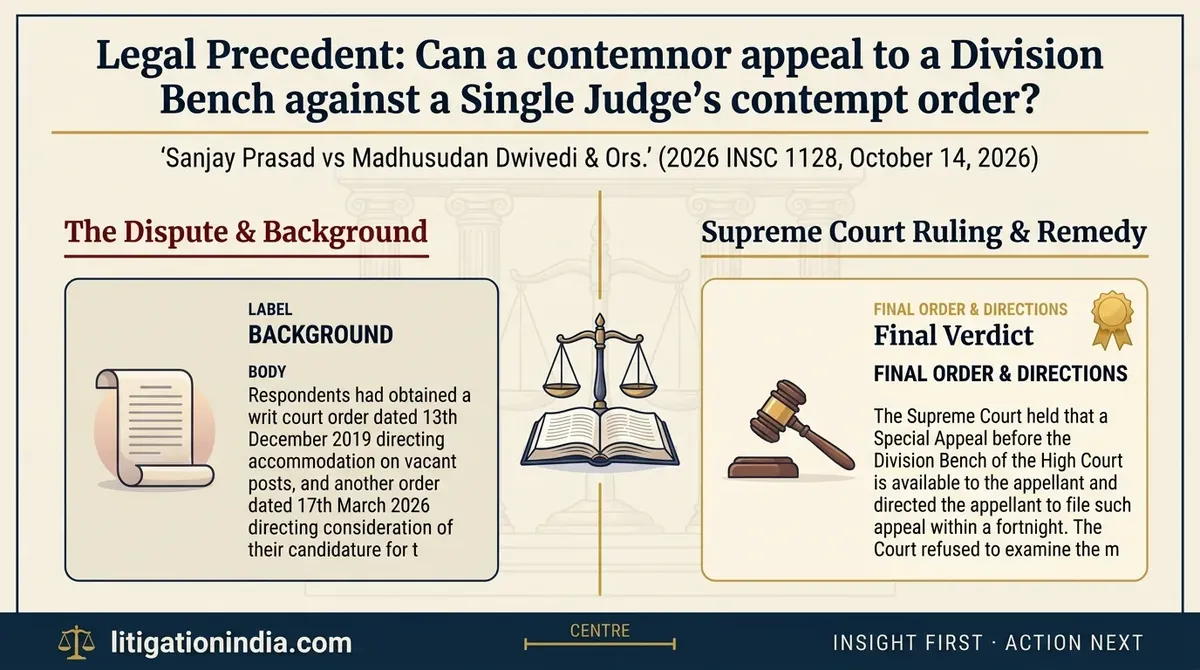
Supreme Court clarifies when Special Appeal lies against contempt court orders — infographic summary

What this case means

This case concerned whether an alleged contemnor could file a Special Appeal before a Division Bench against an interim order passed by a Single Judge in contempt proceedings. The Supreme Court held that a Special Appeal does lie in certain situations where the contempt court decides substantive rights beyond mere punishment. The Court also referred to a larger Bench the question of whether Ram Kishan Fauji correctly interpreted the Letters Patent regarding intra-court appeals.

What the Supreme Court held

The Supreme Court held that a Special Appeal before the Division Bench of the High Court is available to the appellant and directed the appellant to file such appeal within a fortnight. The Court refused to examine the merits of the impugned order and stayed the contempt proceedings before the Single Judge for two months. The Court also referred the question of correctness of Ram Kishan Fauji v. State of Haryana (2017) 5 SCC 533 to an appropriate larger Bench through the Chief Justice.

Case: Sanjay Prasad vs Madhusudan Dwivedi & Ors. (2026) Citation: 2026 INSC 1128

Want the full legal reasoning, citations and case documents?

Read the full judgment analysis
Sanjay Prasad
Madhusudan Dwivedi
contempt of court
intra-court appeal
Special Appeal
Allahabad High Court Rules 1952
Contempt of Courts Act 1971
Article 226
Ram Kishan Fauji
Letters Patent
civil contempt
quasi-criminal
Section 2(b), Section 12, Section 19, Contempt of Courts Act, 1971
Articles 136, 215, 226, 227, 14, 21, 39A, Constitution of India, 1950