
All insights

Can police statements of hostile witnesses be used as substantive evidence of guilt?

Supreme Court Acquits Murder Accused as All Witnesses Turned Hostile and Evidence Was Inadmissible

Naresh was convicted for double murder and sentenced to life imprisonment based on police statements of witnesses who all turned hostile in court. The Supreme Court held that statements recorded under

Litigation India Editorial 16 November 2026 1 min read 2026 INSC 1220

Story

Case at a glance1 / 6

Supreme Court of India

Double Murder Acquittal: When All Witnesses Turn Hostile

Naresh v. State of Haryana — 2026 INSC 1220

Court: Supreme Court of India; decided November 16, 2026Bench: Justice Satish Chandra Sharma and Justice Nongmeikapam Kotiswar SinghArea of law: Criminal law — murder, circumstantial evidence, hostile witnessesAppellant convicted for double murder, life imprisonment; Supreme Court acquits
Supreme Court Acquits Murder Accused as All Witnesses Turned Hostile and Evidence Was Inadmissible · 2026 INSC 12202026-11-16T20:50:27.313753+00:00
The legal question2 / 6

Can Police Statements of Hostile Witnesses Prove Guilt?

Core legal dispute on admissibility of Section 161 CrPC statements

  • Appellant: Every private witness turned hostile; FIR is hearsay; police statements are inadmissible under Section 162 CrPC; recoveries not proved; forensic evidence inconclusive.
  • Appellant: Same evidence was held insufficient against Subhash; parity demands acquittal.
  • Respondent State: Witnesses named Appellant consistently within hours of occurrence; they resiled only due to loyalty to accused.
  • Respondent State: Disclosure statements led to blood-stained clothes and weapons; motive established; concurrent findings should not be disturbed under Article 136.
Supreme Court Acquits Murder Accused as All Witnesses Turned Hostile and Evidence Was Inadmissible · 2026 INSC 12202026-11-16T20:50:27.313753+00:00
Statutory comparison3 / 6

Police Statements vs. Court Testimony: What the Law Allows

Section 162 CrPC and Section 27 Evidence Act applied in this case

ProvisionWhat it permitsHow the Court applied it
Section 162(1) CrPC — police statementsOnly to contradict a witness; never as substantive evidence of factsCourts below used hostile witnesses' police statements to prove motive and complicity — held to be an error of law
Section 27 Evidence Act — disclosure recoveriesOnly the fact distinctly discovered; exact words of accused must be proved by investigating officerPW-17 and PW-20 never narrated exact words; disclosure statements held not proved in accordance with law
Section 164 CrPC — Magistrate's statementStronger footing than Section 161 statement; still not substantive evidence if resiledNo witness was produced before a Magistrate; every statement relied upon fell under Section 162 CrPC bar
Sections 25 and 26 Evidence Act — confessions to policeInadmissible; confession made to police officer cannot be provedMotive stated in disclosure statement (Ex.PS and Ex.PT) — inadmissible as confessions to police
A proved contradiction only impeaches the witness's credit; it never makes his police statement evidence of the facts narrated.
Supreme Court Acquits Murder Accused as All Witnesses Turned Hostile and Evidence Was Inadmissible · 2026 INSC 12202026-11-16T20:50:27.313753+00:00
The Court's reasoning4 / 6

How the Court Reached Acquittal: Step by Step

Applying the panchsheel of circumstantial evidence from Sharad Birdhichand Sarda

  1. 1Step 1: All private witnesses — including the informant and deceased's son — turned hostile; FIR was hearsay; Section 162 CrPC bars use of police statements as evidence.
  2. 2Step 2: Disclosure statements not proved; investigating officers never narrated exact words of Appellant; danda unconnected to incised fatal injuries; gandasi disclosure tainted by post-mortem timing.
  3. 3Step 3: Medical opinion equally applicable to gandasi and to co-accused's axe; forensic blood evidence inconclusive throughout; nothing linking Appellant's clothes to either deceased.
  4. 4Step 4: Charges under Sections 449, 297 and 201 IPC had no admissible foundation; no proved act of house-entry, body-movement or motive.
  5. 5Step 5: Parity — once FIR and Section 161 statements excluded, evidence identical to that found insufficient against Subhash; conviction cannot stand on principle of parity.
Supreme Court Acquits Murder Accused as All Witnesses Turned Hostile and Evidence Was Inadmissible · 2026 INSC 12202026-11-16T20:50:27.313753+00:00
The verdict5 / 6

The Court's Final Verdict

Criminal Appeal Nos. 1137-1138 of 2014 — Allowed

  • The Fact: Two widows were murdered in village Ranila on 17 April 2011; every eyewitness turned hostile; no direct evidence ever placed the Appellant at the scene.
  • The Law: Section 162 CrPC absolutely bars police statements as substantive evidence; Section 27 Evidence Act requires exact words of disclosure to be proved; panchsheel of circumstantial evidence (Sharad Birdhichand Sarda) requires complete chain excluding all other hypotheses.
  • The Result: Conviction and sentence under Sections 302, 449, 297 and 201 IPC set aside; Appellant acquitted of all charges; immediate release ordered; compensation order set aside; District Legal Services Authority recommended to consider victim compensation.
Prosecution failed to prove guilt beyond reasonable doubt; Appellant entitled to benefit of doubt; conviction and sentence set aside in entirety.
Supreme Court Acquits Murder Accused as All Witnesses Turned Hostile and Evidence Was Inadmissible · 2026 INSC 12202026-11-16T20:50:27.313753+00:00
Why it matters6 / 6

What This Judgment Means for Ordinary People

Practical significance of the ruling

  • Police cannot build a conviction on out-of-court statements that witnesses disown in court — this protects everyone from being convicted on fabricated or withdrawn accounts.
  • A second disclosure statement produced only after post-mortem findings change the weapon of offence is a red flag courts must not ignore.
  • Courts must treat co-accused identically when the evidence against each is of the same kind and quality — no selective application of the same legal reasoning.
  • Even when an accused is acquitted, the Court can recommend victim compensation so families of victims are not left without remedy.
Suspicion, however grave, cannot take the place of proof — a conviction for murder must rest on admissible evidence proving guilt beyond reasonable doubt.
Supreme Court Acquits Murder Accused as All Witnesses Turned Hostile and Evidence Was Inadmissible · 2026 INSC 12202026-11-16T20:50:27.313753+00:00
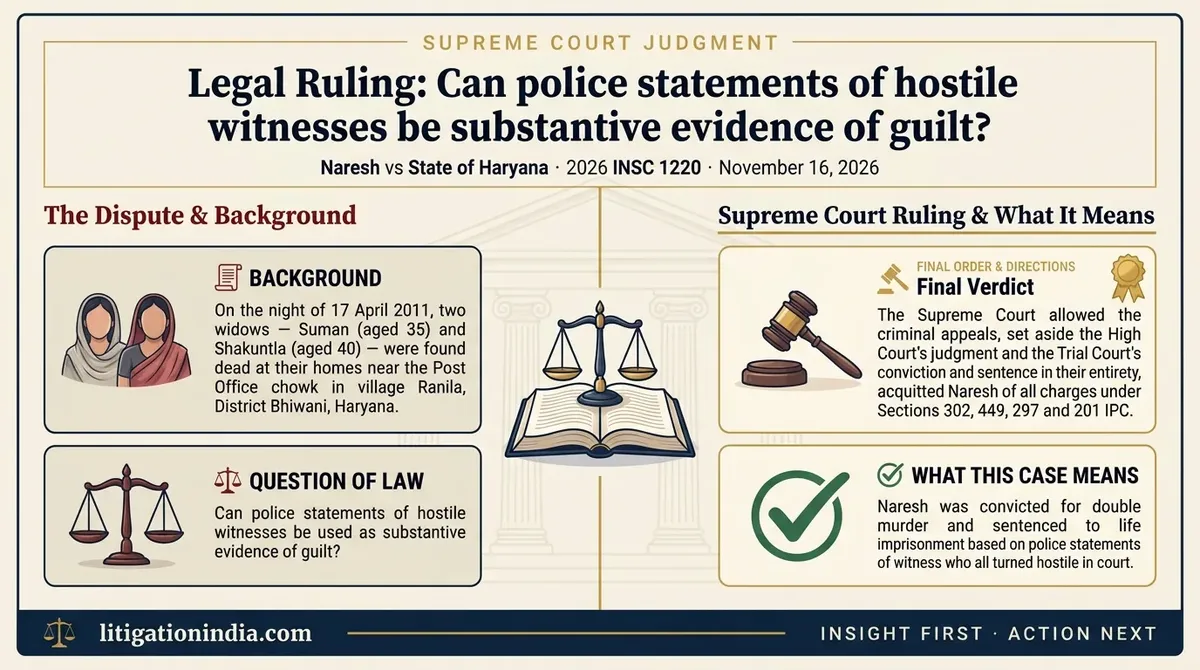
Supreme Court Acquits Murder Accused as All Witnesses Turned Hostile and Evidence Was Inadmissible — infographic summary

What this case means

Naresh was convicted for double murder and sentenced to life imprisonment based on police statements of witnesses who all turned hostile in court. The Supreme Court held that statements recorded under Section 161 CrPC cannot be used as substantive evidence, that recoveries were not properly proved, and that forensic evidence was inconclusive. The Court acquitted him, stressing that suspicion cannot replace proof.

What the Supreme Court held

The Supreme Court allowed the criminal appeals, set aside the High Court's judgment and the Trial Court's conviction and sentence in their entirety, and acquitted Naresh of all charges under Sections 302, 449, 297 and 201 IPC. The Court directed his immediate release if in custody and set aside the compensation order under Section 357 CrPC, while recommending that the District Legal Services Authority, Bhiwani, consider compensation to the families of the deceased under the Victim Compensation Scheme under Section 396 of the Bharatiya Nagarik Suraksha Sanhita, 2023.

Case: Naresh vs State of Haryana (2026) Citation: 2026 INSC 1220

Want the full legal reasoning, citations and case documents?

Read the full judgment analysis
Naresh v State of Haryana
murder acquittal
hostile witnesses
Section 162 CrPC
Section 27 Evidence Act
circumstantial evidence
panchsheel principles
honour killing
disclosure statement
FIR hearsay
Section 162(1), Section 161, Section 173, Section 313, Section 357, Section 357A(3), Section 366, Code of Criminal Procedure, 1973
Section 27, Section 25, Section 26, Section 145, Section 155(3), Indian Evidence Act, 1872
Sections 302, 449, 297, 201, Section 34, Indian Penal Code, 1860
Article 136, Constitution of India