
All insights

Can one accused be convicted under Section 302 IPC alone when charged only jointly under Section 302 read with Section 34?

Supreme Court Acquits Mother-in-Law After Reversing High Court Murder Conviction

A woman convicted by the High Court for murdering her daughter-in-law by burning was acquitted by the Supreme Court. The Court found that three dying declarations were inconsistent with each other, an

Litigation India Editorial 15 November 2026 1 min read 2026 INSC 1196

Story

Case at a glance1 / 6

Supreme Court of India

Murder Conviction Reversed: Dying Declaration Without Corroboration

Sau. Kamalbai Waman Patil v. State of Maharashtra — 2026 INSC 1196

Court: Supreme Court of India; Date: 5 November 2026Bench: Justice Ujjal Bhuyan and Justice Atul S. ChandurkarArea of law: Criminal Law — Murder, Dying Declaration, Reversal of AcquittalAppellant acquitted after High Court wrongly reversed Sessions Court acquittal
Supreme Court Acquits Mother-in-Law After Reversing High Court Murder Conviction · 2026 INSC 11962026-11-15T16:34:45.303903+00:00
The legal question2 / 6

Can One Accused Be Convicted Under Section 302 IPC Alone When Charged Only Jointly Under Section 302 read with Section 34?

Core legal issue in this appeal

  • Appellant: High Court erred by accepting only Exhibit-56 without corroboration while discarding two other dying declarations.
  • Appellant: Reversing acquittal required clear and convincing evidence; prosecution evidence was inconsistent.
  • Respondent: Dying declaration at Exhibit-56 by Medical Officer was voluntary; accused admitted appellant was alone with victim.
  • Respondent: Seizure of incriminating material and chemical analyser report supported conviction.
Supreme Court Acquits Mother-in-Law After Reversing High Court Murder Conviction · 2026 INSC 11962026-11-15T16:34:45.303903+00:00
Statutory comparison3 / 6

Three Dying Declarations: What Each Said and Court's Treatment

Exhibits 56, 44, and 48 — inconsistencies that determined the outcome

Dying DeclarationWho Recorded ItWhat It Said About AppellantCourt's Treatment
Exhibit-56Medical Officer PW-7 (Dr. Prashant Shinde)Appellant poured kerosene AND set victim on fireSessions Court: rejected; High Court: accepted; Supreme Court: insufficient without corroboration
Exhibit-44Police Officer PW-4 (ASI Prakash Wagh)Appellant poured kerosene; father-in-law A2 set fire; A1 and A4 tied hands and legsSessions Court: rejected; High Court: discarded; Supreme Court: not disturbed
Exhibit-48Special Executive Magistrate PW-5 (Sardar Mansuri)Similar to Exhibit-44; appellant poured kerosene; A2 set fireSessions Court: rejected; High Court: discarded; Supreme Court: not disturbed
When dying declarations are inconsistent, corroborative evidence is essential before relying on any one of them.
Supreme Court Acquits Mother-in-Law After Reversing High Court Murder Conviction · 2026 INSC 11962026-11-15T16:34:45.303903+00:00
The Court's reasoning4 / 6

Court's Reasoning: Why the Conviction Could Not Stand

Step-by-step legal analysis

  1. 1Step 1: Charge was only under Section 302 read with Section 34 IPC against all four accused jointly — no independent charge under Section 302 against appellant alone.
  2. 2Step 2: High Court acquitted A1, A2, A4 — meaning in law they did not participate; appellant could not have acted in common intention with them.
  3. 3Step 3: Convicting appellant under Section 302 alone after three accused were acquitted amounted to creating a new charge never framed — impermissible per Krishna Govind Patil v. State of Maharashtra (1962 INSC 19).
  4. 4Step 4: Sole basis for conviction — Exhibit-56 — was inconsistent with two other dying declarations; Vishwas Desle, material witness present when Exhibit-56 was made, was never examined.
  5. 5Step 5: Without corroboration of Exhibit-56 and with prosecution's initial burden undischarged, Section 106 Evidence Act could not be used against appellant — acquittal restored.
Supreme Court Acquits Mother-in-Law After Reversing High Court Murder Conviction · 2026 INSC 11962026-11-15T16:34:45.303903+00:00
The verdict5 / 6

Supreme Court's Final Verdict

Criminal Appeal No. 118 of 2018 — Allowed

  • The Fact: Sunitabai died of 90% burn injuries on 15 April 2005; three inconsistent dying declarations recorded; appellant's son and two others also accused.
  • The Law: Conviction under Section 302 IPC alone impermissible where charge was only under Section 302 read with Section 34 IPC and other accused were acquitted; single uncorroborated dying declaration insufficient to reverse acquittal.
  • The Result: High Court's judgment quashed; appellant acquitted under Section 302 IPC; directed to be released forthwith.
High Court's judgment in Criminal Appeal No.63 of 2008 dated 28.09.2017 is quashed; appellant acquitted and to be set free forthwith.
Supreme Court Acquits Mother-in-Law After Reversing High Court Murder Conviction · 2026 INSC 11962026-11-15T16:34:45.303903+00:00
Why it matters6 / 6

What This Judgment Means for Ordinary People

Practical significance

  • An accused cannot be punished for a specific charge that was never individually framed against them — the law protects citizens from surprise convictions.
  • When multiple dying declarations contradict each other, courts must look for corroborating evidence before relying on just one to convict.
  • The prosecution must prove its case first; the accused's silence or inability to explain cannot substitute the prosecution's burden of proof.
  • Appellate courts must be cautious when reversing acquittals — the presumption of innocence grows stronger once a person is acquitted by a trial court.
A conviction cannot rest on one uncorroborated dying declaration when other dying declarations contradict it and a material witness was never examined.
Supreme Court Acquits Mother-in-Law After Reversing High Court Murder Conviction · 2026 INSC 11962026-11-15T16:34:45.303903+00:00
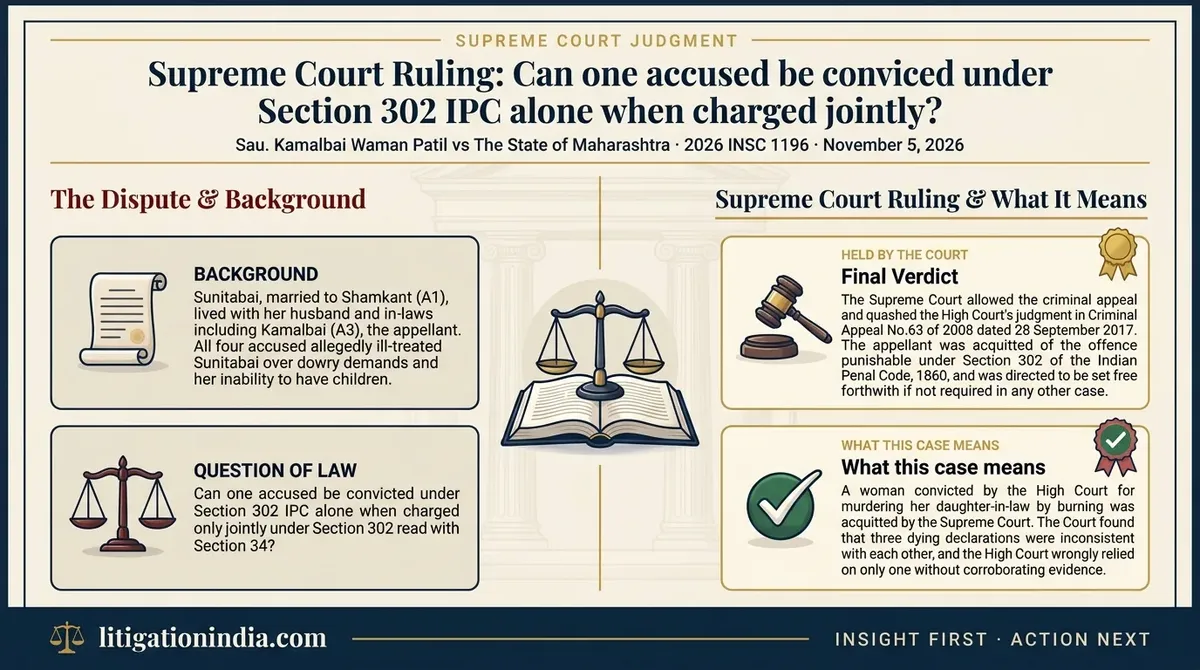
Supreme Court Acquits Mother-in-Law After Reversing High Court Murder Conviction — infographic summary

What this case means

A woman convicted by the High Court for murdering her daughter-in-law by burning was acquitted by the Supreme Court. The Court found that three dying declarations were inconsistent with each other, and the High Court wrongly relied on only one without corroborating evidence. Additionally, the accused was convicted under Section 302 IPC alone even though the charge was only under Section 302 read with Section 34 IPC against all accused jointly.

What the Supreme Court held

The Supreme Court allowed the criminal appeal and quashed the High Court's judgment in Criminal Appeal No.63 of 2008 dated 28 September 2017. The appellant was acquitted of the offence punishable under Section 302 of the Indian Penal Code, 1860, and was directed to be set free forthwith if not required in any other case.

Case: Sau. Kamalbai Waman Patil vs The State of Maharashtra (2026) Citation: 2026 INSC 1196

Want the full legal reasoning, citations and case documents?

Read the full judgment analysis
Kamalbai Waman Patil
State of Maharashtra
Section 302 IPC
Section 34 IPC
dying declaration
reversal of acquittal
common intention
murder
2026 INSC 1196
Section 106 Evidence Act
inconsistent dying declarations
Section 302, Section 34, Section 498A, Section 342, Section 406, Indian Penal Code, 1860
Section 106, Evidence Act, 1872
Section 161, Section 386(a), Code of Criminal Procedure, 1973