
All insights

Can a POCSO conviction stand when key witnesses fail to identify the accused?

Supreme Court Acquits Accused in POCSO Case Due to Unreliable Prosecution Evidence

The case involved a man convicted under the POCSO Act for allegedly sexually assaulting his intellectually disabled minor niece. The Supreme Court acquitted him after finding that key witnesses failed

Litigation India Editorial 10 October 2026 1 min read 2026 INSC 1102

Story

Case at a glance1 / 5

Supreme Court of India

POCSO Conviction Set Aside: Identification Failure and Witness Tutoring

Charming Rupon vs State of Meghalaya | 2026 INSC 1102

Court: Supreme Court of India | Date: 09 October 2026Bench: Justice Vikram Nath and Justice Sandeep MehtaArea of Law: Criminal Law — POCSO Act, appeal against convictionAccused convicted under Section 6, POCSO Act for assault on intellectually disabled minor
Supreme Court Acquits Accused in POCSO Case Due to Unreliable Prosecution Evidence · 2026 INSC 11022026-10-10T08:07:11.965233+00:00
The legal question2 / 5

Can a POCSO conviction stand when witnesses fail to identify the accused in court?

Core legal issue decided by the Supreme Court

  • Appellant: Victim and cousin both failed to identify accused in court; victim admitted being tutored by prosecutor.
  • Appellant: FIR delayed 10 days; material witness (teacher) not examined; alibi proved by documentary evidence.
  • Respondent: Section 164 CrPC statements recorded early corroborate prosecution case; minor discrepancies are natural.
  • Respondent: Victim's mental disability and passage of time explain identification failure; Section 106 Evidence Act burden shifts to accused.
Supreme Court Acquits Accused in POCSO Case Due to Unreliable Prosecution Evidence · 2026 INSC 11022026-10-10T08:07:11.965233+00:00
The Court's reasoning3 / 5

How the Court Reasoned to Acquittal

Step-by-step reasoning of the Supreme Court

  1. 1Step 1: PW-4 (victim) failed to identify accused in court and admitted being coached by the Special Public Prosecutor.
  2. 2Step 2: PW-2 (cousin) retracted her examination-in-chief, admitting she got the accused's name from PW-1, not from personal knowledge.
  3. 3Step 3: PW-1 (mother/informant) showed unnatural conduct; FIR omitted key facts later improved upon during trial.
  4. 4Step 4: Medical witnesses (PW-3, PW-8) denied effective cross-examination opportunity; prosecution withheld teacher-witness without explanation.
  5. 5Step 5: Credible alibi evidence brushed aside; cumulatively, prosecution failed to prove guilt beyond reasonable doubt — accused acquitted.
Supreme Court Acquits Accused in POCSO Case Due to Unreliable Prosecution Evidence · 2026 INSC 11022026-10-10T08:07:11.965233+00:00
The verdict4 / 5

The Supreme Court's Final Verdict

Fact, Law, and Result

  • The Fact: Prosecution witnesses failed to identify the accused; victim admitted tutoring; FIR omitted material facts; teacher-witness withheld.
  • The Law: Prosecution must prove guilt beyond reasonable doubt even in POCSO cases; adverse inference lies for withholding material witness.
  • The Result: Conviction under Section 6 POCSO Act and High Court judgment set aside; accused acquitted; directed to be released forthwith.
Conviction set aside; accused acquitted and directed to be released forthwith if not wanted in any other case.
Supreme Court Acquits Accused in POCSO Case Due to Unreliable Prosecution Evidence · 2026 INSC 11022026-10-10T08:07:11.965233+00:00
Why it matters5 / 5

Why This Judgment Matters for Ordinary People

Practical significance

  • Even in sensitive POCSO cases, an accused cannot be convicted unless the prosecution proves guilt beyond reasonable doubt.
  • Tutoring a witness to give pre-scripted answers before the court seriously damages the prosecution case and may result in acquittal.
  • Prosecutors must examine all material witnesses; withholding a key witness without explanation can lead courts to draw adverse inference.
  • Trial courts must ensure accused persons have genuine opportunity to cross-examine prosecution witnesses; denial of this is a serious error.
Proof beyond reasonable doubt is non-negotiable — sympathy for a victim cannot substitute for credible, untutored evidence.
Supreme Court Acquits Accused in POCSO Case Due to Unreliable Prosecution Evidence · 2026 INSC 11022026-10-10T08:07:11.965233+00:00
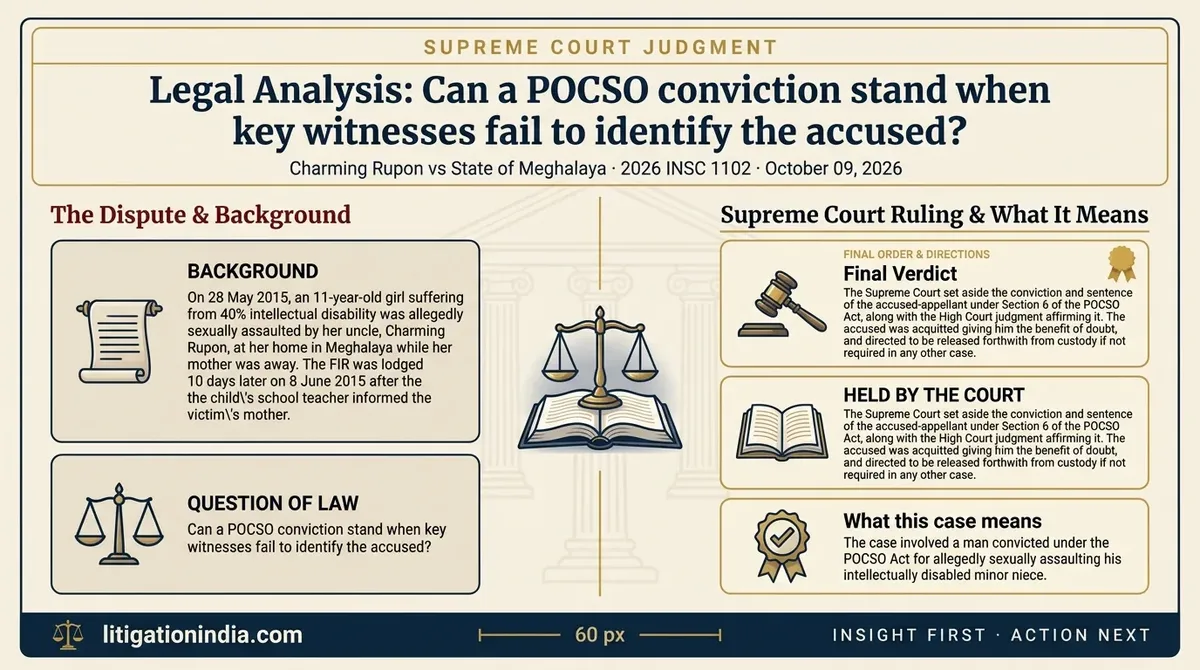
Supreme Court Acquits Accused in POCSO Case Due to Unreliable Prosecution Evidence — infographic summary

What this case means

The case involved a man convicted under the POCSO Act for allegedly sexually assaulting his intellectually disabled minor niece. The Supreme Court acquitted him after finding that key witnesses failed to identify him in court, the victim admitted being tutored by the public prosecutor, and the prosecution withheld a crucial teacher-witness. The judgment underlines that even in sensitive cases, the standard of proof beyond reasonable doubt cannot be diluted.

What the Supreme Court held

The Supreme Court set aside the conviction and sentence of the accused-appellant under Section 6 of the POCSO Act, along with the High Court judgment affirming it. The accused was acquitted giving him the benefit of doubt, and directed to be released forthwith from custody if not required in any other case.

Case: Charming Rupon vs State of Meghalaya (2026) Citation: 2026 INSC 1102

Want the full legal reasoning, citations and case documents?

Read the full judgment analysis
Charming Rupon
State of Meghalaya
POCSO Act
sexual assault
intellectually disabled child
benefit of doubt
identification failure
tutoring of witness
FIR delay
alibi
material witness withheld
2026 INSC 1102
Section 6, Protection of Children from Sexual Offences Act, 2012
Section 161, Section 164, Section 173(2), Section 313, Code of Criminal Procedure, 1973