
All insights

Can heirs claim possession based on an Agreement to Sell when a registered sale deed exists?

Suit for Possession Dismissed: Agreement to Sell Without Registered Deed Confers No Title

The legal heirs of Sohan Singh sued for possession of a Delhi plot, claiming he had an Agreement to Sell. The Supreme Court dismissed the appeal, holding the suit was barred by limitation, Sohan Singh

Litigation India Editorial 16 October 2026 1 min read 2026 INSC 1137

Story

Case at a glance1 / 7

Supreme Court of India

Possession Suit Fails: Agreement to Sell Cannot Replace Registered Sale Deed

Smt. Rano Singh and Others vs. Sh. Gurbax Singh (D) Th LRs and Others | 2026 INSC 1137

Court: Supreme Court of India | Date: 16 October 2026Bench: Justice Aravind Kumar and Justice Vipul M. PancholiArea of Law: Civil Law — Property, Limitation, EstoppelDispute: Possession of Plot No. 8, Friends Colony, New Delhi (approx. 4,132 sq. yds.)
Suit for Possession Dismissed: Agreement to Sell Without Registered Deed Confers No Title · 2026 INSC 11372026-10-16T13:37:59.659177+00:00
The legal question2 / 7

Can Legal Heirs Claim Possession on an Agreement to Sell Alone?

Core legal issue decided by the Supreme Court

  • Appellant: Sohan Singh held an Agreement to Sell from 1952 and paid consideration; his heirs claim ownership and possession.
  • Appellant: Sale deed in defendant's favour was fraudulent and executed in collusion with the society.
  • Respondent: Sohan Singh voluntarily wrote in 1954 requesting transfer to defendant; he never held a registered sale deed.
  • Respondent: Defendant built the house from own funds, holds a registered sale deed since 1960, and has been in continuous possession.
Suit for Possession Dismissed: Agreement to Sell Without Registered Deed Confers No Title · 2026 INSC 11372026-10-16T13:37:59.659177+00:00
Statutory comparison3 / 7

Limitation Articles Applied to Each Claim

Limitation Act, 1963 — Articles 54, 59 and 64

ProvisionWhat it coversHow the Court applied it
Article 54Specific performance — 3 years from date fixed or notice of refusalExpired by 1958 (date fixed) or 1966 (1963 knowledge); suit filed 1975 — barred
Article 59Cancellation of instrument — 3 years from knowledgeEven from 1963 knowledge, expired 1966; suit filed 1975 — barred
Article 64 + Section 27Possession based on prior possession — 12 years from dispossessionDispossession in 1954; expired 1966; suit filed 1975 — barred and right extinguished
The suit filed in 1975 was barred under every applicable article of the Limitation Act, 1963.
Suit for Possession Dismissed: Agreement to Sell Without Registered Deed Confers No Title · 2026 INSC 11372026-10-16T13:37:59.659177+00:00
The Court's reasoning4 / 7

Why the Possession Suit Could Not Succeed

Court's reasoning from facts to conclusion

  1. 1Step 1: Agreement to Sell (1952) is not a sale deed — Section 54, Transfer of Property Act, 1882 — no title passed to Sohan Singh.
  2. 2Step 2: Sohan Singh's letter (04.10.1954) voluntarily surrendered his right to construct and requested transfer to defendant — direct acquiescence.
  3. 3Step 3: Society executed registered Sale Deed in favour of defendant (03.12.1960) — defendant became legal owner; cloud on plaintiffs' title arose.
  4. 4Step 4: Plaintiffs filed suit for possession only in 1975 without seeking cancellation of defendant's registered sale deed — suit not maintainable per Anathula Sudhakar.
  5. 5Step 5: Suit barred under Articles 54, 59 and 64 of Limitation Act, 1963 — appeal dismissed.
Suit for Possession Dismissed: Agreement to Sell Without Registered Deed Confers No Title · 2026 INSC 11372026-10-16T13:37:59.659177+00:00
Key points5 / 7

Estoppel vs. Acquiescence: Both Applied Against Plaintiffs

Section 115, Indian Evidence Act and the equitable doctrine of acquiescence

  • Estoppel (Section 115): Sohan Singh's letter made a factual representation; society and defendant acted on it; defendant's position permanently altered by building and receiving sale deed.
  • Acquiescence: Sohan Singh never revoked his 1954 letter or challenged the sale deed during his lifetime — silent consent to the transfer.
  • Effect: Neither Sohan Singh nor his heirs can deny the contents of the 1954 letter or reassert title over the plot.
  • Distinction: Acquiescence is independent of delay or limitation — it is founded on conduct and knowledge, not on time alone.
Suit for Possession Dismissed: Agreement to Sell Without Registered Deed Confers No Title · 2026 INSC 11372026-10-16T13:37:59.659177+00:00
The verdict6 / 7

The Court's Final Decision

Civil Appeal No. 7025 of 2012 dismissed

  • The Fact: Sohan Singh voluntarily surrendered his rights under the 1952 Agreement to Sell in 1954; defendant held a registered sale deed since 1960 and was in uninterrupted possession.
  • The Law: Agreement to Sell confers no title (Section 54, TP Act); suit for possession without cancellation of registered sale deed not maintainable; suit time-barred under Articles 54, 59 and 64, Limitation Act, 1963.
  • The Result: Appeal dismissed; High Court judgment affirming dismissal of suit upheld; no order as to costs.
Appeal dismissed; judgment of the High Court affirming dismissal of suit warrants no interference and is upheld.
Suit for Possession Dismissed: Agreement to Sell Without Registered Deed Confers No Title · 2026 INSC 11372026-10-16T13:37:59.659177+00:00
Why it matters7 / 7

What This Means for Property Owners and Buyers

Practical lessons from the judgment

  • An Agreement to Sell is not ownership: always insist on a registered sale deed to secure legal title to any property.
  • If you know of a fraudulent document affecting your property, challenge it in court within three years — delay is fatal.
  • If your title is disputed by a registered deed held by another, you must seek cancellation of that deed, not just possession.
  • Voluntarily giving up rights in writing (even informally) can permanently estop you and your heirs from asserting those rights later.
An Agreement to Sell without a registered sale deed gives you no ownership — act within limitation or lose your rights forever.
Suit for Possession Dismissed: Agreement to Sell Without Registered Deed Confers No Title · 2026 INSC 11372026-10-16T13:37:59.659177+00:00
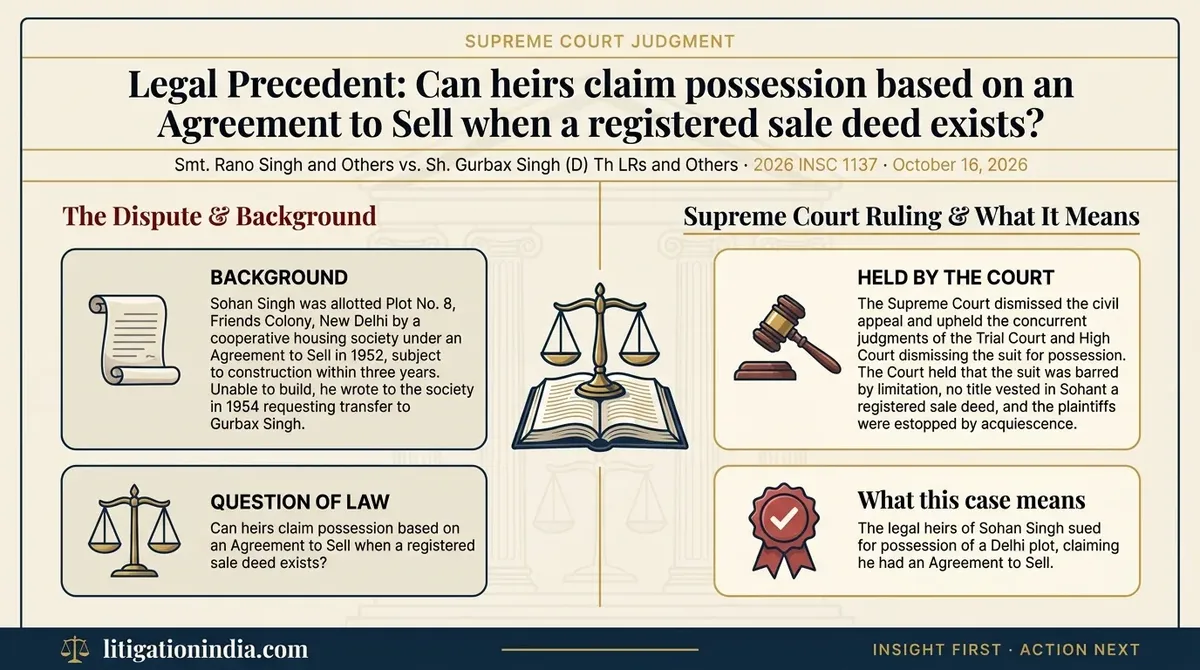
Suit for Possession Dismissed: Agreement to Sell Without Registered Deed Confers No Title — infographic summary

What this case means

The legal heirs of Sohan Singh sued for possession of a Delhi plot, claiming he had an Agreement to Sell. The Supreme Court dismissed the appeal, holding the suit was barred by limitation, Sohan Singh had no title without a registered sale deed, and he was estopped by his own letter requesting transfer to the defendant. This clarifies that an Agreement to Sell alone cannot found a possession suit where title is disputed.

What the Supreme Court held

The Supreme Court dismissed the civil appeal and upheld the concurrent judgments of the Trial Court and High Court dismissing the suit for possession. The Court held that the suit was barred by limitation, no title vested in Sohan Singh without a registered sale deed, and the plaintiffs were estopped by acquiescence. No order as to costs was made.

Case: Smt. Rano Singh and Others vs. Sh. Gurbax Singh (D) Th LRs and Others (2026) Citation: 2026 INSC 1137

Want the full legal reasoning, citations and case documents?

Read the full judgment analysis
Rano Singh vs Gurbax Singh
Agreement to Sell
Section 53A Transfer of Property Act
part performance
limitation
estoppel
acquiescence
registered sale deed
possession suit
Friends Colony New Delhi
Article 59 Limitation Act
Article 64 Limitation Act
Section 53A, Transfer of Property Act, 1882
Section 54, Transfer of Property Act, 1882