
All insights

Can a stranger to a consent decree seek leave to appeal against it?

Stranger to Consent Decree Granted Leave to Appeal Against Fraudulent Decree

Respondents who were not parties to a 2013 consent decree sought leave to appeal, alleging the decree was obtained by fraud and collusion. The Supreme Court held that strangers to a consent decree are

Litigation India Editorial 30 October 2026 1 min read 2026 INSC 1177

Story

Case at a glance1 / 6

Supreme Court of India

Stranger to Consent Decree: Can They Appeal?

Girishbhai Natwarlal Patel v. Gautam Punjabhai Palkhiwala (Dead) By LRS & Ors. — 2026 INSC 1177

Court: Supreme Court of India; Date: 30 October 2026Bench: Justice J.B. Pardiwala and Justice K. Vinod ChandranArea of Law: Civil Procedure — Consent Decrees, Leave to Appeal, InjunctionsDispute: HUF members challenged a 2013 consent decree over agricultural land, alleging fraud and collusion
Stranger to Consent Decree Granted Leave to Appeal Against Fraudulent Decree · 2026 INSC 11772026-10-30T19:24:56.753457+00:00
The legal question2 / 6

Can a Non-Party Challenge a Consent Decree Under Section 96 CPC?

Core legal issue decided by the Supreme Court

  • Appellant: Section 96(3) CPC bars any appeal against a consent decree; non-parties have no cause of action.
  • Appellant: HUF is a distinct legal entity; Respondents 1-9 lack individual locus standi.
  • Appellant: Delay of 11 years in filing appeal was inordinate and could not be condoned without proper exchange of pleadings.
  • Respondents 1-9: They are strangers to the decree; the bar under Section 96(3) operates only against parties to the compromise.
  • Respondents 1-9: They discovered the alteration of revenue records only in 2023; delay must be counted from knowledge, not from the decree date.
Stranger to Consent Decree Granted Leave to Appeal Against Fraudulent Decree · 2026 INSC 11772026-10-30T19:24:56.753457+00:00
Statutory comparison3 / 6

Section 96(3) CPC: Parties vs Strangers to Consent Decree

How the bar on appeals from consent decrees applies differently

Legal SubjectParty to the CompromiseStranger to the Decree
Appeal under Section 96(3) CPCBarred; cannot appeal against consent decreeNot barred; may seek leave if legally cognisable interest is prejudiced
Estoppel under Order XXIII Rule 3Bound by the compromise; operates as estoppelNot bound; cannot be deemed to have consented
Bar under Order XXIII Rule 3ACannot file suit to set aside decreeBar does not apply to strangers asserting independent rights
Remedy availableOnly approach the court that passed the decreeMay seek leave to appeal from the appellate court
The bar under Section 96(3) CPC is an estoppel between consenting parties — it cannot silence those who never consented.
Stranger to Consent Decree Granted Leave to Appeal Against Fraudulent Decree · 2026 INSC 11772026-10-30T19:24:56.753457+00:00
The Court's reasoning4 / 6

Court's Reasoning: Step-by-Step

From legal bar to grant of leave to appeal

  1. 1Step 1: Section 96(3) CPC bars appeal against consent decrees — but only for parties to the compromise, not strangers.
  2. 2Step 2: Order XXIII Rules 3 and 3A operate as estoppel only between compromising parties; non-parties assert independent rights.
  3. 3Step 3: A stranger must show a legally cognisable interest prejudicially affected by the decree to obtain leave to appeal.
  4. 4Step 4: Respondents 1-9 showed prima facie interest via 1975 sale deed and HUF mutation entries; circumstances of alleged fraud sufficient for appellate scrutiny.
  5. 5Step 5: Delay counted from discovery in 2023, not from 2013 decree date; condonation valid for non-parties unaware of proceedings.
Stranger to Consent Decree Granted Leave to Appeal Against Fraudulent Decree · 2026 INSC 11772026-10-30T19:24:56.753457+00:00
The verdict5 / 6

The Court's Verdict

All three appeals dismissed

  • The Fact: HUF members discovered in 2023 that a 2013 consent decree had resulted in revenue records showing the appellant as occupant of their claimed land.
  • The Law: Section 96(3) CPC and Order XXIII Rules 3 and 3A bar appeals by parties to a compromise, not by strangers who assert independent legal interests prejudicially affected by the decree.
  • The Result: Appeals dismissed; ex parte injunction upheld; leave to appeal and condonation of 11-year delay affirmed; High Court directed to hear main appeal within three months.
Appeals dismissed. High Court directed to hear the main appeal finally within three months from the date of this judgment.
Stranger to Consent Decree Granted Leave to Appeal Against Fraudulent Decree · 2026 INSC 11772026-10-30T19:24:56.753457+00:00
Why it matters6 / 6

Why This Judgment Matters

Practical significance for property owners and HUF members

  • Property owners and HUF members who were not parties to a court-recorded compromise can challenge the decree if it prejudicially affects their genuine ownership claims.
  • Courts cannot use the bar under Section 96(3) CPC to shut out persons who never participated in the compromise and had no opportunity to protect their interests.
  • For non-parties, the limitation period for challenging a decree runs from when they actually or reasonably discovered the prejudice, not from the decree date.
  • Interim injunctions can be granted to protect land even before formal impleadment, when prima facie circumstances indicate fraud and risk of irreversible alienation.
A consent decree cannot be a shield for fraud — those whose property rights are genuinely threatened by it retain the right to seek appellate justice.
Stranger to Consent Decree Granted Leave to Appeal Against Fraudulent Decree · 2026 INSC 11772026-10-30T19:24:56.753457+00:00
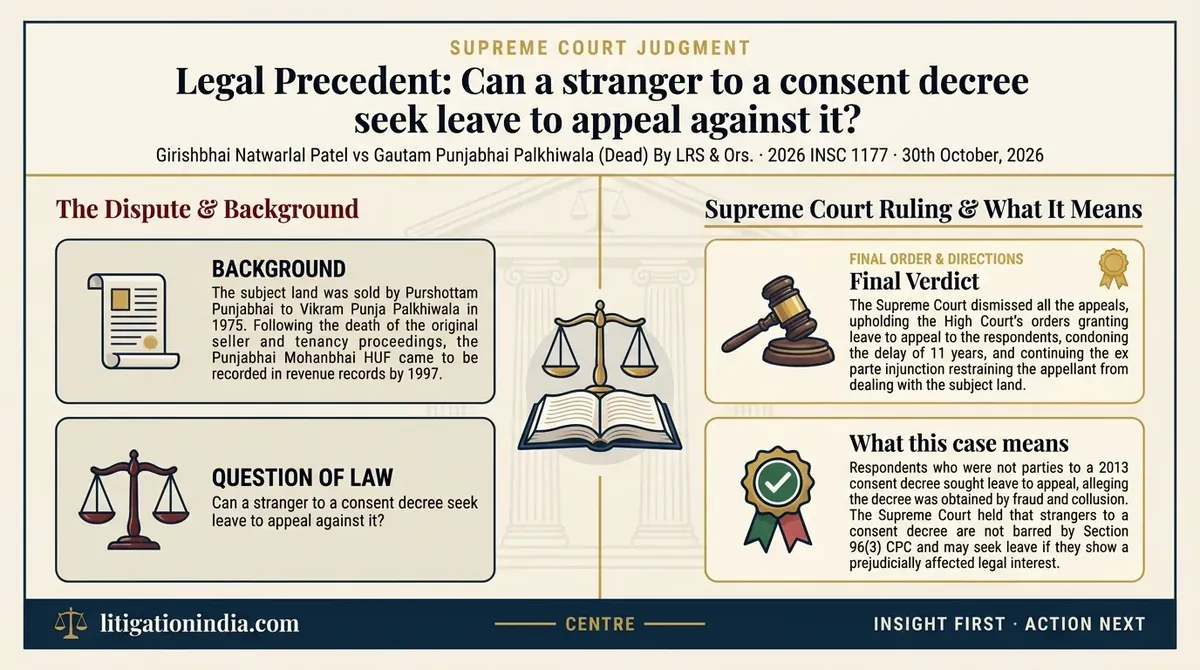
Stranger to Consent Decree Granted Leave to Appeal Against Fraudulent Decree — infographic summary

What this case means

Respondents who were not parties to a 2013 consent decree sought leave to appeal, alleging the decree was obtained by fraud and collusion. The Supreme Court held that strangers to a consent decree are not barred by Section 96(3) CPC and may seek leave if they show a prejudicially affected legal interest. The court upheld the High Court's orders granting leave, condoning 11 years' delay, and continuing the injunction.

What the Supreme Court held

The Supreme Court dismissed all the appeals, upholding the High Court's orders granting leave to appeal to the respondents, condoning the delay of 11 years, and continuing the ex parte injunction restraining the appellant from dealing with the subject land. The Court directed the High Court to hear and dispose of the main appeal within three months.

Case: Girishbhai Natwarlal Patel vs Gautam Punjabhai Palkhiwala (Dead) By LRS & Ors. (2026) Citation: 2026 INSC 1177

Want the full legal reasoning, citations and case documents?

Read the full judgment analysis
consent decree
stranger to suit
leave to appeal
Section 96 CPC
Order XXIII Rule 3
condonation of delay
ex parte injunction
non-party appeal
fraud and collusion
specific performance
Section 96(3), Code of Civil Procedure, 1908
Order XXIII Rule 3, Code of Civil Procedure, 1908
Order XXIII Rule 3A, Code of Civil Procedure, 1908
Section 11, Explanation 6, Code of Civil Procedure, 1908