
All insights

Can police automatically re-arrest someone released due to constitutional arrest violations?

Re-arrest After Constitutional Violation of Arrest Rights Requires Judicial Approval

The case concerned whether a person released due to violation of Articles 22(1) and 22(2) of the Constitution (non-supply of arrest grounds and production before a Magistrate beyond 24 hours) can be a

Litigation India Editorial 21 September 2026 1 min read 2026 INSC 1022

Story

Case at a glance1 / 6

Supreme Court of India

Re-arrest After Constitutional Violation Needs Judicial Sanction

Jaskaran Jeet Singh Deol vs State of Punjab | 2026 INSC 1022

Court: Supreme Court of India | Date: September 21, 2026Bench: Justice Ujjal Bhuyan and Justice Atul S. ChandurkarArea of Law: Constitutional Law / Criminal Law — Arrest Rights under Article 22Accused arrested without written grounds of arrest and produced beyond 24 hours — both Article 22(1) and 22(2) violated
Re-arrest After Constitutional Violation of Arrest Rights Requires Judicial Approval · 2026 INSC 10222026-09-21T19:45:43.114700+00:00
The legal question2 / 6

Can an accused released for constitutional violations be automatically re-arrested?

The core constitutional question before the Supreme Court

  • Appellant: Violation of Articles 22(1) and 22(2) is incurable; the same police force cannot automatically re-arrest the released person.
  • Appellant: Re-arrest without judicial sanction risks making constitutional safeguards meaningless and enables harassment.
  • Respondent (State): Procedural lapse in arrest does not confer blanket immunity; investigating agency retains power to re-arrest lawfully.
  • Respondent (Complainant): No provision in Constitution or BNSS bars fresh arrest; release is not equivalent to bail and carries no protection against re-arrest.
Re-arrest After Constitutional Violation of Arrest Rights Requires Judicial Approval · 2026 INSC 10222026-09-21T19:45:43.114700+00:00
Statutory comparison3 / 6

Arrest Rights: Constitutional Provisions vs Statutory Equivalents

How the Constitution and statutes protect persons at the time of arrest

Legal SubjectConstitutional ProvisionCrPC (Old Law)BNSS (New Law)
Grounds of arrest must be communicatedArticle 22(1)Section 50(1) CrPCSection 47 BNSS
Must be produced before Magistrate within 24 hoursArticle 22(2)Section 57 CrPCSection 58 BNSS
Application for re-arrest after violationArticles 21 & 22 read togetherSection 482 CrPC (inherent powers)Section 528 BNSS
Default bail for chargesheet delayArticle 21Section 167(2) CrPCSection 187(2) BNSS
Re-arrest After Constitutional Violation of Arrest Rights Requires Judicial Approval · 2026 INSC 10222026-09-21T19:45:43.114700+00:00
The Court's reasoning4 / 6

Procedure for Re-arrest After Constitutional Violation

Steps mandated by the Supreme Court in this judgment

  1. 1Step 1: Accused is released by Magistrate for violation of Article 22(1) or 22(2) — arrest is illegal.
  2. 2Step 2: Investigating agency first supplies written grounds of arrest to the accused in a language he understands.
  3. 3Step 3: Agency files application before concerned Magistrate stating reasons for re-arrest and explaining earlier non-compliance; application must be endorsed by immediate superior authority.
  4. 4Step 4: Magistrate decides application expeditiously, preferably within one week, following principles of natural justice.
  5. 5Step 5: Erring officer is replaced; departmental enquiry initiated; adverse finding leads to entry in service record.
Power to re-arrest must not rest with the same authority that violated the Constitution — it must have the judicial imprimatur.
Re-arrest After Constitutional Violation of Arrest Rights Requires Judicial Approval · 2026 INSC 10222026-09-21T19:45:43.114700+00:00
The verdict5 / 6

Supreme Court's Final Decision

Appeal allowed; High Court order quashed

  • The Fact: Appellant arrested under BNS and POCSO for alleged offences against a minor; produced before Magistrate beyond 24 hours without written grounds of arrest — both Articles 22(1) and 22(2) violated.
  • The Law: Breach of Article 22(1) or 22(2) renders arrest illegal; re-arrest requires supply of grounds of arrest, application before Magistrate endorsed by superior authority, and judicial sanction — not automatic executive action.
  • The Result: High Court order and Magistrate's impugned observations quashed; investigating agency directed to follow the procedure prescribed in Mihir Rajesh Shah and this judgment before any re-arrest.
Appeal allowed; High Court order quashed; re-arrest only after written grounds given and Magistrate's judicial sanction obtained.
Re-arrest After Constitutional Violation of Arrest Rights Requires Judicial Approval · 2026 INSC 10222026-09-21T19:45:43.114700+00:00
Why it matters6 / 6

What This Means for Every Citizen

Practical significance of the Supreme Court's ruling

  • If police arrest you without giving written reasons, or keep you beyond 24 hours without producing you before a Magistrate, your arrest is unconstitutional and you must be released.
  • Police cannot simply re-arrest you after such illegal release — they must first give you written grounds, then get a court's permission.
  • The gravity of the alleged crime does not matter; constitutional protections apply equally in all cases, including serious offences.
  • Erring police officers face mandatory departmental action, and courts can award compensation for violations of arrest rights.
Constitutional arrest rights are absolute — no offence, however grave, justifies bypassing them. Re-arrest needs a court's permission, not just police initiative.
Re-arrest After Constitutional Violation of Arrest Rights Requires Judicial Approval · 2026 INSC 10222026-09-21T19:45:43.114700+00:00
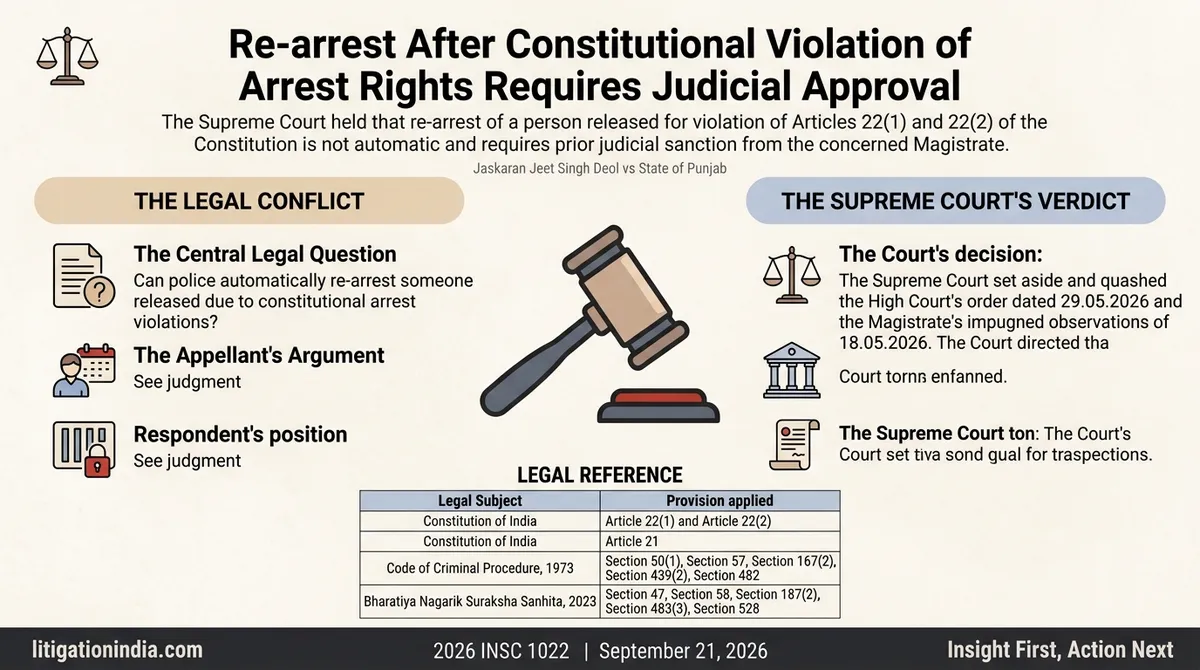
Re-arrest After Constitutional Violation of Arrest Rights Requires Judicial Approval — infographic summary

What this case means

The case concerned whether a person released due to violation of Articles 22(1) and 22(2) of the Constitution (non-supply of arrest grounds and production before a Magistrate beyond 24 hours) can be automatically re-arrested by the same police. The Supreme Court held that re-arrest is not automatically permitted; the investigating agency must first file an application before the concerned Magistrate, supply the grounds of arrest, and obtain judicial sanction. This ruling strengthens constitutional safeguards against arbitrary police action.

What the Supreme Court held

The Supreme Court set aside and quashed the High Court's order dated 29.05.2026 and the Magistrate's impugned observations of 18.05.2026. The Court directed that any re-arrest of the appellant for custodial interrogation must follow the procedure laid down in Mihir Rajesh Shah and supplemented by this judgment — requiring supply of grounds of arrest, a Magistrate's application endorsed by a superior officer, and judicial sanction. The Court also directed circulation of the judgment to all Directors General of Police, Registrar Generals of High Courts, and Directors of State Judicial Academies.

Case: Jaskaran Jeet Singh Deol vs State of Punjab (2026) Citation: 2026 INSC 1022

Want the full legal reasoning, citations and case documents?

Read the full judgment analysis
Article 22
grounds of arrest
re-arrest
POCSO
BNS
BNSS
Mihir Rajesh Shah
constitutional safeguards
personal liberty
illegal arrest
custodial interrogation
Jaskaran Jeet Singh Deol
Article 22(1) and Article 22(2), Constitution of India
Article 21, Constitution of India