
All insights

Is a cheque dishonour notice valid if received by the accused's family member at his correct address?

Notice Delivered to Accused's Mother at Correct Address Deemed Valid Service Under Section 138

The case concerned whether a statutory demand notice under Section 138 of the Negotiable Instruments Act, 1881, served at the correct address of the accused but received by his mother, amounts to vali

Litigation India Editorial 30 September 2026 1 min read 2026 INSC 1069

Story

Case at a glance1 / 6

Supreme Court of India

Cheque Notice to Family Member: Does It Count?

Sainaba vs State of Kerala & Anr. | 2026 INSC 1069

Court: Supreme Court of India | Date: September 30, 2026Bench: Justice Ahsanuddin Amanullah and Justice ManmohanArea of law: Criminal Law / Negotiable Instruments / Cheque DishonourCheque for Rs.3,00,000 dishonoured; demand notice received by accused's mother at correct address
Notice Delivered to Accused's Mother at Correct Address Deemed Valid Service Under Section 138 · 2026 INSC 10692026-09-30T13:36:24.052091+00:00
The legal question2 / 6

Does Notice to Family Member at Correct Address Satisfy Section 138?

The core legal dispute before the Supreme Court

  • Appellant: Sending notice by registered post to correct address raises presumption of valid service; accused must rebut it.
  • Appellant: Receipt by mother at correct residential address is not a valid rebuttal; accused appeared in court via summons at same address.
  • Appellant: High Court exceeded revisional jurisdiction by re-appreciating evidence and substituting concurrent findings of fact.
  • Respondent No.2: Silent — did not appear despite service of notice by Supreme Court.
Notice Delivered to Accused's Mother at Correct Address Deemed Valid Service Under Section 138 · 2026 INSC 10692026-09-30T13:36:24.052091+00:00
Statutory comparison3 / 6

Presumption of Service: Binding Precedent vs Per Incuriam Ruling

How the Court distinguished C.C. Alavi Haji from M.D. Thomas

Legal SubjectC.C. Alavi Haji (3-Judge Bench, 2007) — BindingM.D. Thomas (Division Bench, 2009) — Per Incuriam
Bench strengthThree-Judge Bench — authoritativeTwo-Judge Division Bench — coordinate
Presumption triggerCorrect address + registered post = presumption of valid serviceActual personal receipt by drawer required
Burden of proofDrawer must rebut presumptionComplainant must show accused's knowledge
Family member recipientIrrelevant if notice sent to correct addressTreated as failure of service (wrongly)
Status after this judgmentAffirmed as binding precedentDeclared per incuriam under Article 141
M.D. Thomas created an anomaly: notice not delivered at all got presumption, but notice delivered to co-resident family member did not.
Notice Delivered to Accused's Mother at Correct Address Deemed Valid Service Under Section 138 · 2026 INSC 10692026-09-30T13:36:24.052091+00:00
The Court's reasoning4 / 6

Court's Reasoning: Step by Step

From the legal question to the final conclusion

  1. 1Step 1: Section 138 requires 'giving of notice' — dispatch to correct address, not actual personal receipt by drawer.
  2. 2Step 2: Section 27, General Clauses Act, 1897 and Section 114, Evidence Act, 1872 raise a rebuttable presumption of service on dispatch by registered post to correct address.
  3. 3Step 3: C.C. Alavi Haji (three-Judge Bench, 2007) binding: once correctly addressed, burden shifts to drawer to rebut presumption.
  4. 4Step 4: M.D. Thomas (2009) declared per incuriam as it ignored C.C. Alavi Haji and produced anomalous results.
  5. 5Step 5: Respondent No.2 never disputed his address, appeared via summons at same address, and failed to rebut — conviction restored.
Notice Delivered to Accused's Mother at Correct Address Deemed Valid Service Under Section 138 · 2026 INSC 10692026-09-30T13:36:24.052091+00:00
The verdict5 / 6

The Supreme Court's Verdict

Fact, Law and Result

  • The Fact: Statutory demand notice sent by registered post to accused's correct address; received by his mother; accused never disputed address.
  • The Law: Dispatch to correct address raises rebuttable presumption of valid service under Section 27, General Clauses Act, 1897 and Section 114, Evidence Act, 1872; M.D. Thomas declared per incuriam.
  • The Result: Appeal allowed; Kerala High Court order set aside; Trial Court conviction of six months imprisonment and Rs.3,00,000 fine restored.
Appeal allowed; Trial Court conviction sentencing respondent No.2 to six months simple imprisonment and fine of Rs.3,00,000 stands restored.
Notice Delivered to Accused's Mother at Correct Address Deemed Valid Service Under Section 138 · 2026 INSC 10692026-09-30T13:36:24.052091+00:00
Why it matters6 / 6

What This Means for You

Practical significance of this judgment

  • If you send a cheque dishonour notice by registered post to the correct address, you have legally 'given notice' even if a family member receives it.
  • The accused, not the complainant, must prove they were unaware of the notice or that the address was wrong.
  • Cheque drawers cannot escape Section 138 liability by ensuring only family members, and not themselves, receive demand notices.
  • High Courts cannot reverse concurrent findings of Trial and Appellate Courts in revision merely by re-appreciating evidence.
Sending a cheque notice to the right address is enough — the law presumes it was received; it is for the accused to prove otherwise.
Notice Delivered to Accused's Mother at Correct Address Deemed Valid Service Under Section 138 · 2026 INSC 10692026-09-30T13:36:24.052091+00:00
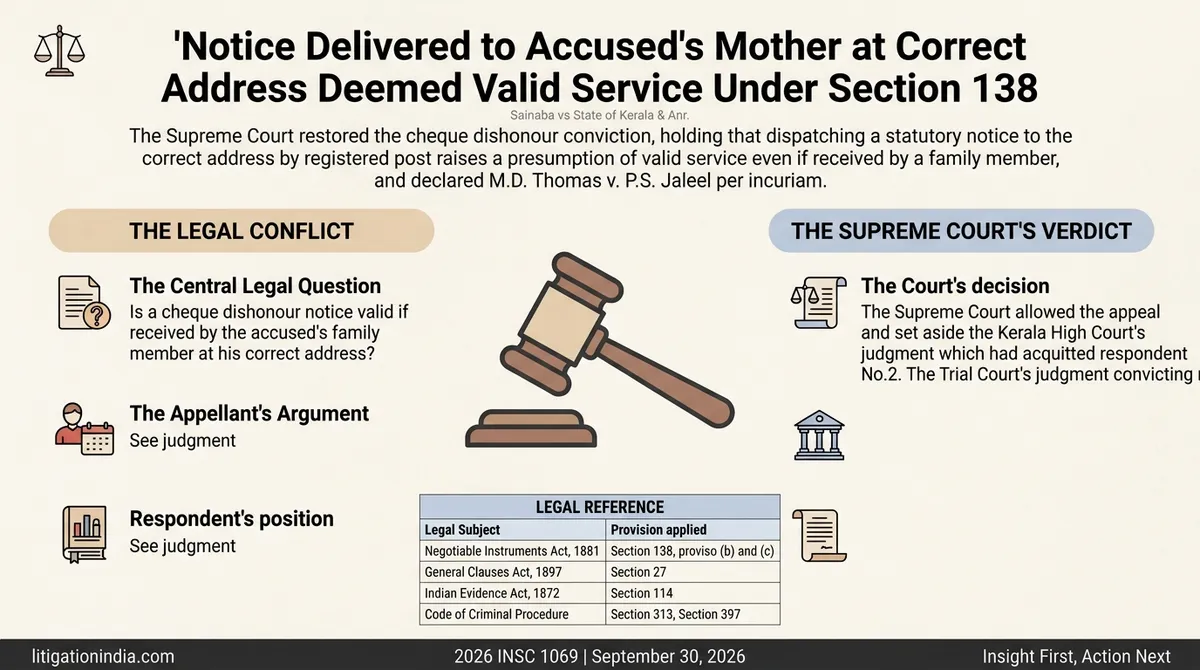
Notice Delivered to Accused's Mother at Correct Address Deemed Valid Service Under Section 138 — infographic summary

What this case means

The case concerned whether a statutory demand notice under Section 138 of the Negotiable Instruments Act, 1881, served at the correct address of the accused but received by his mother, amounts to valid service. The Supreme Court held that dispatching the notice by registered post to the correct address raises a rebuttable presumption of valid service, regardless of who physically received it. The Court also declared the earlier judgment in M.D. Thomas v. P.S. Jaleel as per incuriam.

What the Supreme Court held

The Supreme Court allowed the appeal and set aside the Kerala High Court's judgment which had acquitted respondent No.2. The Trial Court's judgment convicting respondent No.2 under Section 138 of the Negotiable Instruments Act, 1881 and sentencing him to six months simple imprisonment along with a fine of Rs.3,00,000 was restored. The Court also declared the Division Bench judgment in M.D. Thomas v. P.S. Jaleel (2009) 14 SCC 398 as per incuriam.

Case: Sainaba vs State of Kerala & Anr. (2026) Citation: 2026 INSC 1069

Want the full legal reasoning, citations and case documents?

Read the full judgment analysis
Sainaba vs State of Kerala
Section 138 Negotiable Instruments Act
cheque dishonour
statutory demand notice
presumption of service
Section 27 General Clauses Act
Section 114 Indian Evidence Act
per incuriam
M.D. Thomas
C.C. Alavi Haji
registered post service
Kerala High Court revision
Section 138, proviso (b) and (c), Negotiable Instruments Act, 1881
Section 27, General Clauses Act, 1897