
All insights

Can a mother sell a minor's inherited land share for a flat and cash?

Mother Allowed to Enter Development Agreement for Minor Son's Inherited Property

A mother sought court permission under Section 8 of the Hindu Minority and Guardianship Act, 1956 to allow a developer to build on her minor son's inherited land in exchange for a flat and Rs. 10 lakh

Litigation India Editorial 22 October 2026 1 min read 2026 INSC 621

Story

Case at a glance1 / 6

Supreme Court of India

Mother's Bid to Develop Minor's Land Approved by Supreme Court

Shephali Chakraborty v. State of West Bengal — 2026 INSC 621

Court: Supreme Court of India; Date: June 3, 2026Bench: Justice Sanjay Karol and Justice Nongmeikapam Kotiswar SinghArea of Law: Family Law — Guardian's power over minor's immovable propertyKey Act: Section 8, Hindu Minority and Guardianship Act, 1956
Mother Allowed to Enter Development Agreement for Minor Son's Inherited Property · 2026 INSC 6212026-10-22T12:31:36.705890+00:00
The legal question2 / 6

Can Vacant Land Be Swapped for a Flat in the Minor's Best Interest?

The core legal question under Section 8(4), HMGA 1956

  • Appellant: The development agreement yields a concrete flat and Rs. 10 lakhs, securing the minor's future better than undeveloped land.
  • Appellant: The undivided share in vacant land offers no immediate utility and is difficult to monetise.
  • Respondent (lower courts): The petition gave only a bald statement of necessity; the identity of co-owners of the proposed flat was unclear.
  • Respondent (lower courts): Present utilisation of the land was not disclosed, so comparison with proposed use was impossible.
Mother Allowed to Enter Development Agreement for Minor Son's Inherited Property · 2026 INSC 6212026-10-22T12:31:36.705890+00:00
Statutory comparison3 / 6

Section 8 HMGA: Four Substantive Parts Compared

How the Court read the provision

ProvisionWhat it saysHow the Court applied it
Section 8(1)Natural guardian may do all acts necessary or reasonable for minor's benefitBroad managerial power, but expressly subject to sub-section (2) restrictions
Section 8(2)No alienation of minor's immovable property without prior court permissionDevelopment agreement required prior permission; this was the basis of the application
Section 8(3)Unauthorised alienation is voidable, not void ab initio, at minor's instanceDistinction preserved minor's right on majority to affirm or avoid the transaction
Section 8(4)Court may grant permission only for necessity or evident advantage to the minorCourt assessed flat plus cash vs. undivided vacant land share to find evident advantage
Mother Allowed to Enter Development Agreement for Minor Son's Inherited Property · 2026 INSC 6212026-10-22T12:31:36.705890+00:00
The Court's reasoning4 / 6

Court's Reasoning: From Application to Permission Granted

Steps in the Supreme Court's analysis

  1. 1Step 1: Section 8 HMGA is an ex ante protection — prior court permission is mandatory before any alienation of a minor's immovable property.
  2. 2Step 2: The welfare of the minor is the sole and paramount standard; family convenience or guardian's preference is insufficient.
  3. 3Step 3: Parens patriae doctrine obliges the court to independently assess the minor's interests, going beyond the guardian's consent.
  4. 4Step 4: Undivided share in 0.13 acres of vacant land is notional, illiquid and vulnerable; a first-floor flat plus Rs. 10 lakhs is concrete, usable and enforceable.
  5. 5Step 5: The mix of liquid and illiquid assets constitutes 'evident advantage' — appeal allowed with protective conditions for the minor's cash share.
Mother Allowed to Enter Development Agreement for Minor Son's Inherited Property · 2026 INSC 6212026-10-22T12:31:36.705890+00:00
The verdict5 / 6

Supreme Court's Final Decision

Appeal allowed with protective conditions

  • The Fact: Minor inherited a share in undeveloped land; family agreed to give it to a developer for a flat and Rs. 10 lakhs; lower courts refused permission.
  • The Law: Section 8(4) HMGA permits alienation only for necessity or evident advantage; the standard is the minor's welfare, assessed by independent judicial scrutiny under parens patriae.
  • The Result: Supreme Court reversed the District Court and High Court; development agreement permitted subject to safeguards protecting the minor's monetary share until majority.
Rs. 10 lakhs to be kept in a nationalised bank on auto-renewal until the minor attains majority; any change to the agreement needs court approval.
Mother Allowed to Enter Development Agreement for Minor Son's Inherited Property · 2026 INSC 6212026-10-22T12:31:36.705890+00:00
Why it matters6 / 6

What This Means for Families with Minor Co-Owners

Practical significance

  • Courts must compare the minor's current asset against what they will receive — a concrete flat and cash can outweigh a share in vacant land.
  • Guardians need not prove extreme financial hardship; demonstrating 'evident advantage' through measurable, enforceable benefits is enough.
  • Protective conditions — bank deposit, court approval for changes, co-owner sale restrictions — ensure the minor's rights survive until adulthood.
  • The parens patriae principle means courts act as an independent guardian of the minor's interests, beyond what the family has agreed.
A minor's welfare is the supreme standard — courts must look beyond family agreement to independently protect the child's property rights.
Mother Allowed to Enter Development Agreement for Minor Son's Inherited Property · 2026 INSC 6212026-10-22T12:31:36.705890+00:00
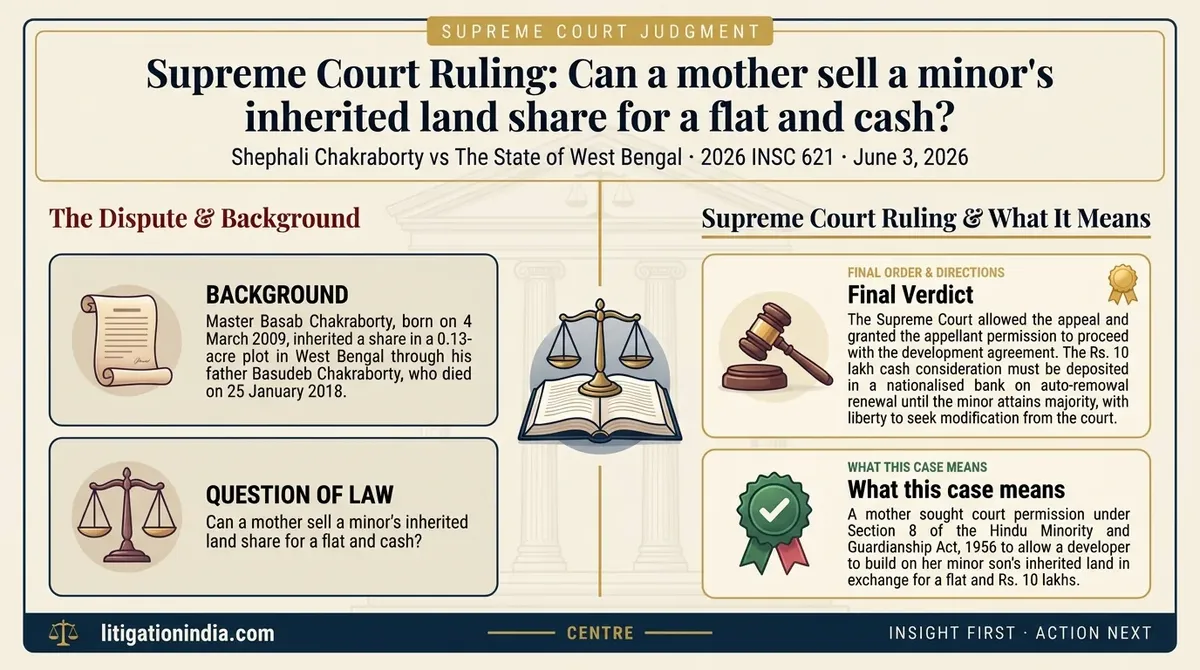
Mother Allowed to Enter Development Agreement for Minor Son's Inherited Property — infographic summary

What this case means

A mother sought court permission under Section 8 of the Hindu Minority and Guardianship Act, 1956 to allow a developer to build on her minor son's inherited land in exchange for a flat and Rs. 10 lakhs. The Supreme Court overturned the lower courts' refusal and granted permission, holding that the developed flat plus cash was more beneficial to the minor than an undivided share in vacant land. The judgment elaborates the doctrine of parens patriae and the standard courts must apply when approving guardians' transactions involving minor's property.

What the Supreme Court held

The Supreme Court allowed the appeal and granted the appellant permission to proceed with the development agreement. The Rs. 10 lakh cash consideration must be deposited in a nationalised bank on auto-renewal until the minor attains majority, with liberty to seek modification from the court. Any alteration to the development agreement or sale of a co-owner's share before the minor's majority requires prior court approval, and the District Judge, Darjeeling may impose additional conditions.

Case: Shephali Chakraborty vs The State of West Bengal (2026) Citation: 2026 INSC 621

Want the full legal reasoning, citations and case documents?

Read the full judgment analysis
Shephali Chakraborty
Hindu Minority and Guardianship Act
natural guardian
minor's property
parens patriae
development agreement
Section 8 HMGA
prior court permission
alienation of minor's property
best interest of child
West Bengal
2026 INSC 621
Section 8, Hindu Minority and Guardianship Act, 1956
Sections 7, 17, 29, 31, Guardians and Wards Act, 1890