
All insights

Can a married daughter be denied a fair price shop dealership on compassionate grounds?

Married Daughter Cannot Be Excluded From Fair Price Shop Dependent Quota

A married woman was denied her deceased mother's fair price shop dealership solely because she was married. The Supreme Court held that excluding married daughters from the definition of 'family' in t

Litigation India Editorial 21 October 2026 1 min read 2026 INSC 617

Story

Case at a glance1 / 6

Supreme Court of India

Can Marriage Bar a Daughter From a Welfare Scheme?

Kulsum Nisha v. State of U.P. & Ors. | 2026 INSC 617

Court: Supreme Court of India | Date: 02 June 2026Bench: Justice P.S. Narasimha and Justice Alok AradheArea of Law: Constitutional Law, Gender Discrimination, Welfare SchemesIssue: Whether married daughters can be excluded from fair price shop dependent quota
Married Daughter Cannot Be Excluded From Fair Price Shop Dependent Quota · 2026 INSC 6172026-10-21T08:31:41.995365+00:00
The legal question2 / 6

Is Excluding Married Daughters From 'Family' Definition Constitutional?

Arguments before the Supreme Court

  • Appellant: Exclusion of married daughter lacks intelligible differentia and violates Articles 14, 15(1), 19(1)(g) and 21.
  • Appellant: Marital status of a woman bears no constitutional relevance to eligibility for a welfare scheme.
  • Respondent State: Classification between unmarried, judicially separated and married daughters is reasonable.
  • Respondent State: A married daughter typically does not satisfy the local residence requirement as she shifts to in-laws.
Amicus Curiae: Dependency is a pure question of fact; marital status alone is an irrelevant and unconstitutional criterion.
Married Daughter Cannot Be Excluded From Fair Price Shop Dependent Quota · 2026 INSC 6172026-10-21T08:31:41.995365+00:00
Statutory comparison3 / 6

What the Law Says vs. How the Court Read It

Clause 2(p), 2016 Order — before and after purposive construction

ProvisionLiteral Reading (Before)Purposive Reading (After Court)
Clause 2(p) — daughters coveredOnly unmarried, legally separated and widowed daughtersIncludes married daughters who are dependent and satisfy all other eligibility conditions
Paragraph IV(10) G.O. — family definitionExcludes married daughters explicitlyRead down; exclusion held unconstitutional under Articles 14 and 15(1)
Paragraph IV(5) G.O. — local residenceStated as eligibility conditionRemains independent factual requirement; cannot justify blanket exclusion of married daughters
Married Daughter Cannot Be Excluded From Fair Price Shop Dependent Quota · 2026 INSC 6172026-10-21T08:31:41.995365+00:00
The Court's reasoning4 / 6

Court's Reasoning: Step by Step

From constitutional challenge to purposive construction

  1. 1Step 1: Identify the purpose of the dependent quota — immediate financial relief and continuity of the public distribution system.
  2. 2Step 2: Apply the two-part reasonable classification test under Article 14; find marital status has no rational nexus to dependency, need, or residence.
  3. 3Step 3: Reject the State's residence argument; residence is a separate factual criterion applicable case by case.
  4. 4Step 4: Find the exclusion rooted in a gender stereotype incompatible with Articles 14 and 15(1); married sons are not excluded.
  5. 5Step 5: Apply purposive construction to read 'daughters' in Clause 2(p) as including married daughters who prove dependency and meet all other conditions.
Married Daughter Cannot Be Excluded From Fair Price Shop Dependent Quota · 2026 INSC 6172026-10-21T08:31:41.995365+00:00
The verdict5 / 6

The Supreme Court's Decision

Civil Appeal No. 7667 of 2025 — Allowed

  • The Fact: Kulsum Nisha, a married daughter who lived with her mother and ran the fair price shop, was denied the dealership solely for being married.
  • The Law: Excluding married daughters from the 'family' definition violates Articles 14 and 15(1); marital status has no rational nexus to dependency or eligibility.
  • The Result: All impugned orders quashed; Allahabad High Court decisions in Saida Begum and Smt. Kusumlata overruled; allotment directed within four weeks.
Competent authority shall issue the allotment order in favour of the appellant within four weeks.
Married Daughter Cannot Be Excluded From Fair Price Shop Dependent Quota · 2026 INSC 6172026-10-21T08:31:41.995365+00:00
Why it matters6 / 6

What This Means for Ordinary People

Practical significance of the judgment

  • Married daughters who live with and depend on their parents can now claim fair price shop dealerships in UP on the same terms as other dependents.
  • Authorities cannot reject a welfare application by simply pointing to marital status; they must assess actual dependency and residence as facts.
  • The ruling signals that gender stereotypes embedded in welfare scheme definitions are constitutionally invalid across India.
  • Divergent High Court rulings on married daughters' eligibility for welfare schemes are now authoritatively settled by the Supreme Court.
Marriage cannot be used to deny a dependent daughter her right to welfare — dependency is a question of fact, not a presumption from gender.
Married Daughter Cannot Be Excluded From Fair Price Shop Dependent Quota · 2026 INSC 6172026-10-21T08:31:41.995365+00:00
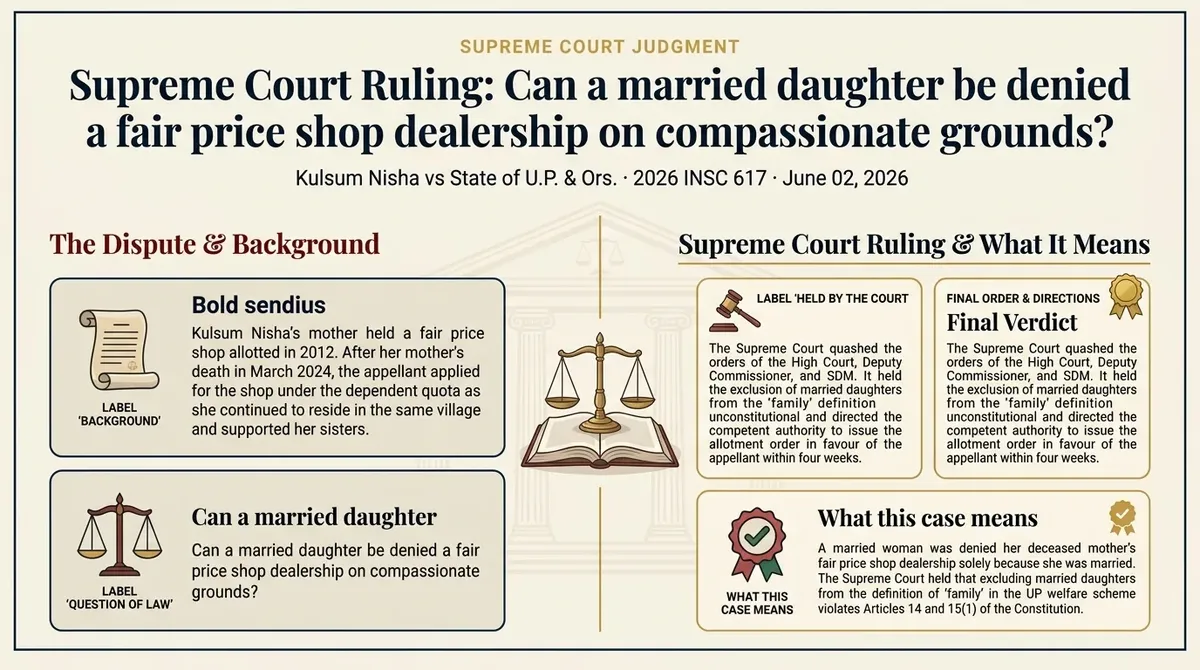
Married Daughter Cannot Be Excluded From Fair Price Shop Dependent Quota — infographic summary

What this case means

A married woman was denied her deceased mother's fair price shop dealership solely because she was married. The Supreme Court held that excluding married daughters from the definition of 'family' in the UP welfare scheme violates Articles 14 and 15(1) of the Constitution. The court directed allotment of the shop to the appellant within four weeks.

What the Supreme Court held

The Supreme Court quashed the orders of the High Court, Deputy Commissioner, and SDM. It held the exclusion of married daughters from the 'family' definition unconstitutional and directed the competent authority to issue the allotment order in favour of the appellant within four weeks. The contrary High Court decisions in Saida Begum and Smt. Kusumlata were overruled.

Case: Kulsum Nisha vs State of U.P. & Ors. (2026) Citation: 2026 INSC 617

Want the full legal reasoning, citations and case documents?

Read the full judgment analysis
Kulsum Nisha
fair price shop
married daughter
compassionate appointment
Article 14
Article 15
Essential Commodities Act 1955
UP 2016 Order
dependent quota
gender discrimination
purposive construction
public distribution system
Section 3, Section 3/7, The Essential Commodities Act, 1955
Articles 14, 15(1), 19(1)(g), 21, 39(a), 39(c), 134-A, Constitution of India