
All insights

Is bleaching and dyeing powerloom fabric 'manufacture' attracting textile cess?

Job Worker Doing Bleaching and Dyeing for Powerlooms Not Liable for Textile Cess

A textile processor doing bleaching and dyeing on fabrics received from powerloom units on job work basis was demanded textile cess by the Textiles Committee. The Supreme Court held that such processi

Litigation India Editorial 26 October 2026 1 min read 2026 INSC 1158

Story

Case at a glance1 / 6

Supreme Court of India

Job Work Bleaching of Powerloom Fabric Is Not Textile Manufacture

The Assessing Officer, Textiles Committee v. M/s. Premium Suiting Pvt. Ltd. — 2026 INSC 1158

Court: Supreme Court of India; Date: October 26, 2026Bench: Justice S.V.N. Bhatti and Justice N.V. AnjariaArea of Law: Taxation Law and Statutory InterpretationTextile cess demand of Rs. 2,68,293/- on job worker doing bleaching and dyeing for powerlooms
Job Worker Doing Bleaching and Dyeing for Powerlooms Not Liable for Textile Cess · 2026 INSC 11582026-10-26T17:41:50.155727+00:00
The legal question2 / 6

Does Bleaching Powerloom Fabric on Job Work Attract Textile Cess?

Core legal dispute under Section 5A, Textiles Committee Act, 1963

  • Appellant: Bleaching and dyeing is 'manufacture' under Section 2(f), Central Excise Act, 1944 and cess is due.
  • Appellant: The powerloom exemption applies only at the loom stage, not after further processing.
  • Respondent: Processing on job work is not manufacture; the company is only an extended arm of exempt powerloom units.
  • Respondent: Definition of manufacture from another statute cannot be imported where it is not defined.
Job Worker Doing Bleaching and Dyeing for Powerlooms Not Liable for Textile Cess · 2026 INSC 11582026-10-26T17:41:50.155727+00:00
Statutory comparison3 / 6

Section 5A: The Levy and the Exemption

How the provision and its proviso operate

ProvisionWhat it saysHow the Court applied it
Section 5A main provision, Textiles Committee Act 1963Cess levied on all textiles manufactured in India at up to 1% ad valoremAppellant relied on this to demand cess from the job worker as an alleged manufacturer
Proviso to Section 5ANo cess shall be levied on textiles manufactured from handloom or powerloom industryCourt held the respondent's fabric originates from exempt powerloom industry; exemption applies
Section 2(f), Central Excise Act 1944Manufacture includes any process incidental or ancillary to completion of a manufactured productCourt refused to import this definition into the Textiles Committee Act, 1963
The word 'manufacture' is not defined in the Textiles Committee Act, 1963 and must be read in its common parlance meaning.
Job Worker Doing Bleaching and Dyeing for Powerlooms Not Liable for Textile Cess · 2026 INSC 11582026-10-26T17:41:50.155727+00:00
The Court's reasoning4 / 6

Court's Reasoning: Step by Step

From the legal question to the final conclusion

  1. 1Step 1: 'Manufacture' is not defined in the Textiles Committee Act, 1963; cannot be imported from the Central Excise Act, 1944.
  2. 2Step 2: Definitions from one statute apply to another only if both are pari materia or legislature expressly provides — neither condition is met here.
  3. 3Step 3: Respondent only receives fabric, applies bleaching/dyeing, and returns it; this is a supplementary and ancillary activity, not independent manufacturing.
  4. 4Step 4: Fabric originates from and returns to powerloom industry, which is expressly exempt under the proviso to Section 5A.
  5. 5Step 5: Therefore no textile cess is attracted; the demand is unsustainable and the appeal is dismissed.
Job Worker Doing Bleaching and Dyeing for Powerlooms Not Liable for Textile Cess · 2026 INSC 11582026-10-26T17:41:50.155727+00:00
The verdict5 / 6

The Supreme Court's Verdict

Civil Appeal No. 785 of 2016 — Dismissed

  • The Fact: Respondent did bleaching and dyeing of powerloom fabrics on job work; no independent manufacture occurred.
  • The Law: Section 5A, Textiles Committee Act, 1963 exempts powerloom textiles; 'manufacture' cannot be redefined by borrowing from the Central Excise Act, 1944.
  • The Result: Respondent is not a manufacturer of textiles; textile cess demand of Rs. 2,68,293/- is quashed.
Appeal dismissed; cess demand quashed; job worker processing powerloom fabric is not a manufacturer under the Textiles Committee Act, 1963.
Job Worker Doing Bleaching and Dyeing for Powerlooms Not Liable for Textile Cess · 2026 INSC 11582026-10-26T17:41:50.155727+00:00
Why it matters6 / 6

What This Means for Ordinary People and Businesses

Practical significance of the judgment

  • Small job workers who process powerloom or handloom fabrics without manufacturing anything independently cannot be taxed with textile cess.
  • Tax authorities cannot expand liability by importing definitions from unrelated laws — a critical protection for small businesses.
  • The powerloom industry exemption under Section 5A extends to job workers who form part of its production chain.
  • Definitions in one law stay in that law unless Parliament expressly says otherwise — a fundamental rule confirmed.
A job worker processing powerloom fabric is not a manufacturer — you cannot be taxed by borrowing definitions from unrelated laws.
Job Worker Doing Bleaching and Dyeing for Powerlooms Not Liable for Textile Cess · 2026 INSC 11582026-10-26T17:41:50.155727+00:00
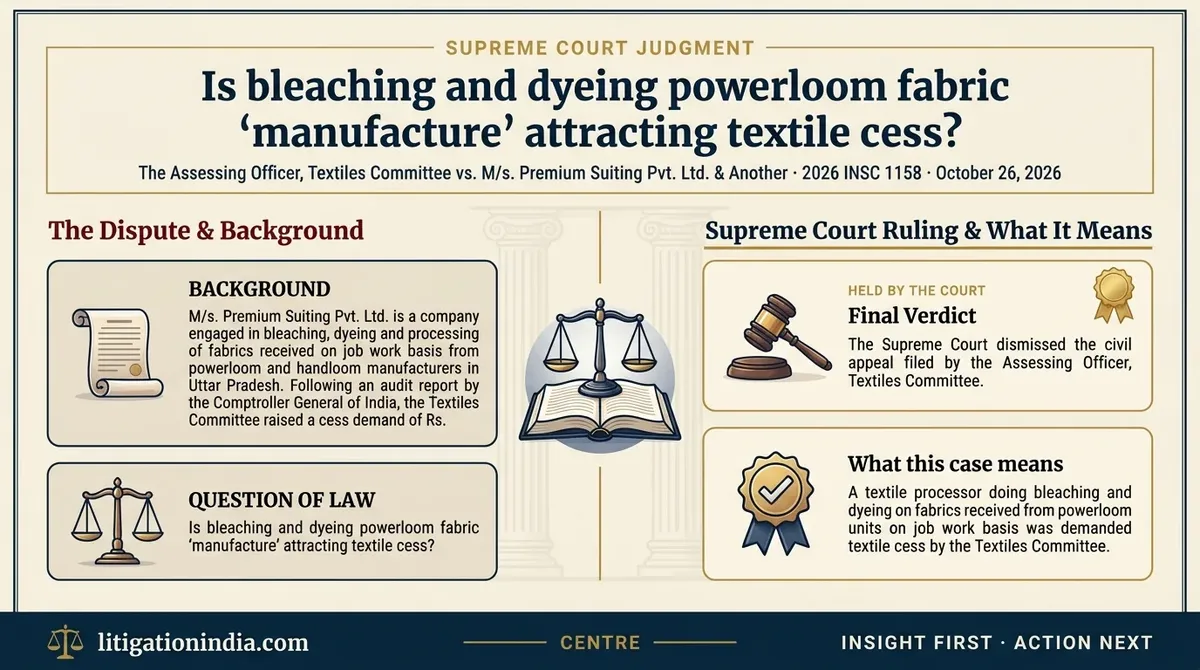
Job Worker Doing Bleaching and Dyeing for Powerlooms Not Liable for Textile Cess — infographic summary

What this case means

A textile processor doing bleaching and dyeing on fabrics received from powerloom units on job work basis was demanded textile cess by the Textiles Committee. The Supreme Court held that such processing is not 'manufacture' under the Textiles Committee Act, 1963 and the job worker is only an extended arm of the powerloom industry, which is expressly exempt. The case settles that definitions from other statutes cannot be imported to expand tax liability.

What the Supreme Court held

The Supreme Court dismissed the civil appeal filed by the Assessing Officer, Textiles Committee. The Court held that the respondent company, acting as a job worker doing bleaching and dyeing on powerloom fabrics, does not 'manufacture' textiles within the meaning of Section 5A of the Textiles Committee Act, 1963, and is therefore not liable to pay textile cess. Any pending interlocutory applications were held to have ceased to survive.

Case: The Assessing Officer, Textiles Committee vs. M/s. Premium Suiting Pvt. Ltd. & Another (2026) Citation: 2026 INSC 1158

Want the full legal reasoning, citations and case documents?

Read the full judgment analysis
Textiles Committee Act 1963
textile cess
Section 5A
powerloom exemption
manufacture
job work
bleaching dyeing
statutory interpretation
Central Excise Act
Premium Suiting
cess liability
pari materia
Section 5A, Textiles Committee Act, 1963
Section 2(g), Textiles Committee Act, 1963