
All insights

Which personal law governs succession to a female Bhumidhar's land in Delhi?

Hindu Widow's Limited Estate Converted to Absolute Ownership Under HSA 1956 Governs Bhumidhar Succession

The case concerned whether the succession to a Hindu widow's Bhumidhari land in Delhi should revert to male heirs of the original male owner or pass to her own children. The Supreme Court held that Se

Litigation India Editorial 12 October 2026 1 min read 2026 INSC 1107

Story

Case at a glance1 / 6

Supreme Court of India

Bhumidhar Succession: Whose Law Governs a Widow's Land?

Sultan Singh (Dead) Through LRs v. Financial Commissioner, Govt. of NCT of Delhi | 2026 INSC 1107

Court: Supreme Court of India; Date: October 9, 2026Bench: Justice S.V.N. Bhatti and Justice N.V. AnjariaArea of Law: Agricultural Land Reforms, Hindu Succession, Bhumidhari RightsKey Statute: Section 51(2), Delhi Land Reforms Act, 1954 read with Section 14, Hindu Succession Act, 1956
Which personal law governs succession to a female Bhumidhar's land — the law in 1954 or the law at her death?
Hindu Widow's Limited Estate Converted to Absolute Ownership Under HSA 1956 Governs Bhumidhar Succession · 2026 INSC 11072026-10-12T07:51:32.281195+00:00
The legal question2 / 6

Does Section 51(2)(a)(i) or (ii) of the Delhi Land Reforms Act 1954 Apply?

The core dispute: do reversioners or widow's own children inherit?

  • Appellant: Khajano held only a limited estate in 1954; HSA 1956 cannot alter succession under the Act, 1954; Section 51(2)(a)(i) applies; male heirs of Mauji Ram inherit.
  • Appellant: The Act, 1954 is a complete Code; personal law frozen at 1954; succession traces the last male holder.
  • Respondent: Personal law means the law at the date of death; HSA 1956 Section 14(1) converted Khajano's limited estate to absolute; Section 51(2)(a)(ii) applies.
  • Respondent: Bajaya v. Gopikabai (1978) 2 SCC 542 establishes that general referential personal law includes later amendments; Khajano's sons from second marriage inherit under Section 53.
Hindu Widow's Limited Estate Converted to Absolute Ownership Under HSA 1956 Governs Bhumidhar Succession · 2026 INSC 11072026-10-12T07:51:32.281195+00:00
Statutory comparison3 / 6

Section 51(2)(a): Two Clauses, Two Different Outcomes

Delhi Land Reforms Act, 1954 — which clause applies depends on personal law at date of death

Legal SubjectSection 51(2)(a)(i)Section 51(2)(a)(ii)
Nature of estate at deathLimited / life estate only under personal lawAbsolute ownership under personal law
Who inheritsNearest heir of last male proprietor under Section 50Heirs under table in Section 53
Personal law appliedLaw giving only life estate (pre-HSA 1956)HSA 1956: Section 14(1) converts limited to absolute
Result in this caseClaimed by reversioners (Appellants)Applied by Court — sons of Khajano inherit
The personal law is not frozen at 1954 — it is the law at the date of death that determines whether the estate was limited or absolute.
Hindu Widow's Limited Estate Converted to Absolute Ownership Under HSA 1956 Governs Bhumidhar Succession · 2026 INSC 11072026-10-12T07:51:32.281195+00:00
The Court's reasoning4 / 6

Court's Reasoning: Step by Step

From Section 51(2) grammar to the final succession order

  1. 1Step 1: Literal rule applied — 'dies' in Section 51(2)(a) is simple present tense, fixing trigger at actual date of death (1973), not 1954.
  2. 2Step 2: 'Personal law' in Section 51(2) is a general referential term — it includes all subsequent amendments (Bajaya v. Gopikabai).
  3. 3Step 3: Khajano died in 1973; her personal law was HSA 1956, in force since 17.06.1956.
  4. 4Step 4: Section 14(1), HSA 1956 automatically converted Khajano's limited estate to absolute ownership from 17.06.1956.
  5. 5Step 5: At death, Khajano held absolutely — Section 51(2)(a)(ii) applies; land devolves under Section 53 to her own sons.
Hindu Widow's Limited Estate Converted to Absolute Ownership Under HSA 1956 Governs Bhumidhar Succession · 2026 INSC 11072026-10-12T07:51:32.281195+00:00
The verdict5 / 6

The Court's Final Decision

Civil Appeal dismissed; Division Bench upheld

  • The Fact: Khajano, a Hindu widow declared Bhumidhar in 1954 with a limited estate, died in 1973 after HSA 1956 came into force.
  • The Law: Section 14(1) HSA 1956 converted her limited estate to absolute ownership; Section 51(2)(a)(ii) of the Delhi Land Reforms Act 1954 therefore applies, directing succession under Section 53.
  • The Result: Her sons from the second marriage (Respondent Nos. 2 and 3) are the rightful successors; reversioners' claim rejected.
Civil Appeal dismissed. Mutation of land in favour of Khajano's sons confirmed. No order as to costs.
Hindu Widow's Limited Estate Converted to Absolute Ownership Under HSA 1956 Governs Bhumidhar Succession · 2026 INSC 11072026-10-12T07:51:32.281195+00:00
Why it matters6 / 6

What This Means for You

Practical significance of this ruling for women and families

  • A Hindu woman who held agricultural land in Delhi as a limited estate before 1954 automatically became its full owner from 1956 onwards under HSA 1956.
  • Her own children — not the heirs of the original male owner — will inherit her Bhumidhari land after her death.
  • The personal law that matters for succession is the law in force when the female Bhumidhar dies, not the law at the time she first acquired the land.
  • Distant male relatives or reversioners cannot claim the land simply because the woman originally inherited it from a male ancestor.
A Hindu widow's limited estate automatically became absolute under HSA 1956 — her children inherit, not distant male relatives.
Hindu Widow's Limited Estate Converted to Absolute Ownership Under HSA 1956 Governs Bhumidhar Succession · 2026 INSC 11072026-10-12T07:51:32.281195+00:00
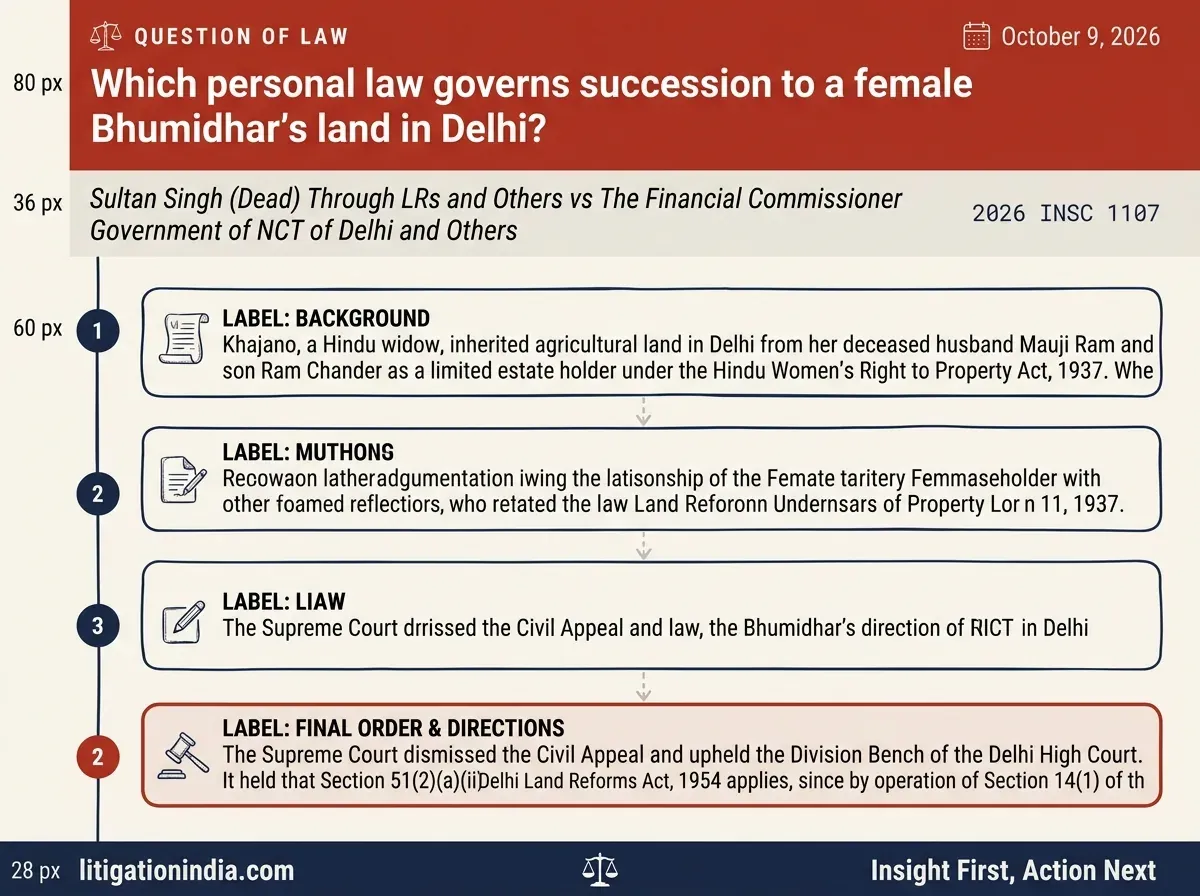
Hindu Widow's Limited Estate Converted to Absolute Ownership Under HSA 1956 Governs Bhumidhar Succession — infographic summary

What this case means

The case concerned whether the succession to a Hindu widow's Bhumidhari land in Delhi should revert to male heirs of the original male owner or pass to her own children. The Supreme Court held that Section 14(1) of the Hindu Succession Act 1956 automatically converted the widow's limited estate into absolute ownership, so succession followed Section 53 of the Delhi Land Reforms Act 1954, benefiting her own sons. This establishes that the personal law applicable at the date of a female Bhumidhar's death governs succession, not the law at the time the Act commenced.

What the Supreme Court held

The Supreme Court dismissed the Civil Appeal and upheld the Division Bench of the Delhi High Court. It held that Section 51(2)(a)(ii) of the Delhi Land Reforms Act, 1954 applies, since by operation of Section 14(1) of the Hindu Succession Act, 1956, Khajano's limited estate was automatically converted into absolute ownership, and succession therefore devolved upon her own sons under Section 53. There was no order as to costs.

Case: Sultan Singh (Dead) Through LRs and Others vs The Financial Commissioner Government of NCT of Delhi and Others (2026) Citation: 2026 INSC 1107

Want the full legal reasoning, citations and case documents?

Read the full judgment analysis
Delhi Land Reforms Act 1954
Section 51(2)
Bhumidhar succession
Hindu Succession Act 1956
Section 14 HSA
limited estate
absolute ownership
Hindu widow property rights
agricultural land Delhi
Bajaya v Gopikabai
reversioners
personal law
Section 51(2)(a)(i) and 51(2)(a)(ii), Section 50, Section 53, Section 5, Section 11, Section 48(2), Section 3(11a), Section 3(12A), Delhi Land Reforms Act, 1954
Section 14(1) with Explanation, Section 14(2), Section 15, Hindu Succession Act, 1956