
All insights

Can a Trial Court acquittal be reversed when eyewitness accounts are wrongly discarded?

High Court Conviction Upheld After Trial Court Wrongly Acquitted Murder Accused

Seven accused were convicted for brutally killing two men at night after the Trial Court wrongly acquitted them by discarding the eyewitness accounts of the victims' wives. The High Court reversed the

Litigation India Editorial 3 November 2026 1 min read 2026 INSC 1189

Story

Case at a glance1 / 6

Supreme Court of India

Double Murder Conviction Upheld: Eyewitnesses Cannot Be Discarded

Shekappa And Ors. vs State of Karnataka — 2026 INSC 1189

Court: Supreme Court of India; decided November 3, 2026Bench: Justice K. V. Viswanathan and Justice Arun PalliArea of law: Criminal Law — Murder, Appeal Against AcquittalSeven accused convicted under Sections 302, 149 IPC for axe-attack killing two menHigh Court reversed Trial Court acquittal; Supreme Court upheld the conviction
High Court Conviction Upheld After Trial Court Wrongly Acquitted Murder Accused · 2026 INSC 11892026-11-03T13:20:49.058633+00:00
The legal question2 / 6

Was the High Court right to reverse the Trial Court's acquittal?

Core legal question decided by the Supreme Court

  • Appellant: Eyewitnesses PW-17 and PW-18 are interested witnesses being widows; their evidence is unreliable.
  • Appellant: No source of light was proved; digestive process showed four-hour gap between two deaths.
  • Appellant: Eyewitness names absent from inquest report; delay in FIR indicates deliberation.
  • Respondent: Trial Court's reasoning was perverse and directly contradicted credible eyewitness accounts.
  • Respondent: Medical evidence, electricity certificate, and PW-18's injury fully corroborate PW-17 and PW-18.
High Court Conviction Upheld After Trial Court Wrongly Acquitted Murder Accused · 2026 INSC 11892026-11-03T13:20:49.058633+00:00
Statutory comparison3 / 6

Inquest Scope: Old Law vs New Law

Section 174 CrPC and its equivalent in BNSS 2023

Legal SubjectNew Law (BNSS 2023)Old Law (CrPC 1973)
Inquest provisionSection 194Section 174
PurposeAscertain apparent cause of death onlyAscertain apparent cause of death only
Eyewitness names required?No — absence cannot discard testimonyNo — absence cannot discard testimony
Details of overt acts required?Not required; foreign to inquest scopeNot required; foreign to inquest scope
Radha Mohan Singh v. State of U.P. (2006) 2 SCC 450: eyewitness names in inquest report are not legally required.
High Court Conviction Upheld After Trial Court Wrongly Acquitted Murder Accused · 2026 INSC 11892026-11-03T13:20:49.058633+00:00
The Court's reasoning4 / 6

How the Court Reached Its Conclusion

Step-by-step legal reasoning

  1. 1Step 1: Applied Arulvelu (2009) — an acquittal can be reversed only if it is perverse or wholly unsustainable.
  2. 2Step 2: Found Trial Court discarded direct eyewitness evidence (PW-17 and PW-18) without justification.
  3. 3Step 3: Held PW-17 and PW-18 are natural witnesses; related does not mean interested or partisan.
  4. 4Step 4: Reaffirmed that Section 174 CrPC inquest scope is narrow — eyewitness names not required.
  5. 5Step 5: Relied on Nihal Singh (1964) and Bobade (1973) — digestive process alone cannot displace oral evidence.
High Court Conviction Upheld After Trial Court Wrongly Acquitted Murder Accused · 2026 INSC 11892026-11-03T13:20:49.058633+00:00
The verdict5 / 6

The Court's Final Decision

Fact, Law, and Result

  • Fact: Seven accused axed two men to death at night; their widows gave clear eyewitness accounts corroborated by medical evidence.
  • Law: Trial Court's acquittal was perverse; eyewitness names need not be in inquest report; digestive process evidence is inconclusive.
  • Result: Criminal appeal dismissed; High Court conviction upheld; appellants directed to surrender forthwith.
Appeal dismissed. Appellants directed to surrender forthwith; failing which Trial Court to take them into custody.
High Court Conviction Upheld After Trial Court Wrongly Acquitted Murder Accused · 2026 INSC 11892026-11-03T13:20:49.058633+00:00
Why it matters6 / 6

Why This Judgment Matters

Practical significance for ordinary people

  • Widows or family members who witness a crime are valid witnesses; courts cannot dismiss them simply for being related to the victim.
  • If your name is not in an inquest report, your eyewitness testimony in court remains fully valid and credible.
  • A doctor's uncertain estimate based on stomach contents alone cannot defeat clear eyewitness accounts of a crime.
  • High Courts can and must reverse acquittals that are perverse or wholly contrary to evidence on record.
Family members who witness a crime are natural witnesses; their evidence cannot be thrown out merely because they are related to the victim.
High Court Conviction Upheld After Trial Court Wrongly Acquitted Murder Accused · 2026 INSC 11892026-11-03T13:20:49.058633+00:00
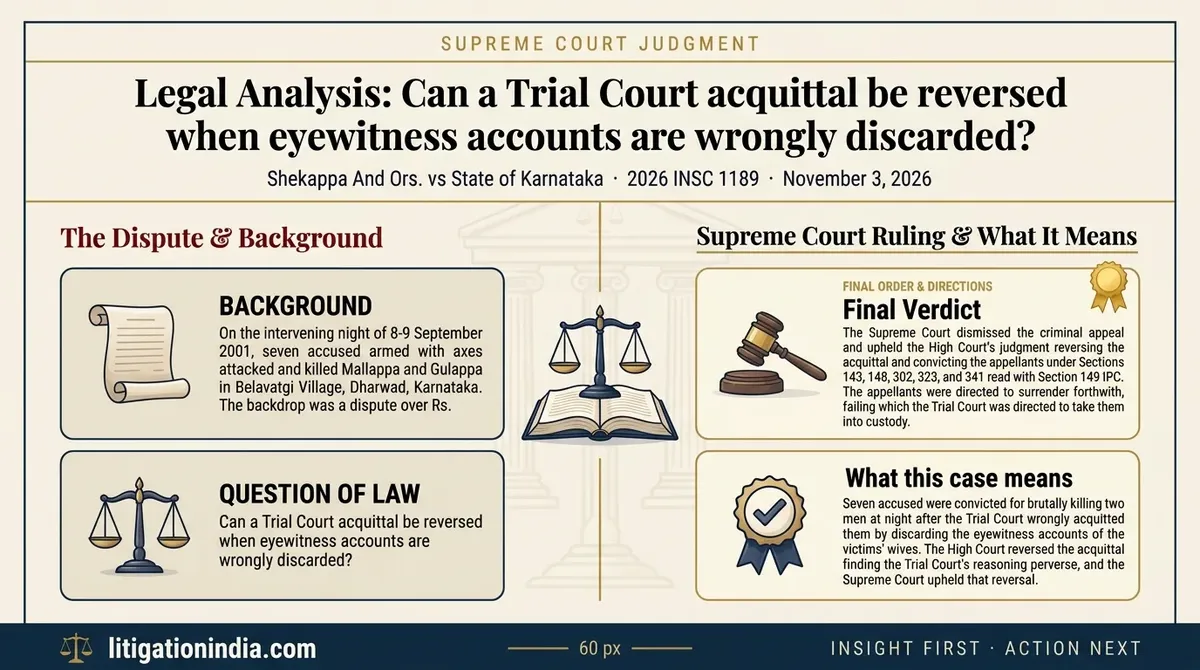
High Court Conviction Upheld After Trial Court Wrongly Acquitted Murder Accused — infographic summary

What this case means

Seven accused were convicted for brutally killing two men at night after the Trial Court wrongly acquitted them by discarding the eyewitness accounts of the victims' wives. The High Court reversed the acquittal finding the Trial Court's reasoning perverse, and the Supreme Court upheld that reversal. The case clarifies that eyewitnesses' names need not appear in inquest reports and that inconclusive digestive process evidence cannot override reliable oral testimony.

What the Supreme Court held

The Supreme Court dismissed the criminal appeal and upheld the High Court's judgment reversing the acquittal and convicting the appellants under Sections 143, 148, 302, 323, and 341 read with Section 149 IPC. The appellants were directed to surrender forthwith, failing which the Trial Court was directed to take them into custody.

Case: Shekappa And Ors. vs State of Karnataka (2026) Citation: 2026 INSC 1189

Want the full legal reasoning, citations and case documents?

Read the full judgment analysis
Shekappa vs State of Karnataka
appeal against acquittal
Section 302 IPC
Section 149 IPC
eyewitness testimony
inquest report Section 174 CrPC
digestive process medical evidence
reversal of acquittal
double murder
natural witnesses
Sections 143, 148, 302, 323, 341 read with Section 149, Indian Penal Code, 1860
Section 174, Code of Criminal Procedure, 1973
Section 194, Bharatiya Nagarik Suraksha Sanhita, 2023
Criminal Law / Murder / Appeal Against Acquittal