
All insights

Can a law disqualify panchayat candidates for having more than two children?

Court Refers Two-Child Norm Election Disqualification to Larger Bench for Reconsideration

A Sarpanch was disqualified from a panchayat election for having more than two children under the Maharashtra Village Panchayats Act. The Supreme Court found that India's Total Fertility Rate has fall

Litigation India Editorial 15 November 2026 1 min read 2026 INSC 1193

Story

Case at a glance1 / 6

Supreme Court of India

Two-Child Norm Election Disqualification Referred for Reconsideration

Mangala Bhimrao Ingle v. Additional Commissioner, Amravati Division & Ors. | 2026 INSC 1193

Court: Supreme Court of India | Date: 04 November 2026Bench: Justice P.S. Narasimha and Justice Alok AradheArea of Law: Constitutional Law, Panchayati Raj, Reproductive RightsIssue: Whether the two-child norm disqualification for panchayat elections remains constitutionally valid
India's Total Fertility Rate has fallen to 1.9 — below replacement level — making population-control election bars obsolete.
Court Refers Two-Child Norm Election Disqualification to Larger Bench for Reconsideration · 2026 INSC 11932026-11-15T16:38:03.786880+00:00
The legal question2 / 6

Can population control still justify barring candidates from panchayat elections?

Core constitutional question before the Court

  • Appellant: Her election was set aside for having a third child; the two-child norm no longer serves any demographic rationale.
  • Appellant: The TFR has fallen below replacement level; continued disqualification violates Articles 14 and 21.
  • Respondent: Section 14(1)(j-1) of the Maharashtra Village Panchayats Act, 1959 was validly upheld in Javed and applies to the facts.
  • Respondent: Factually, the third child's birth is established; the constitutional validity of the provision is not under challenge.
Court Refers Two-Child Norm Election Disqualification to Larger Bench for Reconsideration · 2026 INSC 11932026-11-15T16:38:03.786880+00:00
Statutory comparison3 / 6

Demographic Reality Then vs. Now: Why Javed Must Be Revisited

Key factual assumptions in Javed (2003) versus current data

Legal SubjectAt the Time of Javed (2003)Current Reality (2024-26)
Total Fertility Rate (TFR)3.0 (above replacement level of 2.1)1.9 (below replacement level of 2.1)
Policy concernPopulation explosion, uncontrolled growthAgeing population, shrinking working-age share
China as modelOne-child policy cited as successfulPolicy abandoned; three-child policy introduced with limited effect
National Population Policy goalBring TFR to replacement level by 2010Target surpassed; now TFR below replacement
The factual foundation of Javed has not merely weakened — it has reversed entirely.
Court Refers Two-Child Norm Election Disqualification to Larger Bench for Reconsideration · 2026 INSC 11932026-11-15T16:38:03.786880+00:00
The Court's reasoning4 / 6

How the Court Reasoned Its Way to Referral

Step-by-step legal reasoning

  1. 1Step 1: Identify premise of Javed — population explosion justified barring candidates with more than two children under Article 14.
  2. 2Step 2: Apply doctrine of temporal reasonableness (Malpe Vishwanath Acharya; Satyawati Sharma) — a law may become arbitrary when its factual foundation changes.
  3. 3Step 3: Show TFR has fallen to 1.9, below replacement level — the premise of population explosion no longer holds.
  4. 4Step 4: Identify additional constitutional infirmities — disproportionate impact on women, reproductive autonomy under Article 21, exclusion from political representation.
  5. 5Step 5: Refer to larger bench for reconsideration of Javed; stay High Court order permitting appellant to continue as Sarpanch.
Cessante ratione cessat ipsa lex — when the reason for a law ceases, the law itself ceases.
Court Refers Two-Child Norm Election Disqualification to Larger Bench for Reconsideration · 2026 INSC 11932026-11-15T16:38:03.786880+00:00
The verdict5 / 6

The Court's Verdict

Fact, Law and Result

  • The Fact: Appellant disqualified as Sarpanch under Maharashtra Village Panchayats Act for having a third child; High Court upheld disqualification.
  • The Law: Doctrine of temporal reasonableness requires that laws whose factual foundations have changed be re-examined; two-child norm rests on a collapsed demographic assumption.
  • The Result: Matter referred to larger bench to reconsider Javed; High Court order stayed; appellant permitted to continue as Sarpanch pending disposal.
Registry directed to place judgment before the Chief Justice of India to constitute an appropriate larger bench immediately.
Court Refers Two-Child Norm Election Disqualification to Larger Bench for Reconsideration · 2026 INSC 11932026-11-15T16:38:03.786880+00:00
Why it matters6 / 6

What This Means for Ordinary People

Practical significance of the judgment

  • Women in villages who have more than two children may no longer be lawfully barred from contesting panchayat elections if the larger bench overrules Javed.
  • The right to decide how many children to have is a fundamental right under Article 21 — electoral penalties for reproductive choices are constitutionally suspect.
  • Marginalised communities and women who face forced or unplanned pregnancies should not lose their democratic right to stand for election as a result.
  • India's real demographic challenge is now an ageing population, not overpopulation — public policy, including electoral law, must reflect this new reality.
A law that made sense in 2003 when TFR was 3.0 cannot survive unchanged in 2026 when TFR is 1.9.
Court Refers Two-Child Norm Election Disqualification to Larger Bench for Reconsideration · 2026 INSC 11932026-11-15T16:38:03.786880+00:00
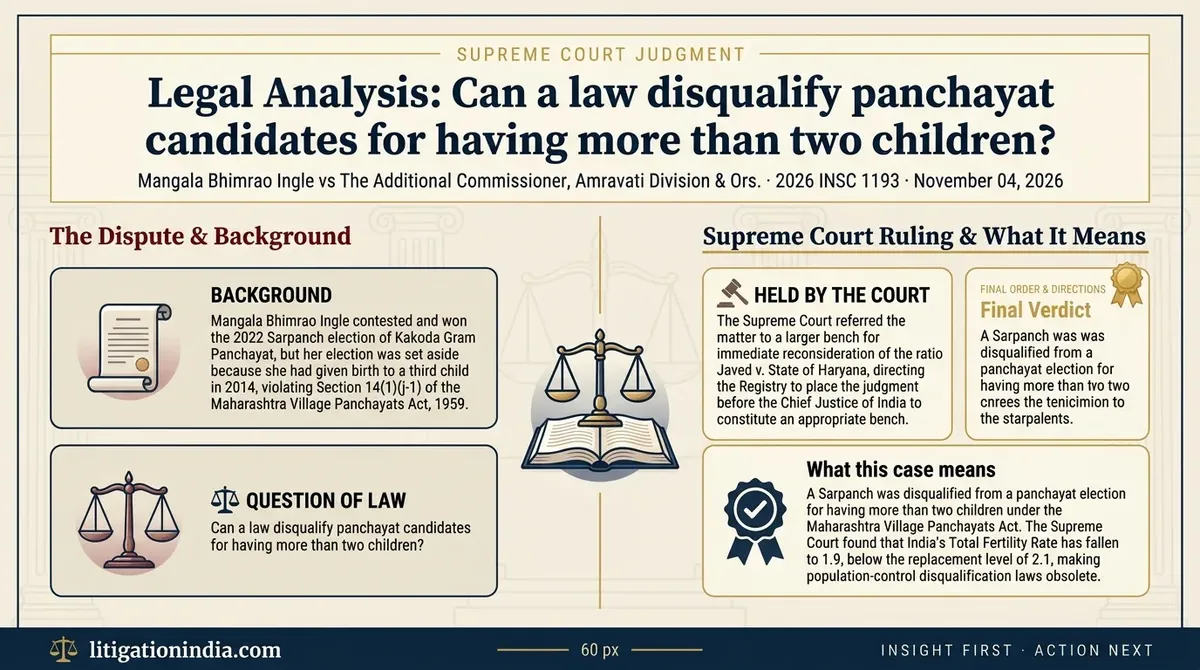
Court Refers Two-Child Norm Election Disqualification to Larger Bench for Reconsideration — infographic summary

What this case means

A Sarpanch was disqualified from a panchayat election for having more than two children under the Maharashtra Village Panchayats Act. The Supreme Court found that India's Total Fertility Rate has fallen to 1.9, below the replacement level of 2.1, making population-control disqualification laws obsolete. The Court referred the 2003 Javed precedent to a larger bench for immediate reconsideration.

What the Supreme Court held

The Supreme Court referred the matter to a larger bench for immediate reconsideration of the ratio in Javed v. State of Haryana, directing the Registry to place the judgment before the Chief Justice of India to constitute an appropriate bench. The stay on the High Court's order setting aside the appellant's election was continued, permitting her to remain as Sarpanch of Kakoda Gram Panchayat until disposal of the Civil Appeal.

Case: Mangala Bhimrao Ingle vs The Additional Commissioner, Amravati Division & Ors. (2026) Citation: 2026 INSC 1193

Want the full legal reasoning, citations and case documents?

Read the full judgment analysis
two-child norm
panchayat election disqualification
Maharashtra Village Panchayats Act
Javed v State of Haryana
Total Fertility Rate
reproductive autonomy
Article 21
temporal reasonableness
Sarpanch
population control
electoral rights
demographic transition
Section 14(1)(j-1), Maharashtra Village Panchayats Act, 1959
Article 14, Constitution of India