
All insights

Was removal of a Rakshak by an Adjutant a violation of Article 311(1)?

Call Letter Is Not Appointment Order; Removal by Equal-Rank Authority Valid Under Article 311(1)

A Railway Protection Special Force Rakshak challenged his removal, arguing it violated Article 311(1) as the removing authority was subordinate to his appointing authority. The Supreme Court held that

Litigation India Editorial 24 September 2026 1 min read 2026 INSC 1047

Story

Case at a glance1 / 6

Supreme Court of India

Call Letter vs Appointment Order: Article 311(1) Limits Clarified

Union of India & Ors. vs Ramdhani Prasad — 2026 INSC 1047

Court: Supreme Court of India; Date: September 24, 2026Bench: Justice Aravind Kumar and Justice Vipul M. PancholiArea of Law: Service Law / Constitutional Law — Article 311(1)Issue: Whether removal of an RPSF Rakshak violated Article 311(1) of the Constitution
Call Letter Is Not Appointment Order; Removal by Equal-Rank Authority Valid Under Article 311(1) · 2026 INSC 10472026-09-24T20:32:39.585217+00:00
The legal question2 / 6

Who Was the Real Appointing Authority for the Rakshak?

The core constitutional question under Article 311(1)

  • Appellant: Call letter of 03.05.1979 was only an invitation to training, not an appointment order.
  • Appellant: Battalion Order dated 04.12.1979 by Assistant Commandant was the actual appointment; Adjutant was of equal rank.
  • Respondent: Call letter issued by Commandant constituted the appointment; subsequent order was only a posting order.
  • Respondent: Removal by Adjutant subordinate to Commandant violated Article 311(1) of the Constitution.
Call Letter Is Not Appointment Order; Removal by Equal-Rank Authority Valid Under Article 311(1) · 2026 INSC 10472026-09-24T20:32:39.585217+00:00
Statutory comparison3 / 6

Call Letter vs Battalion Order: Which Was the Appointment?

Comparing the two documents on which the constitutional question turned

ProvisionCall Letter dated 03.05.1979Battalion Order dated 04.12.1979
Issued byCommandant/Chief Security OfficerAssistant Commandant, 2nd Battalion RPSF
NatureConditional invitation to report for initial trainingUnconditional appointment as Rakshak after training
Language used'Accept the offer'; 'candidature for the post''Appointed as RK' with effect from 04.12.1979
EffectDid not constitute operative appointment orderOperative appointment and simultaneous posting order
Court's findingNot the appointment orderActual appointment order
An order may validly operate as both an appointment order and a posting order — Ramanand Singh v. State of Bihar
Call Letter Is Not Appointment Order; Removal by Equal-Rank Authority Valid Under Article 311(1) · 2026 INSC 10472026-09-24T20:32:39.585217+00:00
The Court's reasoning4 / 6

Court's Step-by-Step Reasoning on Article 311(1)

From identifying the appointing authority to the final constitutional verdict

  1. 1Step 1: Identify appointing authority from actual appointment order and statutory framework.
  2. 2Step 2: Call letter was conditional — operative appointment was Battalion Order dated 04.12.1979 by Assistant Commandant.
  3. 3Step 3: Under Section 6 RPF Act and Rule 20/Schedule I, Assistant Security Officer is a competent appointing authority for Rakshaks.
  4. 4Step 4: Adjutant who removed respondent was of equal rank to appointing Assistant Commandant — not subordinate.
  5. 5Step 5: Article 311(1) bar requires removing authority to be subordinate — ingredient absent here; removal valid.
Call Letter Is Not Appointment Order; Removal by Equal-Rank Authority Valid Under Article 311(1) · 2026 INSC 10472026-09-24T20:32:39.585217+00:00
The verdict5 / 6

Supreme Court's Final Decision

Appeal allowed; removal order of 1983 restored

  • The Fact: Respondent appointed as Rakshak by Assistant Commandant on 04.12.1979; removed by Adjutant of equal rank on 18.03.1983.
  • The Law: Article 311(1) is violated only if removing authority is subordinate in rank to appointing authority; here it was not.
  • The Result: High Court and First Appellate Court judgments set aside; Trial Court judgment and removal order restored.
The Order of Removal dated 18.03.1983 passed by the Adjutant is hereby restored.
Call Letter Is Not Appointment Order; Removal by Equal-Rank Authority Valid Under Article 311(1) · 2026 INSC 10472026-09-24T20:32:39.585217+00:00
Why it matters6 / 6

What This Means for Government Employees

Practical significance of the ruling

  • A call letter or training invitation is NOT an appointment order — actual appointment flows from the formal order issued after training.
  • Article 311(1) protects employees only from removal by an authority lower in rank than the one that appointed them — equal-rank removal is valid.
  • The Chief Security Officer need not personally appoint every Force member; Rules can validly empower Assistant Security Officers to appoint and discipline Rakshaks.
  • Employees who receive charge-sheets, submit replies and are notified of enquiry dates but still absent may face ex-parte proceedings without a natural justice violation.
Article 311(1) bars removal by a subordinate authority — not by an equal-rank authority who also has disciplinary power under the Rules.
Call Letter Is Not Appointment Order; Removal by Equal-Rank Authority Valid Under Article 311(1) · 2026 INSC 10472026-09-24T20:32:39.585217+00:00
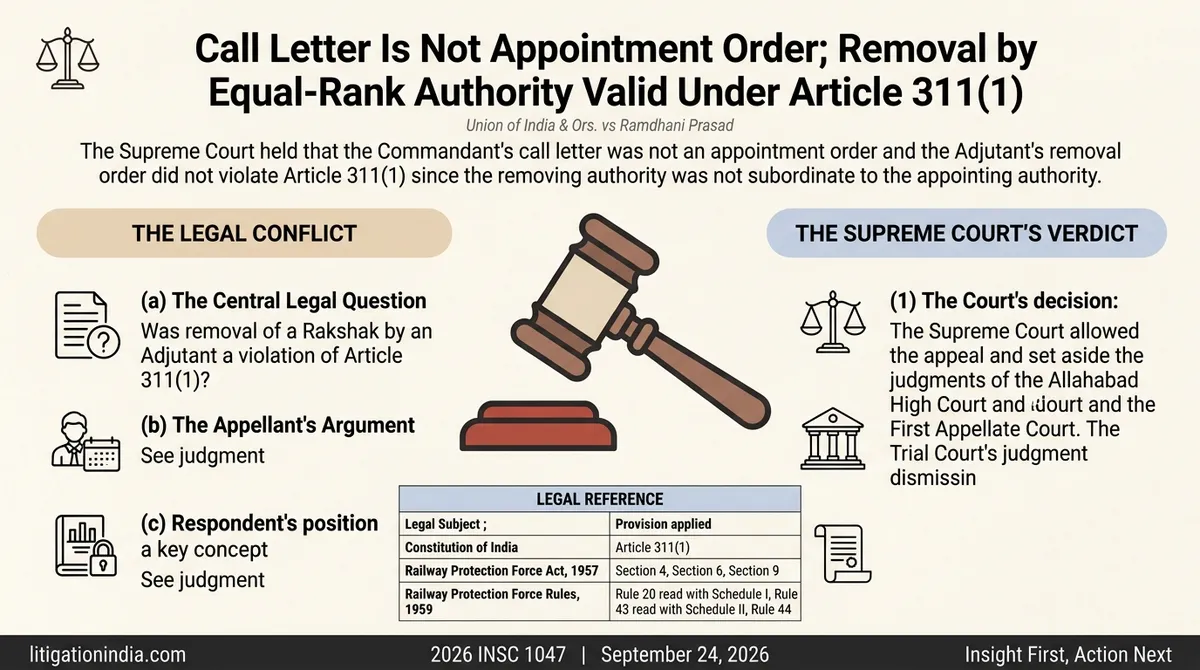
Call Letter Is Not Appointment Order; Removal by Equal-Rank Authority Valid Under Article 311(1) — infographic summary

What this case means

A Railway Protection Special Force Rakshak challenged his removal, arguing it violated Article 311(1) as the removing authority was subordinate to his appointing authority. The Supreme Court held that the call letter issued by the Commandant was not the appointment order; the actual appointment was made by the Assistant Commandant. Since the Adjutant who removed him was of equal rank, no constitutional violation occurred.

What the Supreme Court held

The Supreme Court allowed the appeal and set aside the judgments of the Allahabad High Court and the First Appellate Court. The Trial Court's judgment dismissing the suit was restored, and the order of removal dated 18.03.1983 passed by the Adjutant was also restored. The Court held that the removal did not violate Article 311(1) and that the departmental enquiry was not vitiated by denial of natural justice.

Case: Union of India & Ors. vs Ramdhani Prasad (2026) Citation: 2026 INSC 1047

Want the full legal reasoning, citations and case documents?

Read the full judgment analysis
Union of India vs Ramdhani Prasad
Article 311(1) Constitution
appointing authority
removal from service
Railway Protection Force
Rakshak
Railway Protection Force Act 1957
RPF Rules 1959
call letter vs appointment order
natural justice
Article 311(1), Constitution of India
Section 4, Section 6, Section 9, Railway Protection Force Act, 1957
Rule 20 read with Schedule I, Rule 43 read with Schedule II, Rule 44, Railway Protection Force Rules, 1959
Service Law / Constitutional Law / Article 311