
All insights

Can a bank merger transfer tenancy without the landlord's written consent?

Bank Merger Without Landlord Consent Triggers Eviction Under Rent Control Law

A landlord sought eviction after his bank-tenant's premises passed to another bank through a government-ordered merger, without the landlord's written consent. The Supreme Court held that the eviction

Litigation India Editorial 9 September 2026 1 min read 2026 INSC 671

Story

Key points1 / 7

Case at a Glance

  • Landlord vs bank-tenant whose tenancy transferred through government-ordered merger
  • Premises: Pratap Building, Connaught Circus, New Delhi; rent Rs. 585/month since 1947
  • HCB merged into PNB in 1986 without landlord's written consent
  • Supreme Court citation: 2026 INSC 671
Bank Merger Without Landlord Consent Triggers Eviction Under Rent Control Law · 2026 INSC 6712026-09-09T23:17:51.421979+00:00
Key points2 / 7

What Happened

  • 1947: Landlord leased commercial space to Hindustan Commercial Bank
  • 1986: Government amalgamated HCB into Punjab National Bank via RBI scheme
  • 1987: Landlord filed eviction petition for parting possession without written consent
  • High Court set aside eviction decree; landlord appealed to Supreme Court
Bank Merger Without Landlord Consent Triggers Eviction Under Rent Control Law · 2026 INSC 6712026-09-09T23:17:51.421979+00:00
Key points3 / 7

The Legal Question

  • Does Section 14(1)(b) of Delhi Rent Control Act apply to involuntary transfers?
  • Can a statutory bank amalgamation scheme override the landlord's consent requirement?
  • Is the RBI's amalgamation scheme legislative or administrative in nature?
Bank Merger Without Landlord Consent Triggers Eviction Under Rent Control Law · 2026 INSC 6712026-09-09T23:17:51.421979+00:00
Key points4 / 7

Arguments Made

  • Landlord: Section 14(1)(b) covers voluntary and involuntary transfers equally
  • Landlord: RBI scheme under Section 45 BR Act is administrative, not legislative
  • Tenant: Merger was involuntary, driven by government; not a voluntary assignment
  • Tenant: Transfer by statutory operation cannot attract eviction provisions
Bank Merger Without Landlord Consent Triggers Eviction Under Rent Control Law · 2026 INSC 6712026-09-09T23:17:51.421979+00:00
Key points5 / 7

What the Court Decided

  • Section 14(1)(b) applies regardless of voluntary or involuntary nature of transfer
  • RBI scheme under Section 45 BR Act is administrative, not a statutory enactment
  • Eviction decree restored; respondents to vacate by 31 January 2027
  • Respondents to file undertaking within four weeks and continue paying rent
Bank Merger Without Landlord Consent Triggers Eviction Under Rent Control Law · 2026 INSC 6712026-09-09T23:17:51.421979+00:00
Key points6 / 7

Why It Matters

  • Landlord's consent right survives even government-ordered bank mergers
  • Statutory amalgamation schemes cannot override special rent control laws
  • Distinction between legislative and administrative schemes is crucial for tenancy rights
  • Protects property owners from losing rights through institutional changes
Bank Merger Without Landlord Consent Triggers Eviction Under Rent Control Law · 2026 INSC 6712026-09-09T23:17:51.421979+00:00
Key points7 / 7

Key Takeaways

  • Section 14(1)(b) DRC Act: possession transfer without consent = eviction ground
  • RBI amalgamation scheme under Section 45 BR Act is administrative, not legislative
  • High Court's reliance on Banking Companies Acquisition Act case was misplaced
  • Involuntary transfers via merger do not escape Delhi Rent Control Act's reach
Bank Merger Without Landlord Consent Triggers Eviction Under Rent Control Law · 2026 INSC 6712026-09-09T23:17:51.421979+00:00
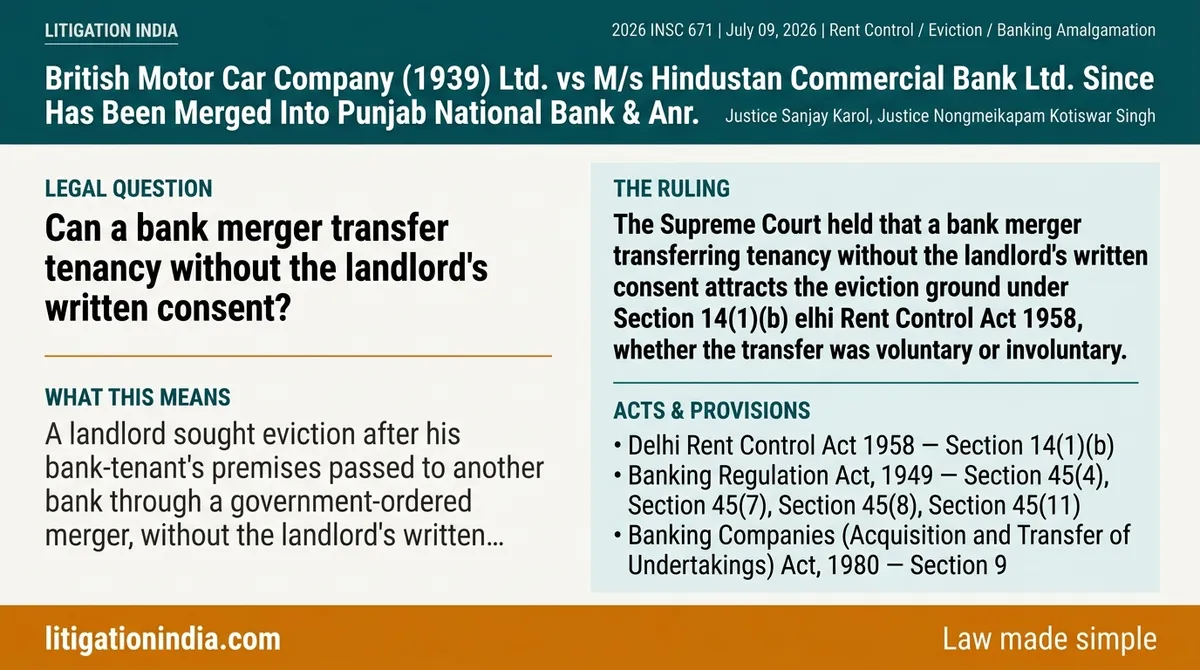
Bank Merger Without Landlord Consent Triggers Eviction Under Rent Control Law — infographic summary

What this case means

A landlord sought eviction after his bank-tenant's premises passed to another bank through a government-ordered merger, without the landlord's written consent. The Supreme Court held that the eviction ground under Section 14(1)(b) of the Delhi Rent Control Act is attracted regardless of whether the transfer was voluntary or involuntary. This ruling clarifies that landlords' consent rights cannot be bypassed even by statutory bank amalgamation schemes.

What the Supreme Court held

The Supreme Court allowed the appellant landlord's appeal and set aside the High Court's judgment dated 12.03.2012 which had set aside the eviction decree. The Court restored the eviction decree passed by the Additional Rent Control Tribunal on 21.05.2001 under Section 14(1)(b) of the Delhi Rent Control Act 1958. However, given the respondents' long possession, the Court granted time until 31st January 2027 to deliver peaceful and vacant possession, subject to filing an undertaking within four weeks and continued payment of rent.

Case: British Motor Car Company (1939) Ltd. vs M/s Hindustan Commercial Bank Ltd. Since Has Been Merged Into Punjab National Bank & Anr. (2026) Citation: 2026 INSC 671

Want the full legal reasoning, citations and case documents?

Read the full judgment analysis
British Motor Car Company
Punjab National Bank
Hindustan Commercial Bank
Delhi Rent Control Act 1958
Banking Regulation Act 1949
Section 14(1)(b)
amalgamation eviction
subletting assignment parting possession
bank merger tenancy
Section 45 BR Act
Section 14(1)(b), Delhi Rent Control Act 1958
Section 45(4), Section 45(7), Section 45(8), Section 45(11), Banking Regulation Act, 1949
Section 9, Banking Companies (Acquisition and Transfer of Undertakings) Act, 1980
Article 227, Article 31-A(1)(c), Constitution of India